The Itential Platform is where every workflow and agent in production becomes a governed service every team can consume, every action visible, every alert closing the loop.
Every workflow you publish becomes a governed service every team can consume on demand. App teams, NOC, support, and customer success run governed operations from a portal, ticket, or API. RBAC, parameter validation, and audit trail apply automatically on every run. Operations stops being the gating step for the rest of the business.
App teams, NOC, support, and customer success teams run governed operations on demand from a portal, ServiceNow ticket, or REST API. Same RBAC, parameter validation, and audit trail apply automatically. Operations teams stop being the bottleneck. Infrastructure becomes a service the rest of the business consumes.
Publish any workflow or operation as a catalog item teams discover, run, and monitor on demand. RBAC, parameter validation, and pre/post checks apply automatically on every run, regardless of who triggered it.
App teams provision infrastructure on demand. NOC runs approved operations without paging engineering. Support teams trigger their own diagnostic workflows. Operations stops being the gating step for the rest of the business.
Portal, ticket, REST API, schedule, or AIOps event. Every consumption method routes through the same governed execution engine with the same RBAC, validation, and audit trail. One operation, every way teams want to call it.
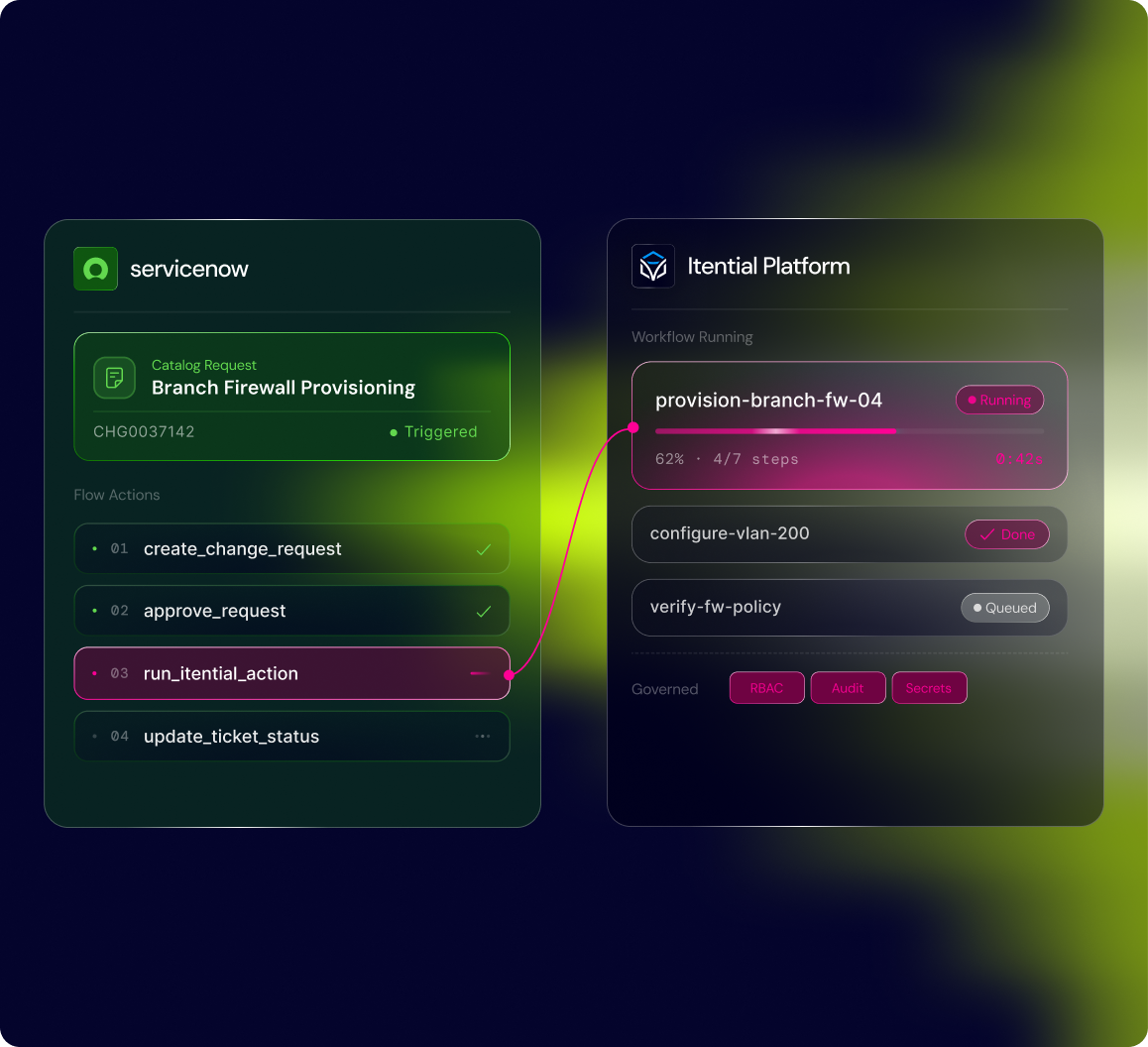
Itential workflows appear dynamically inside ServiceNow with no custom integration code. ServiceNow users run them from a self-service catalog or embed them in ServiceNow Flows using Itential Actions. The work runs governed on Itential, with the same RBAC, validation, and audit every other action gets, and status flows back into the ticket.
New workflows published on the Itential Platform appear automatically in ServiceNow. No custom integration, no ServiceNow engineering work, no maintenance burden. As your workflow library grows, the ServiceNow catalog grows with it.
Embed governed Itential workflows directly inside ServiceNow Flows using Itential Actions. Query infrastructure state, allocate resources, provision services, or trigger remediation as a step in any ServiceNow process, no manual handoffs between teams.
Whether triggered from ServiceNow, the portal, an API, an AIOps event, or an AI agent, every workflow runs through the same governed engine. RBAC, parameter validation, pre/post checks, and audit trail apply identically. ServiceNow operations are not a separate path.
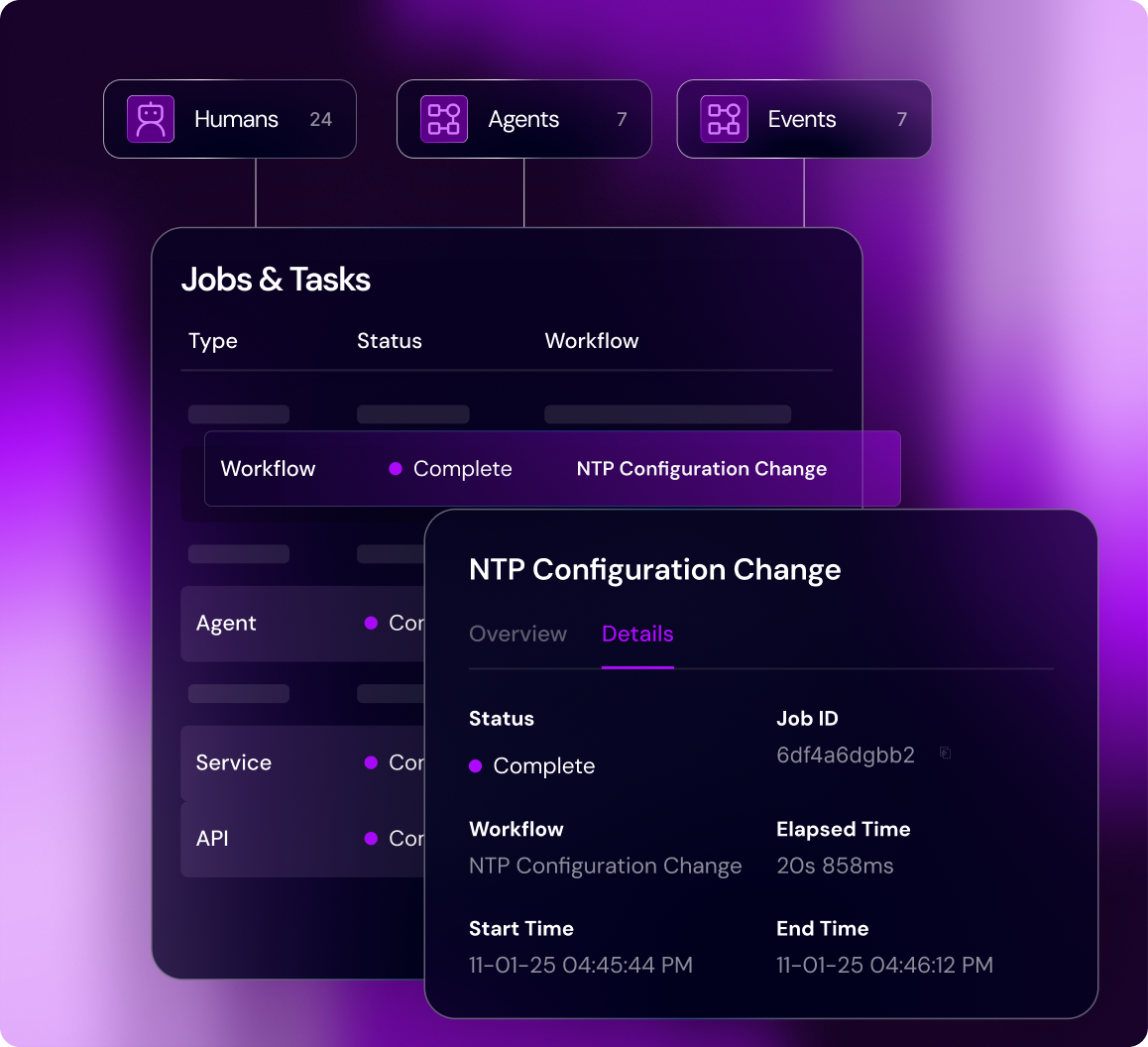
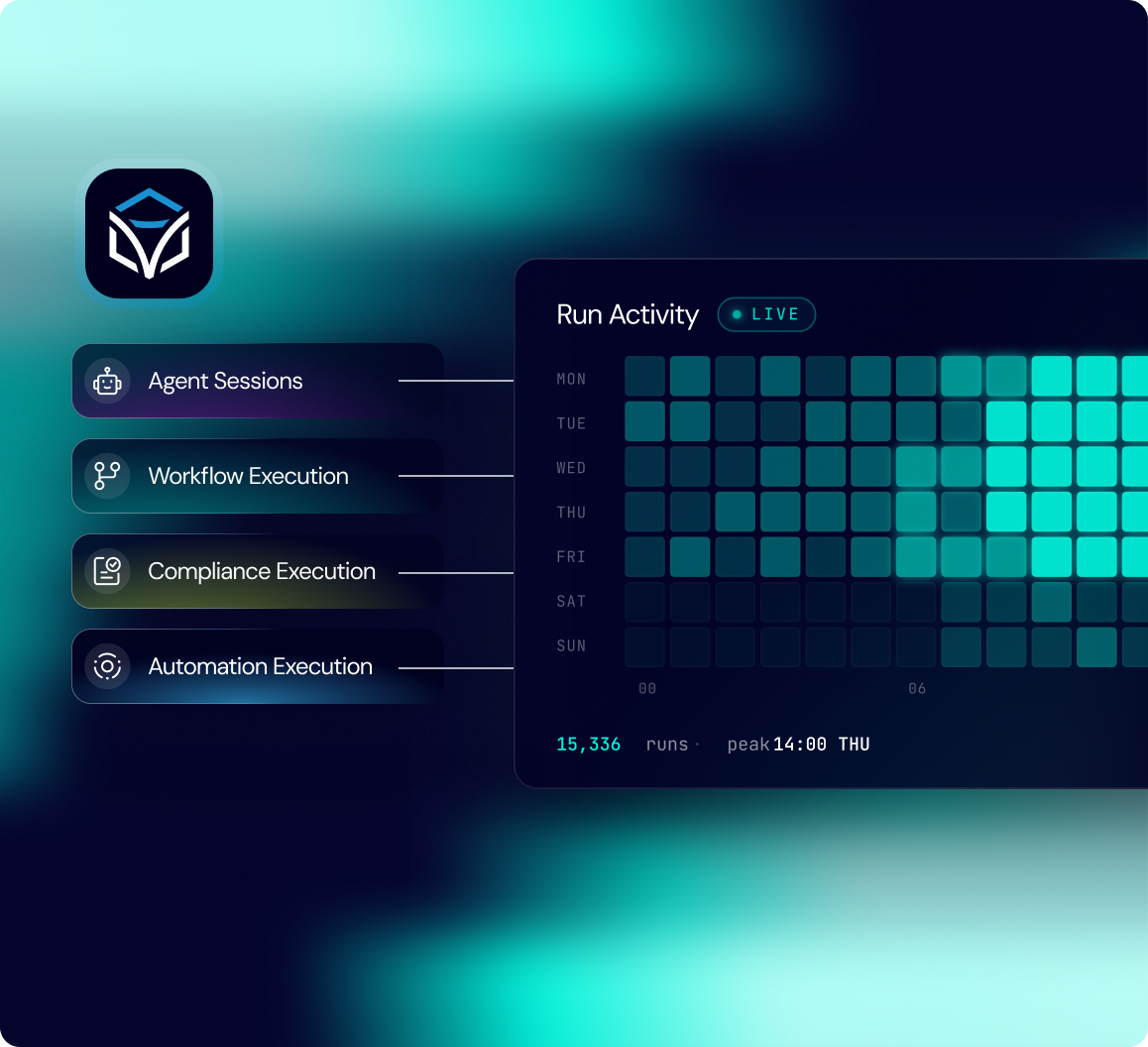
Step-level execution detail for every workflow, agent, and job running in production. Timing, attribution, retry history, and full audit context, captured automatically. When something fails, know exactly what step, what system, and why, without hunting through logs or calling the engineer who built it.
Every task, input, output, and transition captured per execution, attributed to the actor or agent that triggered it. Know exactly what ran, what failed, and why before anyone picks up the phone.
Failures attributed to the specific step, system, and condition that caused them. Retry history, recovery path, and full state context visible immediately, no hunting through logs to reconstruct the timeline.
Performance trends, failure patterns, and operational metrics across your full automation estate. Time savings, execution frequency, and error rates all measurable, all attributable, all queryable through the same engine.
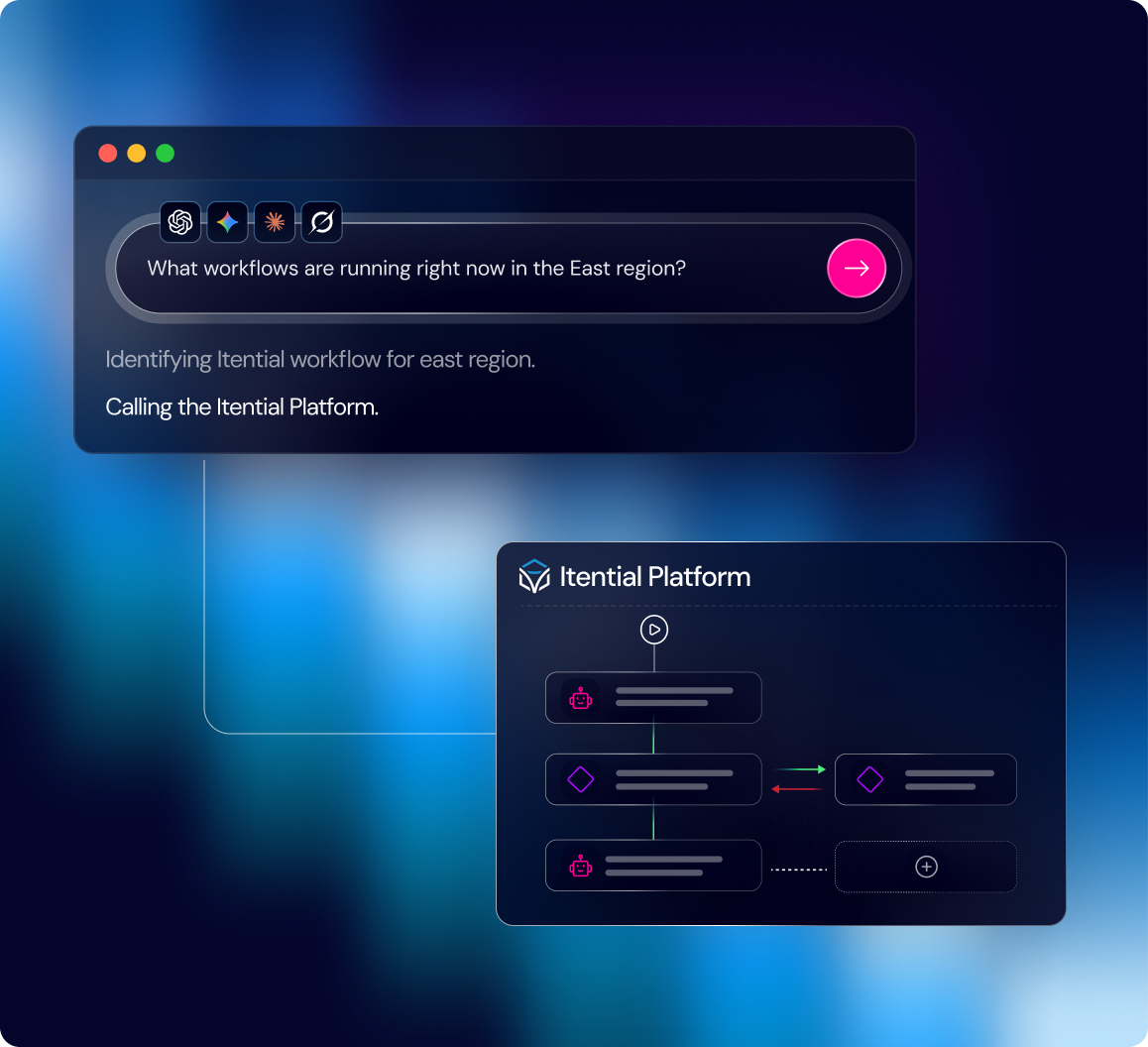
Connect Claude, ChatGPT, or any MCP-compatible model to the platform via the Itential MCP Server. Ask about the status of a change, a running workflow, a device state, or an ongoing operation in plain language. Get a structured answer from live execution data, not a stale CMDB record or cached report.
Anyone on the team asks operational questions in plain language and gets answers from live execution state. Always current, always sourced from the actual platform, no cached dashboards or stale reports between you and the truth.
Connect Claude, ChatGPT, or any MCP-compatible model. The platform exposes execution state, service lifecycle data, workflow status, and infrastructure context as queryable tools. The LLM understands what to call based on the schema.
NOC, SecOps, app, or support teams get real answers without navigating multiple dashboards or waiting on someone who knows where to look. Plain-language operations puts answers within reach of anyone who needs them.
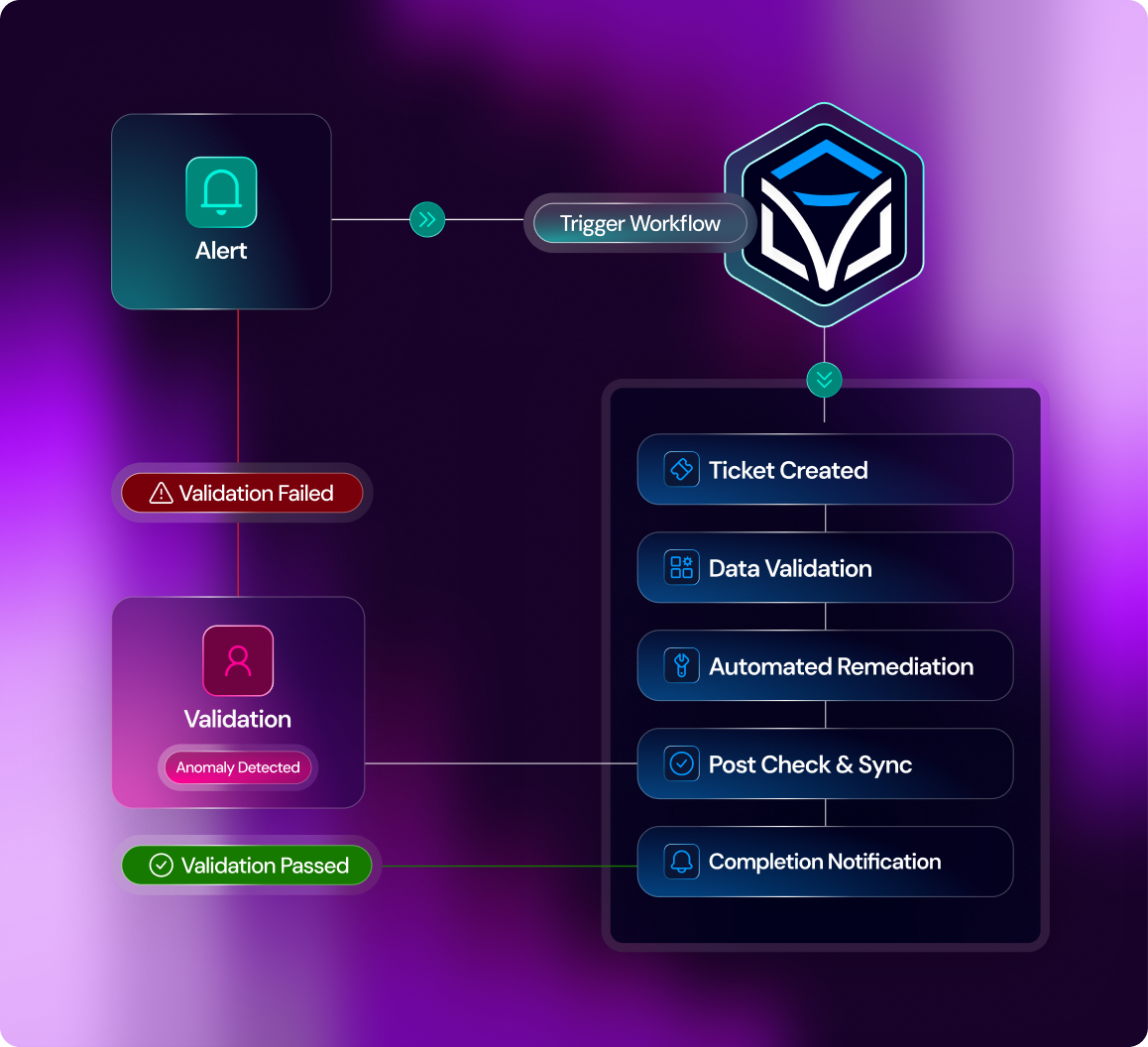
Monitoring tools and AIOps platforms detect anomalies, compliance violations, or health events and trigger governed workflows automatically. An agent queries live state, determines the right response, and executes remediation. Hours of manual coordination become minutes of governed action. Every step logged, attributed, and reversible.
Connect Selector, Forward Networks, IP Fabric, or any monitoring platform via MCP. Detection events trigger governed execution automatically, the response runs through the same engine every other action does.
Agents query current execution context and device configuration before acting. Decisions based on what’s actually running, not a stale alert or a cached CMDB record. The right response, every time, attributed and auditable end to end.
Require human approval before execution or monitor and intervene after. Configure the approval threshold per operation type and blast radius. You define the line. The engine enforces it consistently.
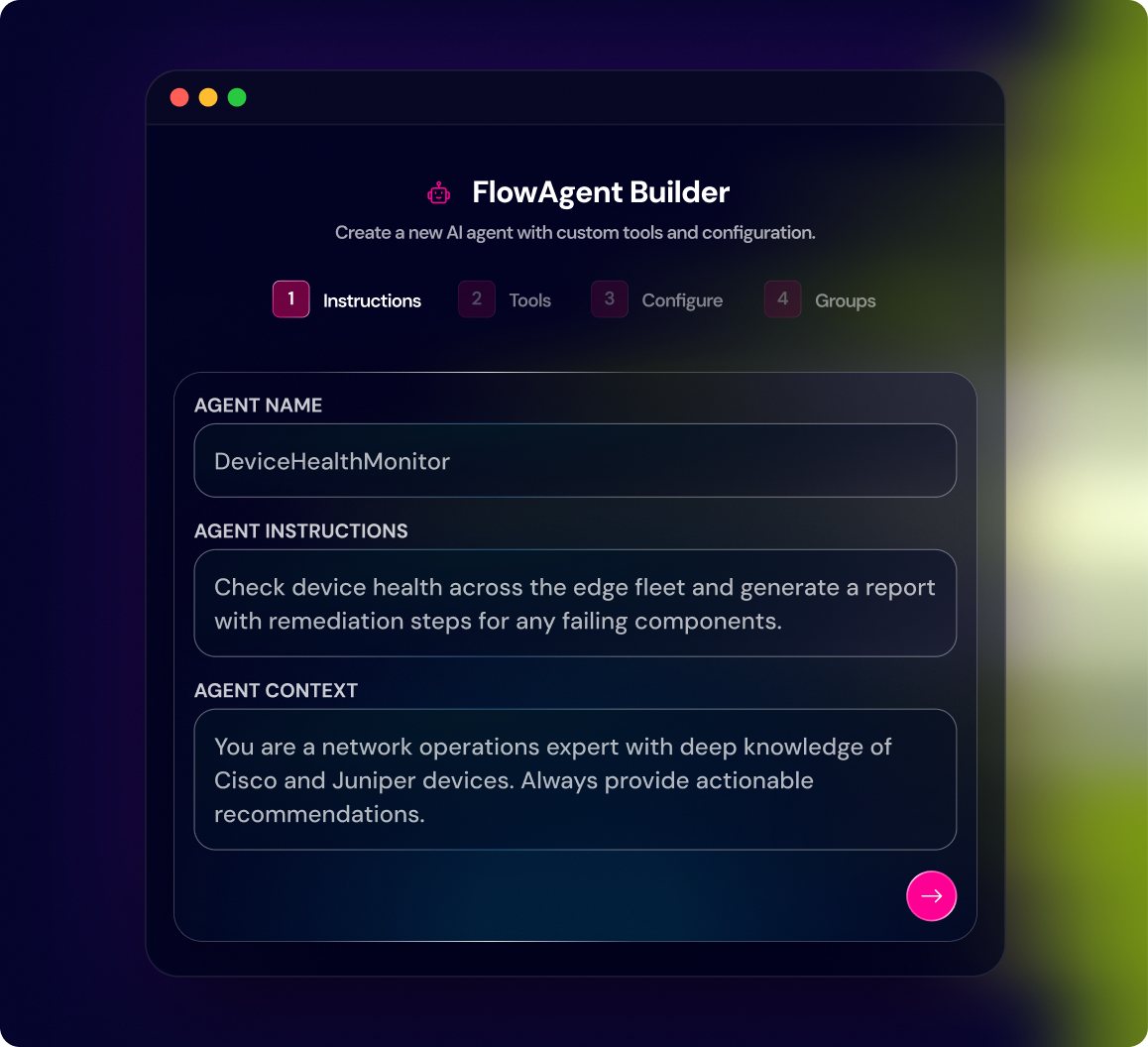
Deploy agents that monitor execution across your environment, query live infrastructure state, and trigger remediation. Configure human-in-the-loop or human-on-the-loop oversight per operation type. Routine work handled by agents. Engineers focus on what actually needs them. You stay in control of the line.
Agents execute autonomously within the thresholds you set. Above them, human-on-the-loop, human-in-the-loop, or full approval gates fire automatically. You define the autonomy line. The engine enforces it on every action.
Ticket enrichment, compliance queries, incident triage, status updates, and routine remediation handled by agents. The operational work that used to consume engineering hours runs through the platform automatically, governed end to end.
When agents handle the routine, engineers focus on building. Operations teams run what they need from the catalog. Nobody waits on anyone. The status update writes itself, you stop being the bottleneck.
From self–service infrastructure delivery to AI–driven incident response, here’s what intelligent operations looks like in production.
New application needs resources. Request submitted. Itential validates, coordinates, and delivers – same day. No ticket to engineering, no manual coordination.
AIOps detects an anomaly. A governed workflow executes the right response, blocking, isolation, or rollback. Human approval only where you defined it.
Step-level detail for every workflow and agent action. When something fails, know exactly what step, what system, and why.
One governed workflow coordinates every system automatically, right order, validation at every step, complete audit trail. Same outcome. No swivel chair.
From ops teams running self-service operations to engineers who never want to be the status update, the Itential Platform meets every team where they work.
See how teams run governed self-service, ask infrastructure anything, and let agents close the loop on the Itential Platform.
Every operation published on the platform carries its own access controls, who can discover it, who can run it, and who can monitor it are defined independently. Parameter validation and pre/post checks are built into every operation. Teams get access to exactly what they should. Nothing outside their defined scope is discoverable or executable.
Connect any LLM to the platform’s live execution layer via MCP. The platform exposes execution state, service lifecycle data, workflow status, and infrastructure context as queryable skills. Ask a question in plain language, the LLM queries live data and returns a structured answer. Not a CMDB. Not a cached report. What’s actually running right now.
Observability tools monitor infrastructure telemetry, metrics, logs, and traces. The platform monitors execution, what operations ran, what steps completed, what changed, who triggered it, and what the outcome was. They’re complementary. Datadog tells you your CPU is spiking. The platform tells you which workflow changed the config, who triggered it, and what it did.
Both, and you control where the line is. Agents execute autonomously within defined boundaries, require human-on-the-loop review above a blast-radius threshold, or require full human-in-the-loop approval before anything runs. Autonomy level is configurable per agent and per operation type. You define the boundaries. The platform enforces them.
Itential workflows published on the platform appear dynamically in ServiceNow, no custom code required. ServiceNow users run governed infrastructure operations from a self-service catalog or embed them in a ServiceNow Flow using Itential Actions. ServiceNow handles the process. Itential handles the execution, validation, and audit trail.
Connect any monitoring or AIOps platform to Itential via REST API or MCP. When the platform detects an anomaly, compliance violation, or health event, it triggers a governed workflow on the Itential Platform automatically. An agent or workflow queries live state, determines the right response, and executes through the same governed engine every other action uses. RBAC, validation, audit, and rollback all apply. Your monitoring stack detects. Itential responds, governed end to end.