The Itential Platform is where every action, human, workflow, or AI agent, runs through one governed engine with pre-checks, post-checks, rollback, and audit evidence built in by default.
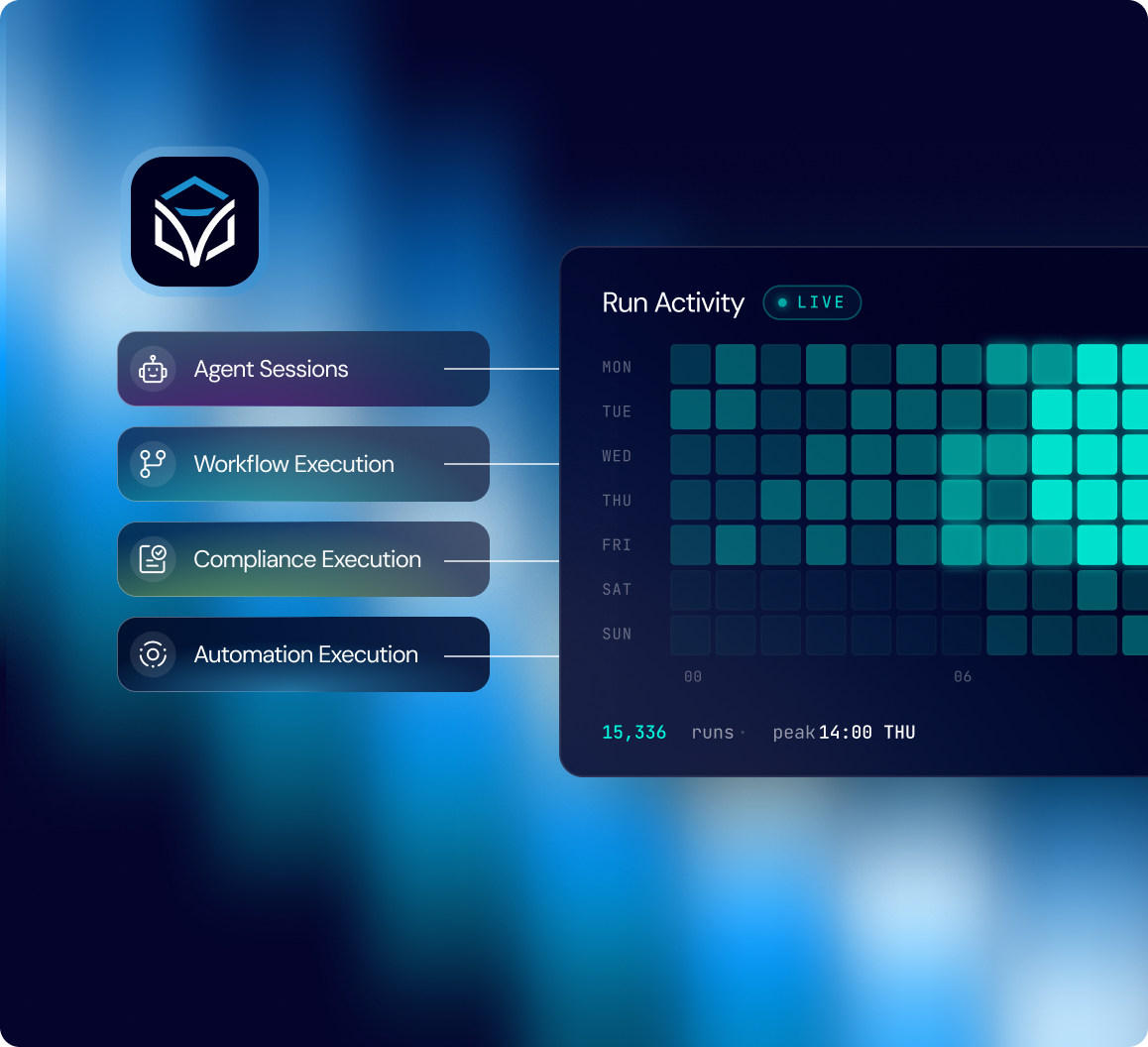
The Itential Platform runs every action through one governed engine. Whether a human triggers a change, a workflow executes a long-running operation, a FlowAgent reasons through a goal, or a scheduled job runs compliance checks, the same RBAC, approval gates, validation, rollback, and audit trail apply. One engine. One governance model. Every execution mode below runs through it.
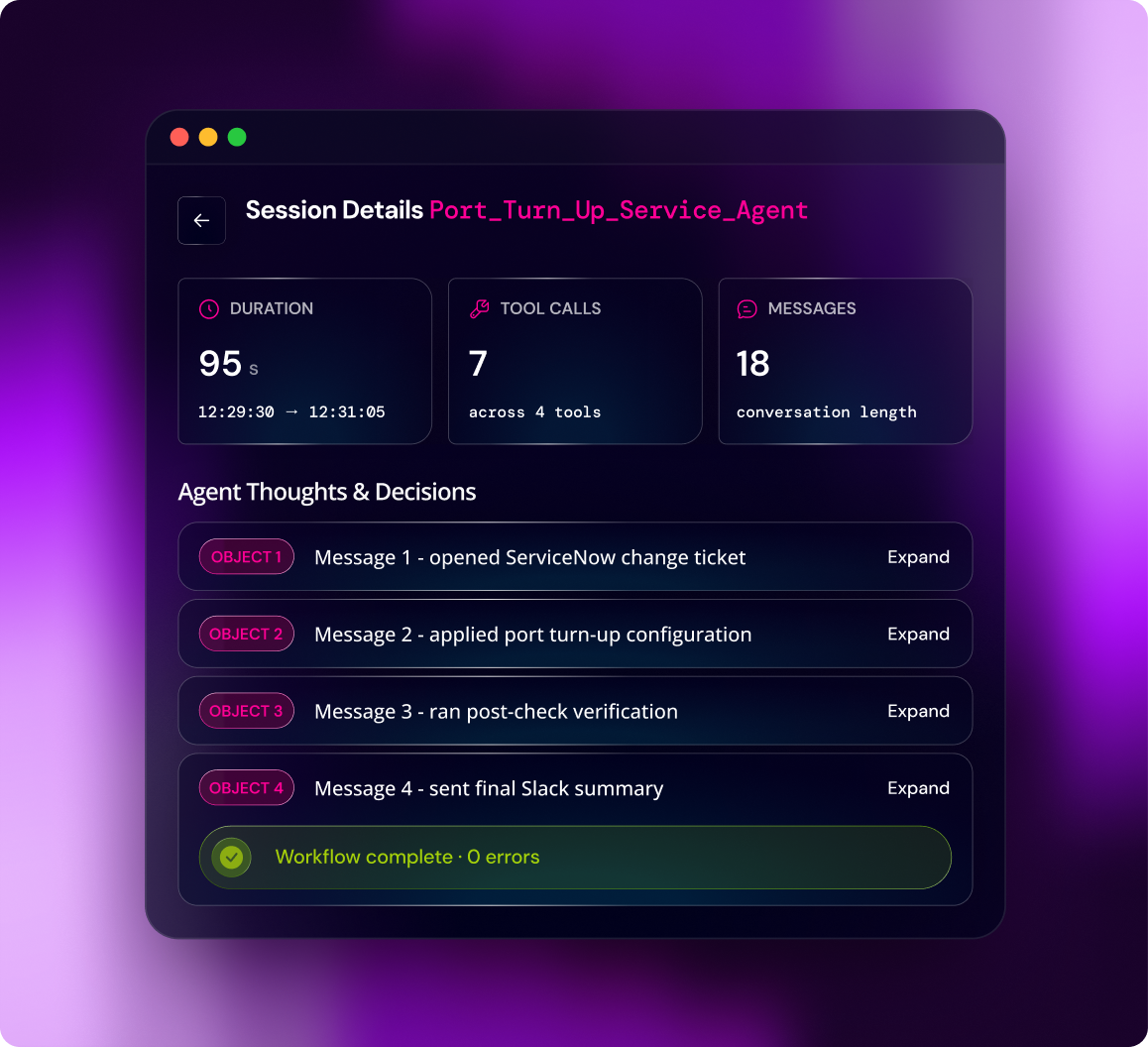
FlowAgents reason through goals and act in real time. Every action, whether the agent invokes a workflow, calls a tool, or reads live state, runs through the same governed engine. RBAC, approval gates, blast-radius limits, and audit trails apply the same way they do for human-triggered actions. Agents reach infrastructure through the platform, never directly. Hybrid execution lets workflows invoke agents at decision points where reasoning matters, then hand back to deterministic steps once uncertainty is resolved.
FlowAgents handle what deterministic workflows can’t: situations where the right next action depends on what the agent finds, not what was scripted in advance.
Each agent gets an explicit allowlist of platform capabilities, defined at build time. Agents call only the tools they’ve been granted, with anything outside that scope blocked at runtime by the same engine that governs every other action.
Set autonomy thresholds at build time, the engine enforces them at run time. Routine actions run autonomously, higher-risk actions require human approval, every agent decision logged with full audit trail.
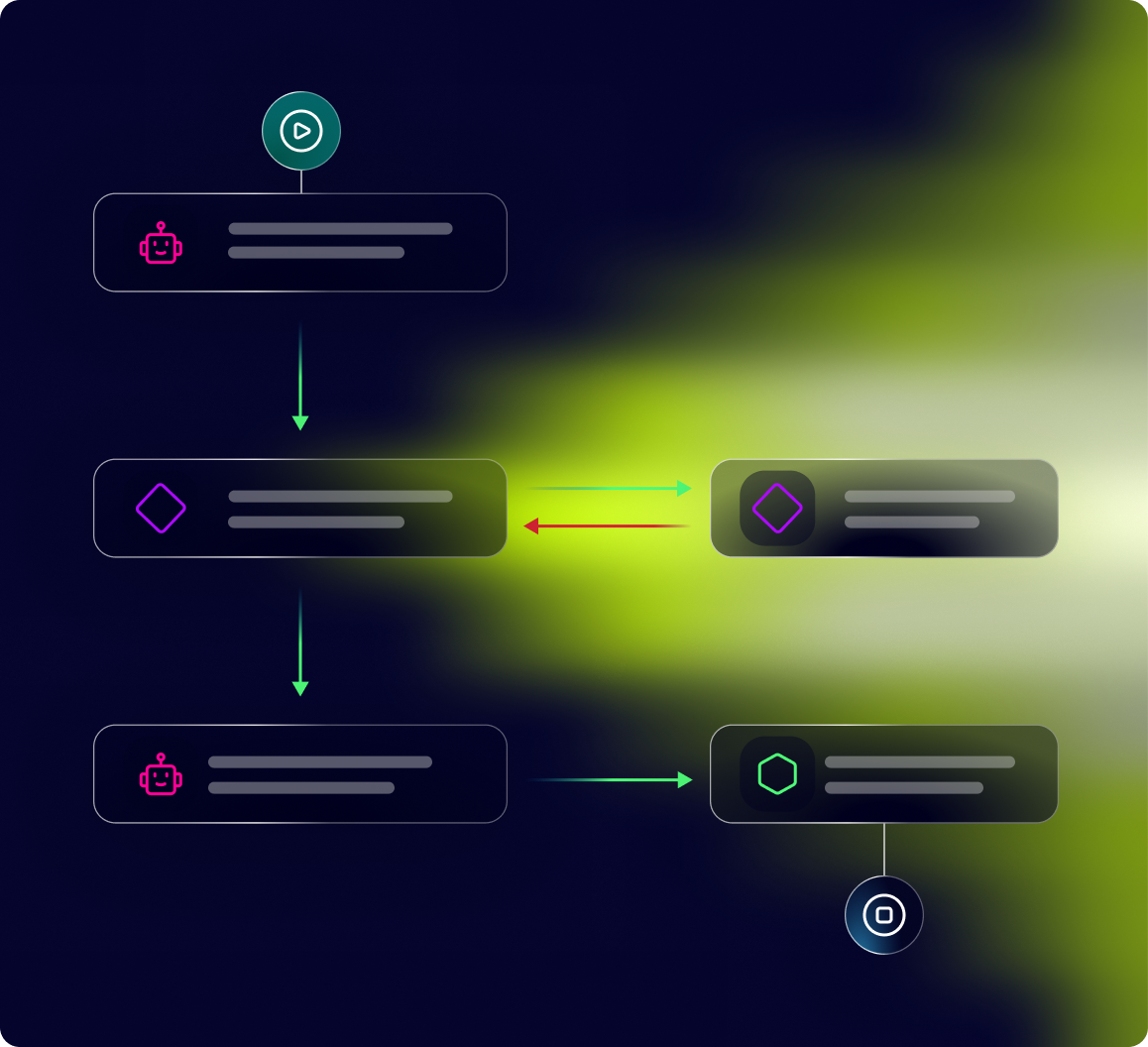
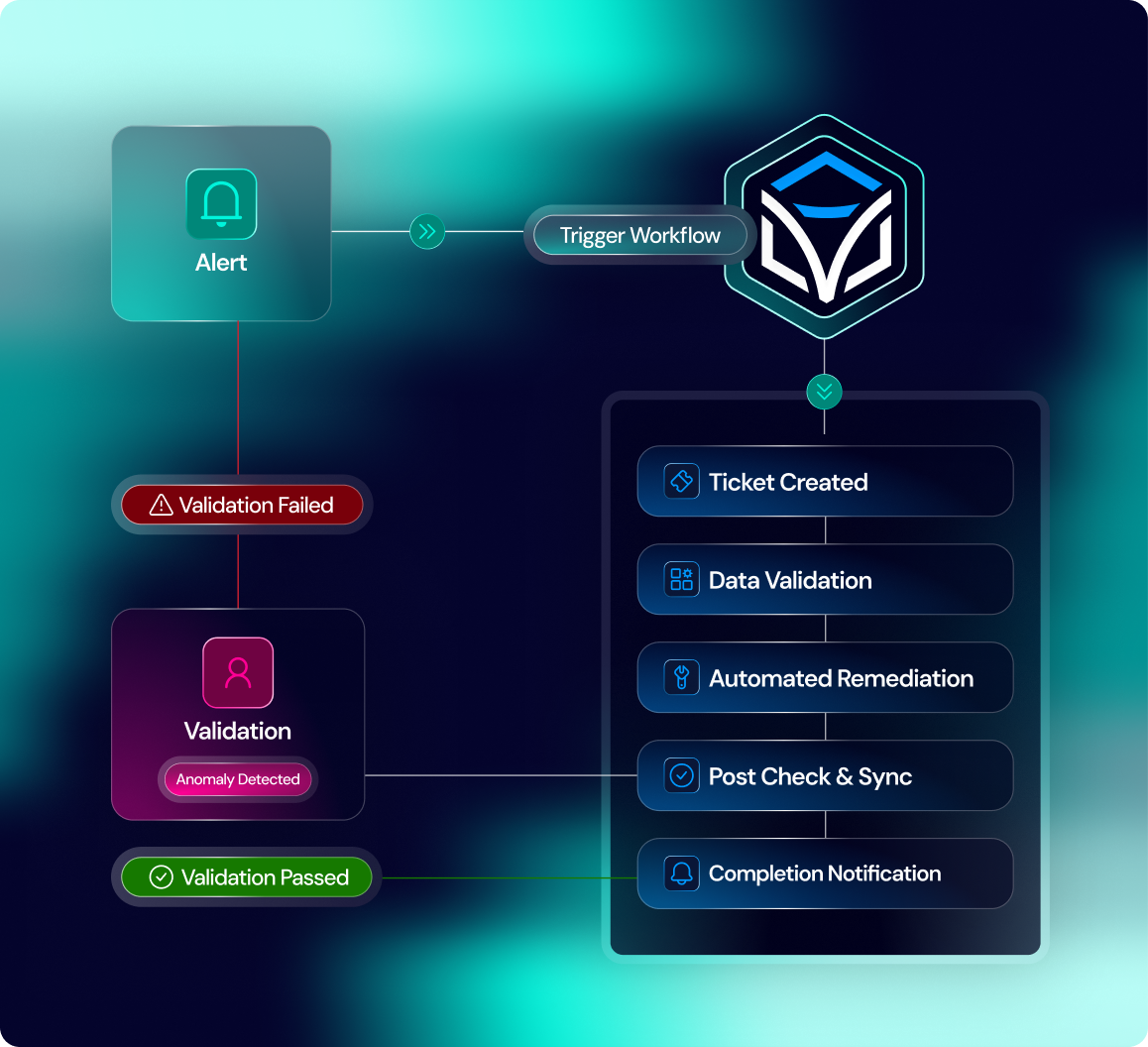
Workflows execute deterministic, multi-step operations exactly as built. Pre-checks validate conditions before any change runs. Post-checks confirm the outcome after each step. Branching logic responds to real-time state. Automated rollback recovers the system to its last known-good state on any failure. Hybrid execution lets workflows invoke FlowAgents at decision points where reasoning matters, then hand back to deterministic steps once uncertainty is resolved. Same governed engine handles both modes.
Workflows run exactly as built, every time, with retries, error handling, and approval gates configured at design time. Predictable behavior at scale, lower cost than inference at run time, and the same governance every other action gets.
Pre-checks validate conditions before execution begins. Post-checks confirm the outcome after every step. State captured before the first action, automated rollback on any failure recovers every affected system to its pre-change state.
Workflows invoke FlowAgents at decision points where reasoning matters, then hand back to deterministic steps once uncertainty is resolved. Combine the predictability of workflows with the adaptability of agents in one governed execution path.
Every configuration change runs against your golden config standards before it executes. Pre-checks catch drift, syntax errors, and policy violations before they reach production. Post-checks confirm the change had the intended effect. Compliance scans run on a schedule across every device, every domain, every region, with drift detected at the attribute level and remediation triggered through governed workflows. Compliance becomes a continuous operating condition, not a quarterly project.
Conditions verified before execution begins, outcomes confirmed after every step. Changes that would fail validation never reach production. Discrepancies between intended and actual state flagged immediately, before the next step runs.
Golden config standards checked continuously against every device. Drift detected at the attribute level, not just file-level diffs. Out-of-policy state flagged in real time and queued for remediation through governed workflows.
Every compliance check produces an immutable audit record automatically. Pass or fail, drift detected or not, the evidence is captured the same way every other execution is, ready to export when auditors arrive.
Every execution captured, attributed, and queryable in real time. Step-level visibility into every running workflow, agent, and job. Immutable audit records produced as a byproduct of normal operations, with the actor, trigger, approval chain, before/after state, and outcome of every action. Self-service catalog lets any authorized team run governed operations on demand through portal, ticket, or API. Compliance evidence always current, always exportable.
Step-level insight into every running workflow, agent, and job in one view. See what’s executing, what’s waiting on approval, and what just finished, attributed to the actor or agent that triggered it.
Every action logged with actor, trigger, timestamp, approval chain, before/after state, and outcome. Tamper-proof, always exportable, generated automatically as a byproduct of execution rather than a separate audit cycle.
Any authorized team runs governed operations on demand through portal, ticket, or API. Same RBAC, approval gates, and audit trail apply. Infrastructure stops being a bottleneck and starts being a consumable service.
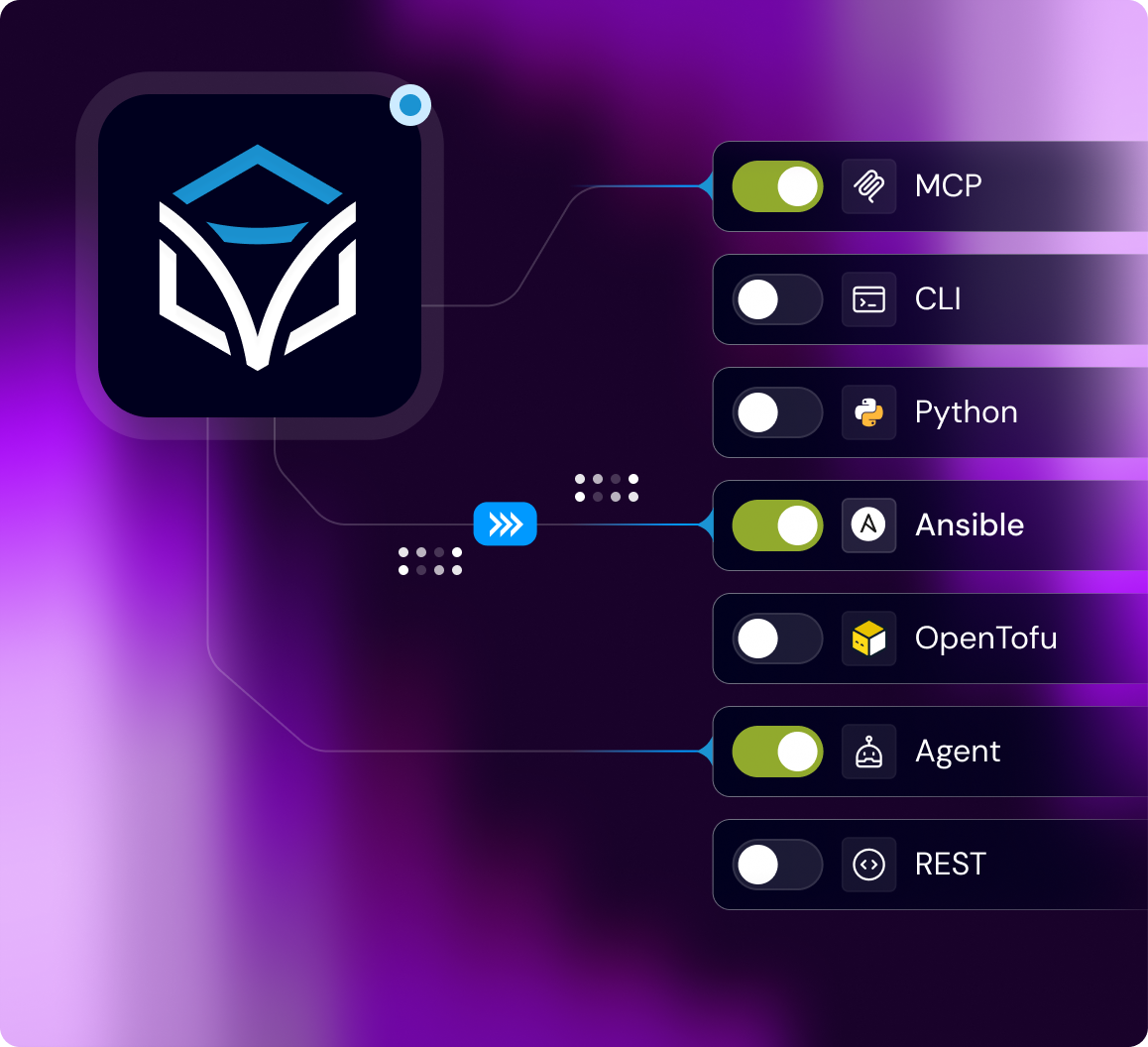
Leverage and extend the automations you already have. Python scripts, Ansible playbooks, and OpenTofu plans pull from Git at execution time, run in isolated environments built fresh for each job, and route through the same RBAC, approval gates, validation, and audit trail every other action does. Engineers keep building in their IDE. Operations teams call the same automations as governed REST API services. AI agents call them as tools. One execution engine, regardless of who or what triggers the run.
Connect to GitHub or GitLab. Every execution pulls the latest committed version directly from your repo, runs in an isolated environment built fresh for the job, and exits clean. No drift between Git and what’s running.
Your automations inherit the same governance every other action gets. RBAC, approval gates, blast-radius controls, validation, rollback, and audit evidence apply automatically. No separate path for scripts, no ungoverned execution.
Workflows, FlowAgents, CI/CD pipelines, and ITSM systems call your automations through auto-generated REST APIs. The same execution engine handles every invocation, regardless of trigger source.
From human-triggered changes and scheduled compliance to workflow orchestration, AI agent action, and AIOps-driven event response, every operation runs through the same governed engine. These are real production scenarios teams run on Itential, every day.
Every change to network, cloud, and security infrastructure runs through one governed engine. Pre-checks validate before execution, post-checks confirm after, rollback recovers automatically, and the audit trail captures who changed what and why, every time.
Golden config standards check thousands of devices on a schedule. Drift detected at the attribute level triggers governed remediation workflows. Compliance becomes a continuous operating condition, audit evidence captured automatically, no quarterly fire drills.
Customer orders trigger workflows that provision SD-WAN, transport, CPE, and ITSM updates across domains. Each step runs governed, branching logic responds to step results, not a fixed execution path. Automated rollback recovers on any failure, full audit trail captured per step.
Monitoring alerts from AIOps tools and ITSM tickets trigger governed remediation workflows automatically. Workflows query live state, execute the right remediation through the same governed engine, run post-checks, and close the ticket, with the full action chain captured for incident review.
From engineers running changes to architects setting policy, platform teams deploying agents, and operations teams running production, the Itential Platform governs every execution the same way.
See how teams run human, workflow, and AI agent actions through one governed engine on the Itential Platform.
Running scripts executes code. Governed execution wraps every action, script, workflow, or agent, in RBAC, policy enforcement, approval gates, pre/post validation, audit logging, and rollback. Scripts run and finish. Governed execution produces an immutable record of what ran, who triggered it, what changed, and what validated it, automatically, every time.
The platform supports both as deployment options inside the same engine. Run a FlowAgent directly when reasoning at run time matters. Convert a validated FlowAgent into a deterministic workflow via Spec-Driven Development when predictability or scale matters more. Or run hybrid, where workflows invoke agents at decision points. Same governance every way, the team closest to the problem chooses the path.
Every AI agent action flows through the same execution engine as everything else. Agents never touch infrastructure directly. RBAC controls what each agent can access. Approval gates apply at defined thresholds. Every action is logged, auditable, and reversible. No separate AI execution path. No ungoverned actions.
Itential captures state before execution begins and validates at every step. If any step fails, automated rollback returns every affected system to its pre-change state. The complete execution history, what ran, what failed, what rolled back, and why, is always available without manual log analysis.
Your infrastructure data never leaves your control. Itential reads from and writes to your existing systems without copying or storing infrastructure data. Itential Gateway runs in your environment when needed for direct device access. Credentials stay in your secrets manager (HashiCorp Vault, AWS Secrets Manager, Azure Key Vault). The platform stores execution metadata for audit, not your infrastructure data itself.
Itential integrates with ServiceNow, Jira Service Management, BMC Helix, and other ITSM platforms through pre-built connectors. Tickets trigger governed workflows directly. Approval gates can route through your existing change advisory board. Execution results, audit trails, and outcomes flow back into the ticket automatically. No separate change process to maintain, governance enforced on every change regardless of how it was requested.