Itential logo
Workflow Orchestration

Orchestrate Infrastructure Changes Across Every Domain

AI generates a production-ready workflow from plain language, deployed automatically and governed from the first run. Or build visually on the Design Studio canvas. Either way, every workflow is a callable tool any agent, team, or system can invoke.

Workflow Orchestration

Workflows Built by Humans or AI, Governed by Default

Workflow orchestration is how every infrastructure change actually happens — across network, cloud, security, and ITSM, with pre/post validation, rollback at every step, and a full audit trail. Build workflows visually on the Design Studio canvas, generate them from plain language with Spec-Driven Development, or have an agent assemble them in real time. Same engine. Same governance. Every time.

Spec-Driven Development

Generate Workflows From Plain Language

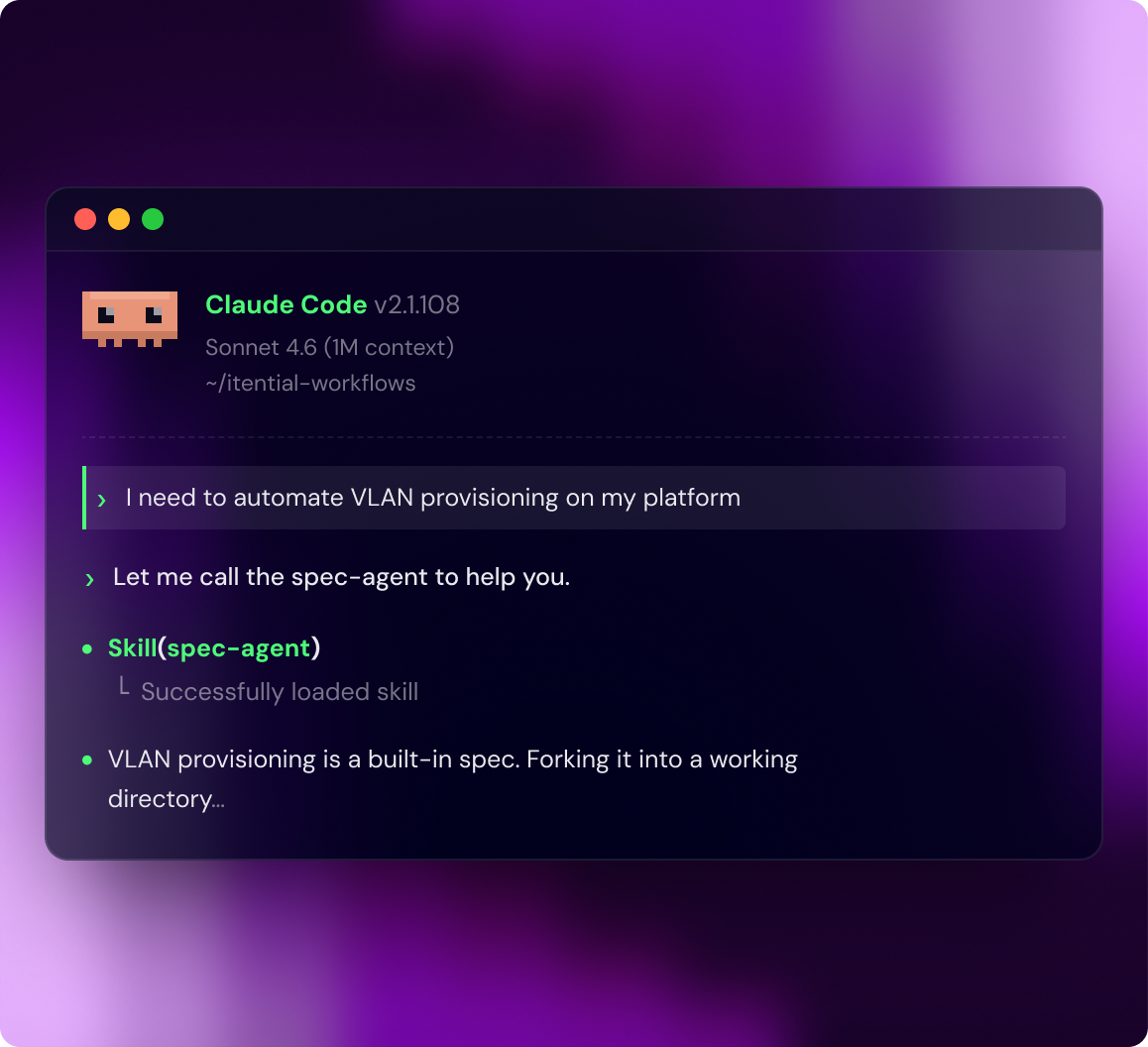
Itential Builder Skills are AI agent skills available on the Anthropic Marketplace that turn plain-language specs into real workflow artifacts. Describe the workflow in plain language. The Builder Skill calls the platform’s documented REST API endpoints (exposed through the Itential MCP Server) to construct the artifact, commits it to your Git repository, and CI/CD deploys it automatically. The output is identical to a hand-built workflow: same schema, same governance, same execution behavior.

Itential Builder Skills on the Anthropic Marketplace

AI agent skills that generate real, production-ready workflow artifacts through the platform’s REST APIs. Available today, installable in minutes.

Git-Native, CI/CD Deployed

Every Builder-Skill-generated workflow commits to GitHub, GitLab, or Bitbucket. CI/CD picks it up and deploys automatically: version-controlled, auditable, and reusable from the first run.

Same Governance, Zero Extra Configuration

Builder-Skill-generated workflows run through the same RBAC, approval gates, audit logging, and rollback as anything built manually. No separate path. No additional setup.

Design Studio

Build Visually on the Design Studio Canvas

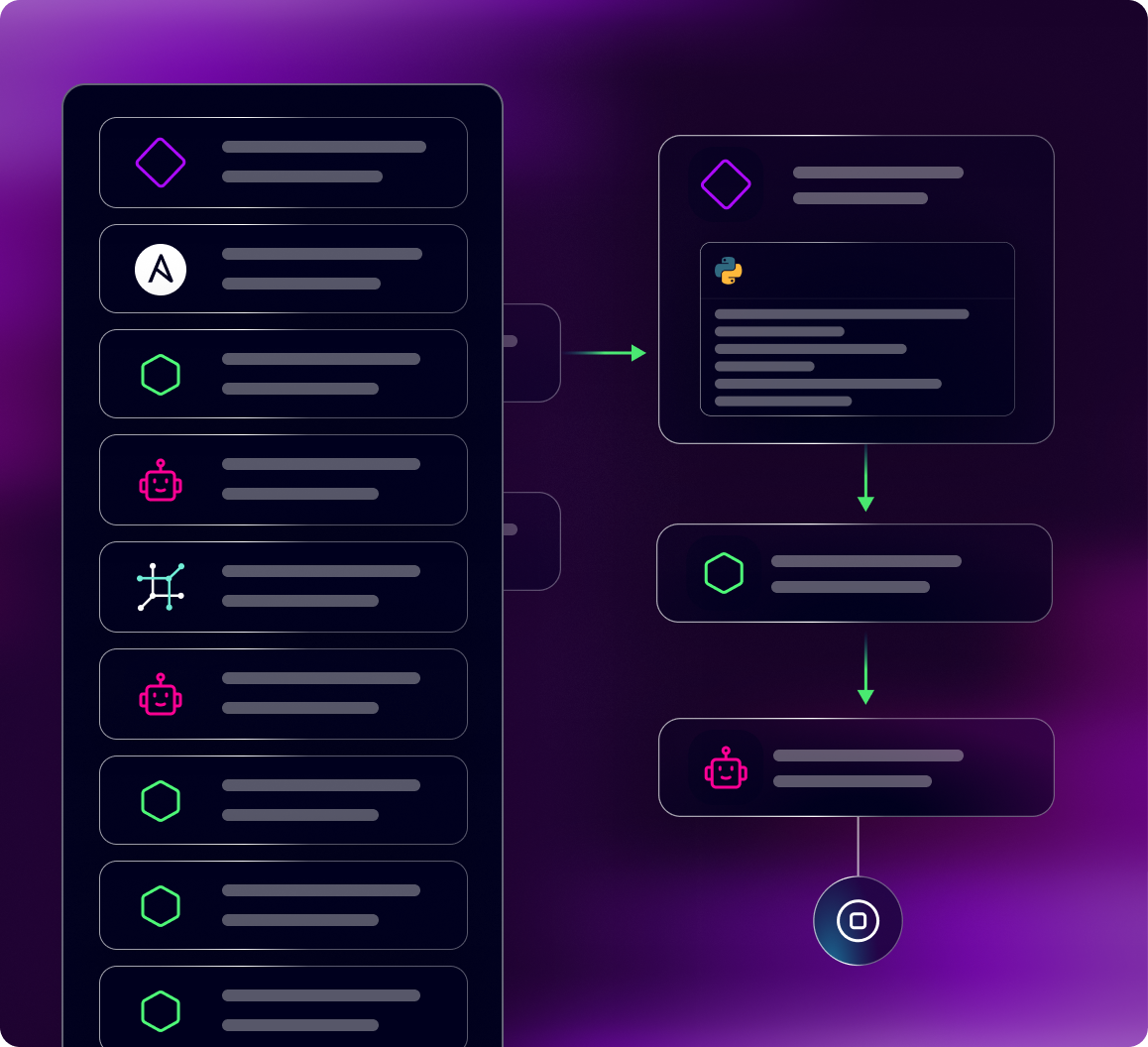
For teams building complex branching logic, reusable modular components, and multi-step orchestrations visually, the Design Studio canvas provides a visual build environment. Add tasks, integrations, agent steps, conditional branches, and inline Python via the new Run Code task, no separate service required. Configure blast-radius limits and validation checkpoints. Every artifact produced on the canvas is version-controlled, auditable, and identical in governance to anything generated via Spec-Driven Development.

Run Code: Inline Python on the Canvas

Drop a Run Code task anywhere a workflow needs custom logic. Write Python in place, define structured inputs and outputs, and the task executes through the same governed engine as every other step – RBAC, secrets injection, audit trail included.

Modular, Reusable Components

Every task, integration, and workflow is reusable. Reference existing components inside new workflows, no rebuilding, no duplication. Projects organize shared assets with RBAC and version control per project.

Icon - Velocity
One Execution Engine Regardless of Build Path

Canvas-built and SDD-generated workflows are identical artifacts. Same schema, same governance, same execution behavior: no distinction at runtime.

Workflow Tools

Workflows as Callable Agent Tools

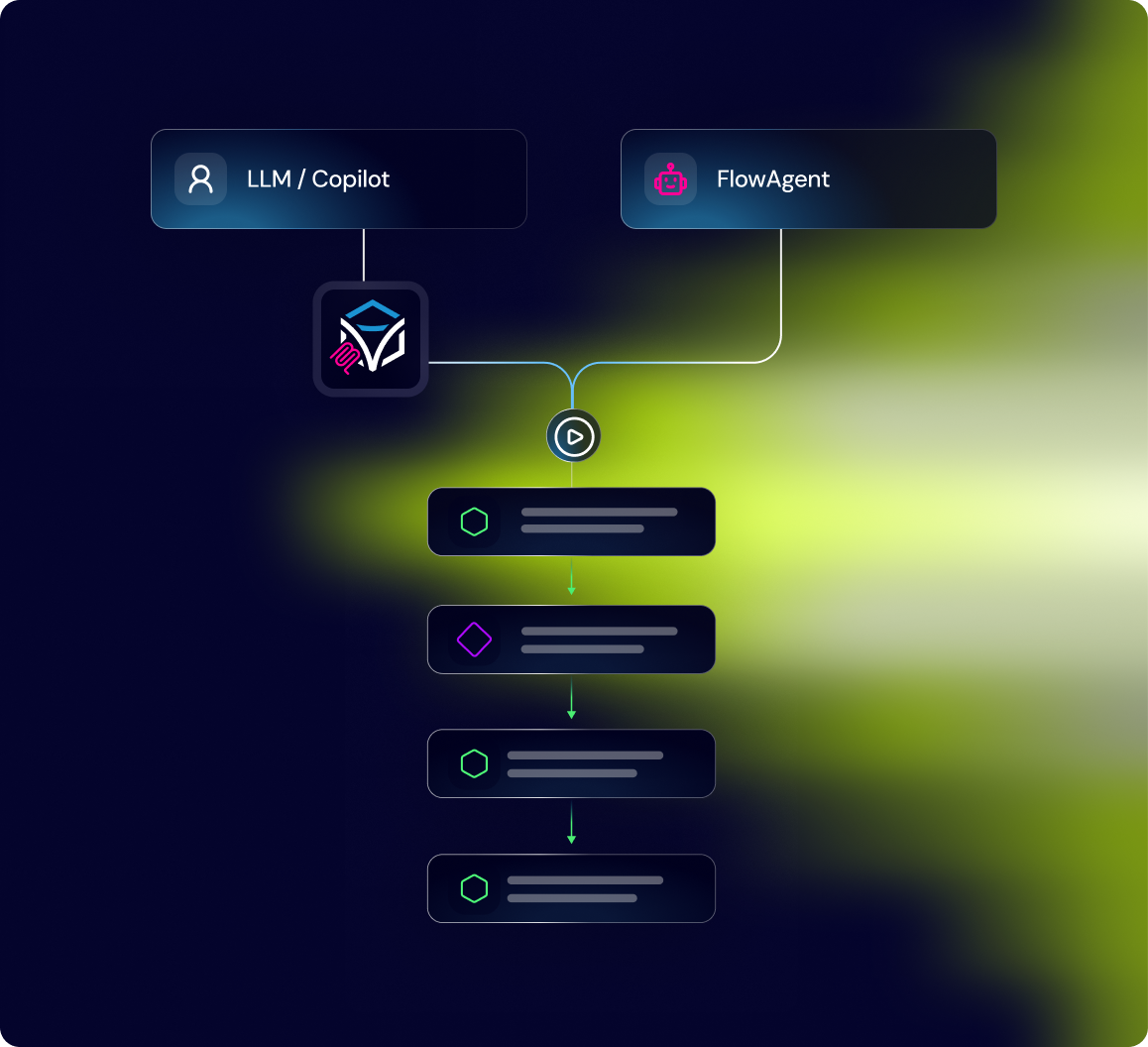
Every workflow published on the platform is automatically exposed as a callable tool any FlowAgent or external AI system can invoke. When a FlowAgent reasons through a goal, it selects the right workflow from its tool library, calls it with structured inputs, and observes the result, then continues reasoning through the next step. This is how agents take real infrastructure action without ever touching infrastructure directly.

Workflows in the Agent Tool Library

Every published workflow is discoverable and callable by any FlowAgent with the right permissions: structured inputs, defined outputs, governed execution.

the logo for Model Context Protocol (MCP)
External AI via MCP

External LLMs and AI systems call workflows through the Itential MCP Server. Schema-validated, RBAC-enforced, and audited before anything executes. No direct infrastructure access.

Closed–Loop Agent Execution

Agent calls workflow → workflow executes → result returned to agent → agent reasons through next step. The deterministic execution layer and the reasoning layer stay cleanly separated.

Itential has been instrumental in our journey to modernize and automate SCE’s network infrastructure. By providing a centralized orchestration platform, we’ve been able to create a vendor-agnostic automation framework that scales across our entire network – from Zero Touch Provisioning for Cisco refreshes to MPLS transport, firewalls, and beyond. With automation at the core of our strategy, we’re not just improving efficiency – we’re redefining how utilities manage network operations in the age of AI and digital transformation.
Matt Deibel of SCE quotation headshot
Matt Deibel
Manager, Grid Automation Services, Southern California Edison
Deterministic Execution

Deterministic Execution for Large-Scale Infrastructure Changes

Not every infrastructure operation should be handled by an agent reasoning in real time. Upgrading 10,000 devices. Running a compliance sweep across an entire network. Executing a major change window. These require speed, predictability, and guaranteed repeatability, not probabilistic reasoning. Deterministic workflows execute step-by-step, exactly as built, with validation at every step and rollback at every failure. No ambiguity. No deviation. Every time.

Icon - Scale
Why Deterministic for Large–Scale Changes

Agent reasoning is powerful but slow and probabilistic. For changes across thousands of devices, where a wrong decision at step 47 means rolling back 10,000 changes, you need deterministic execution that runs exactly as designed, every time.

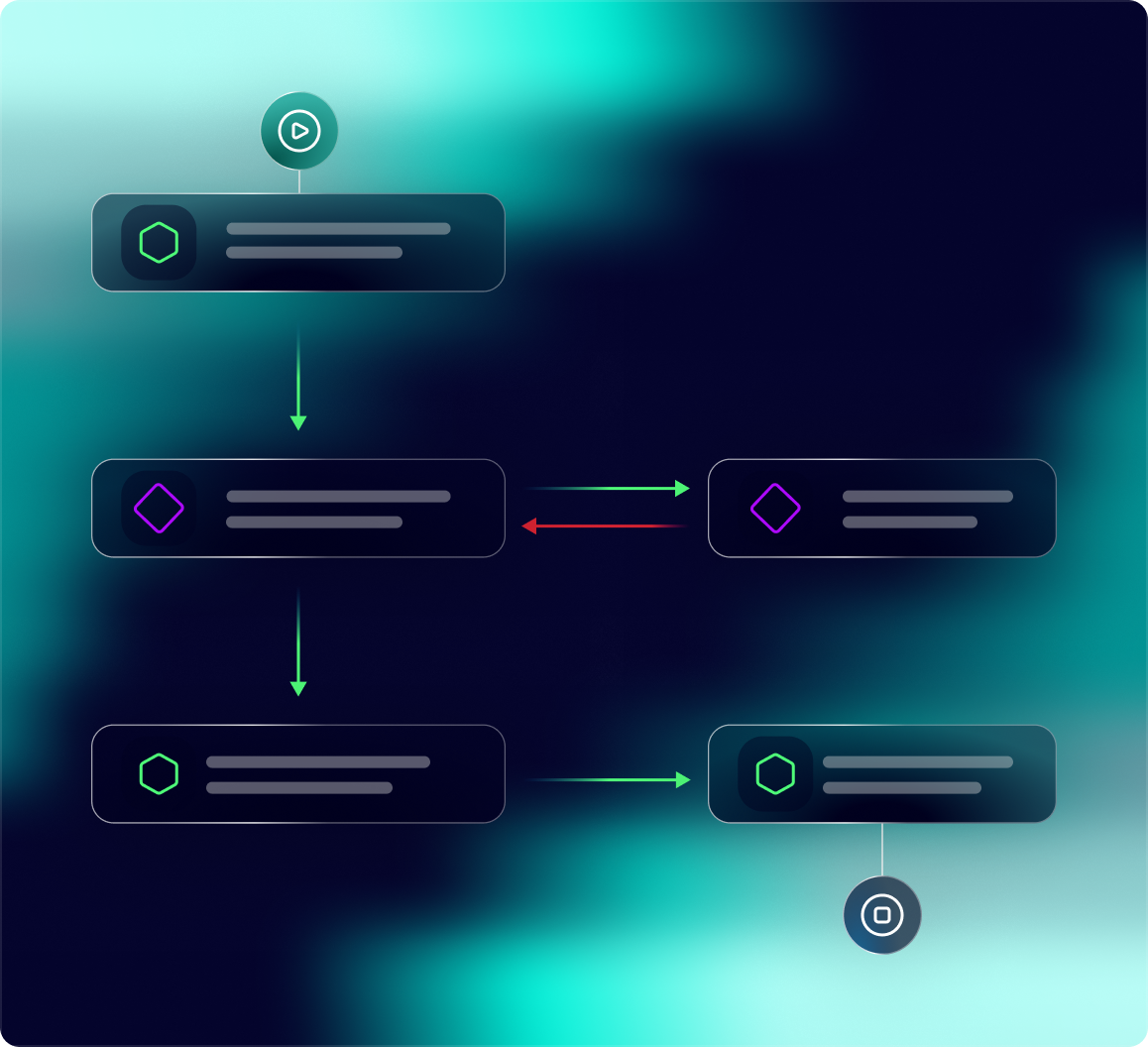
Conditional Branching at Every Step

Pass, fail, and revert paths configured at build time. Workflows evaluate real output at each step and branch accordingly: not a fixed linear sequence, but a predictable one.

simple icon of a checkmark
Pre/Post Validation, Rollback Always Available

State captured before execution. Pre-checks verify conditions against live infrastructure. Post-checks confirm outcomes. Any failure triggers automatic rollback across every affected system. No manual recovery, no partial states.

Hybrid Execution

Agentic & Deterministic in One Engine

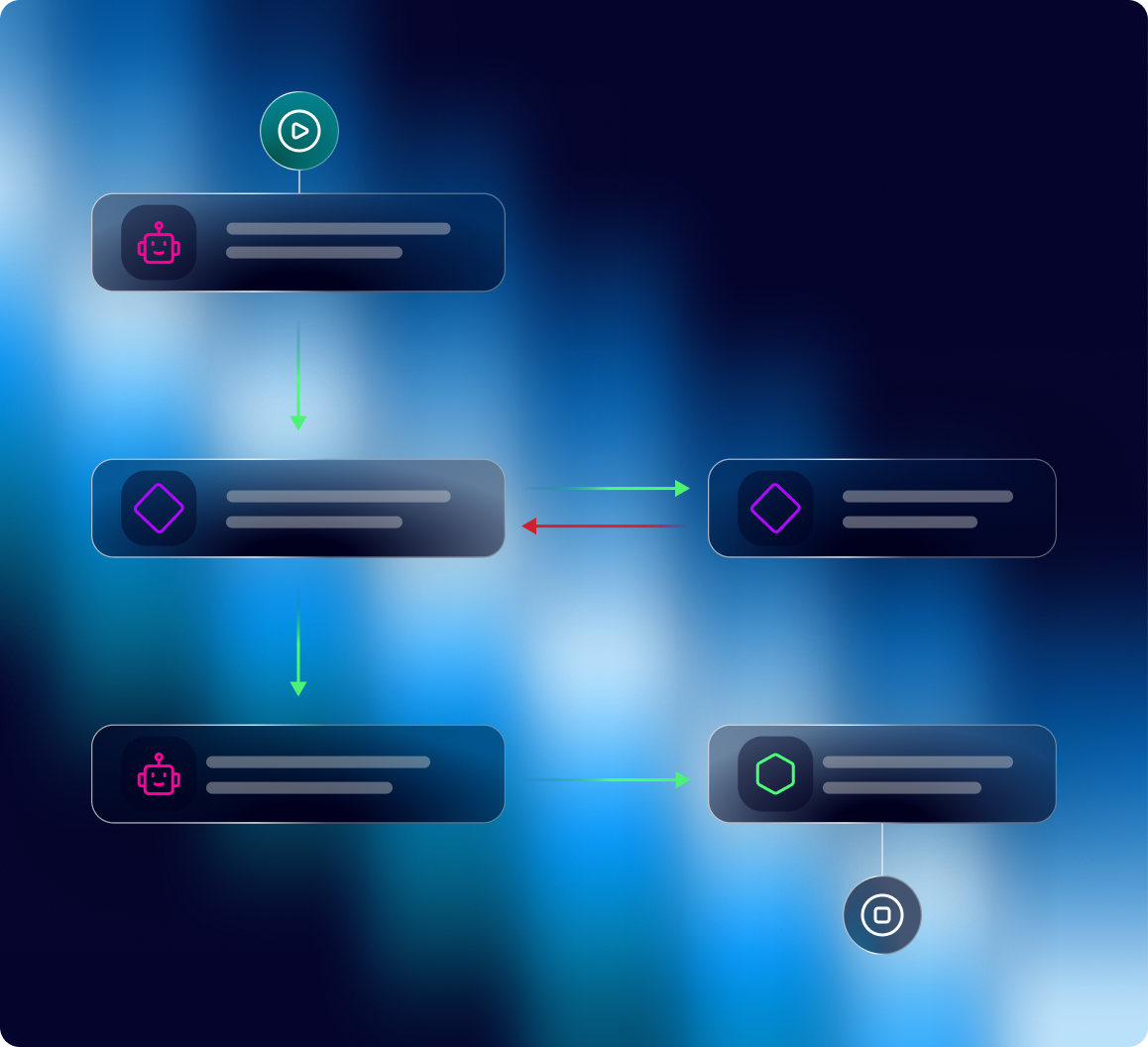
The most powerful pattern isn’t choosing between reasoning and deterministic execution, it’s composing them. A FlowAgent reasons through a complex goal, determines the right approach, and calls a deterministic workflow to execute it at scale. Or a deterministic workflow reaches a decision point it can’t pre-program and hands off to an embedded agent for mid-execution reasoning before returning to deterministic execution. Both modes. One governed engine.

Icon - AI Readiness
Agent Reasons, Workflow Executes

The agent figures out what to do: which devices, which config, which sequence. The deterministic workflow carries it out at scale with validation and rollback at every step. Clean separation of reasoning and execution.

Mid-Workflow Agent Embedding

Embed a FlowAgent as a step inside a deterministic workflow. The agent runs a ReAct loop (observe, reason, act) for log analysis, anomaly detection, or config generation, then returns control to the deterministic path.

Human-in-the-Loop at the Boundary

Configure human-in-the-loop approval at the handoff point between reasoning and deterministic execution. Agent reasons and proposes. Human approves. Workflow executes at scale. You control where the human stays in the loop.

Use Cases

AI-Driven Orchestration in Action

What workflow orchestration looks like at enterprises and service providers running the world’s most critical infrastructure. These are real demos, not concepts. Every example runs through the same engine, with the same validation, rollback, and audit trail on every action.

Self-Service Lifecycle

Productize Infrastructure as On-Demand Services

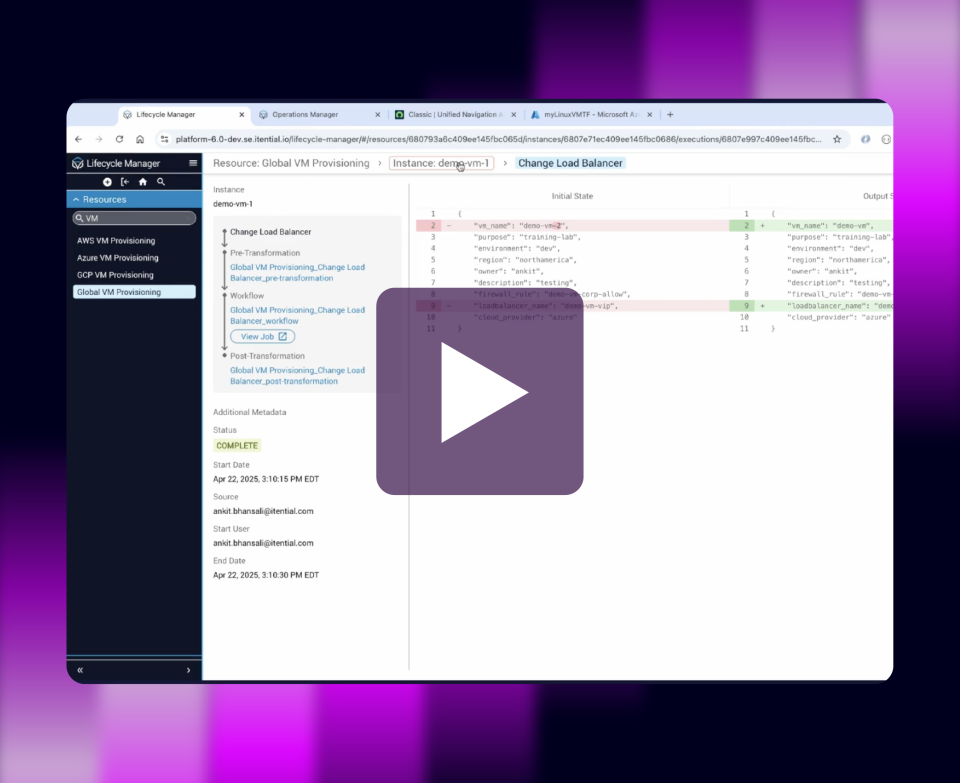
A user requests a VM through a ServiceNow form. A workflow routes it to the right cloud, applies the right firewall rules, attaches the right load balancer, and tracks every attribute as a single product instance. Day 2 changes, compliance sweeps, and auto-decommission all run against the same product. Multi-domain orchestration, productized.

Watch the Demo
Compliance Automation

Orchestrated Server Compliance, Self-Healing

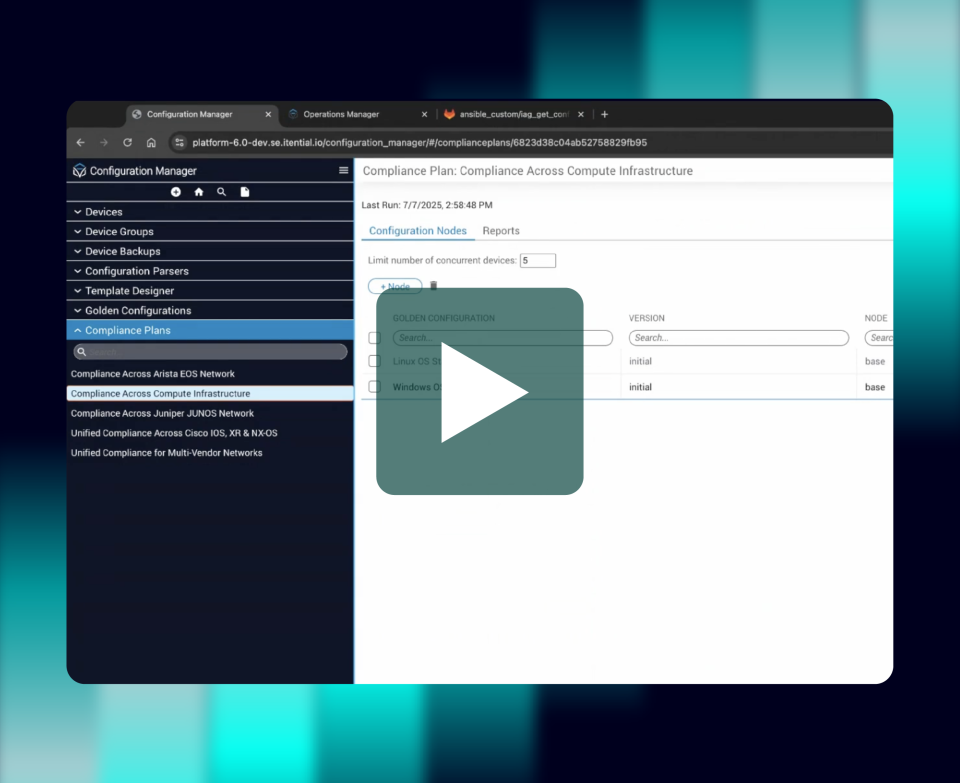
A scheduled compliance plan runs across the entire server estate, detecting drift at the attribute level. Per-server remediation workflows trigger automatically, pre and post validation included, audit report generated. No guesswork, no manual sweeps, no end-of-quarter scramble. Compliance becomes a workflow that runs itself.

Watch the Demo
AI-Initiated Automation

Build & Run Network Workflows With AI Through MCP

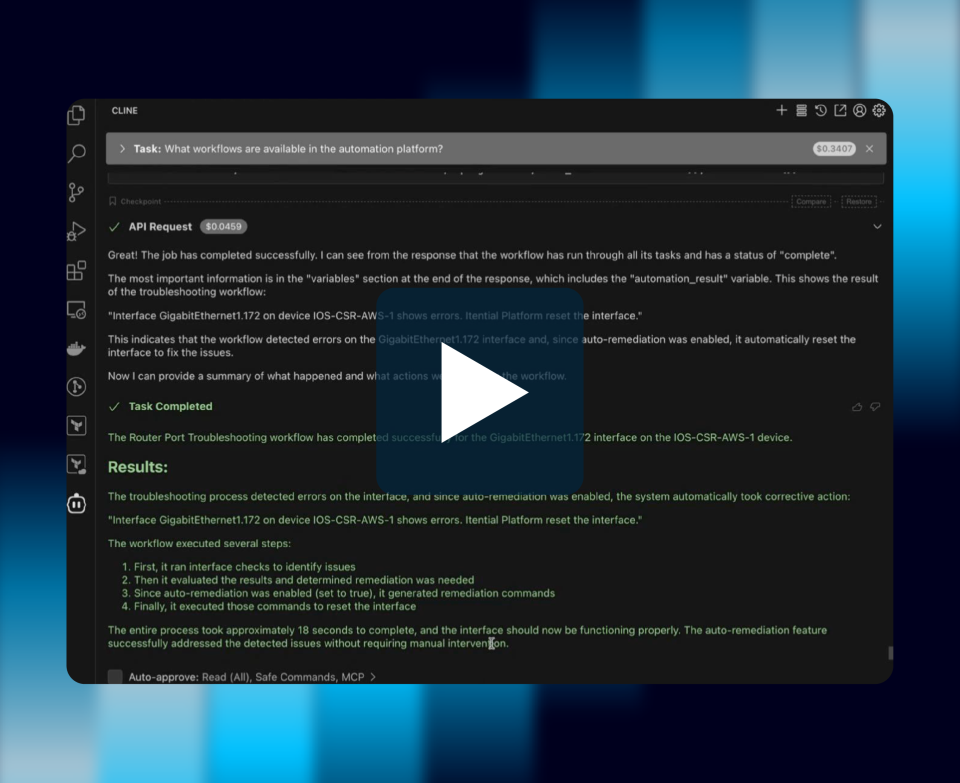
An engineer prompts an LLM to build a network workflow. The Itential MCP Server exposes platform capabilities as callable skills. The LLM constructs the workflow via REST APIs, commits it to Git, and CI/CD deploys it automatically. The same workflow is then callable from the LLM or any agent as a governed tool. Build with AI. Run through governance.

Watch the Demo
Spec-Driven Development

Generate Production Workflows From Plain Language

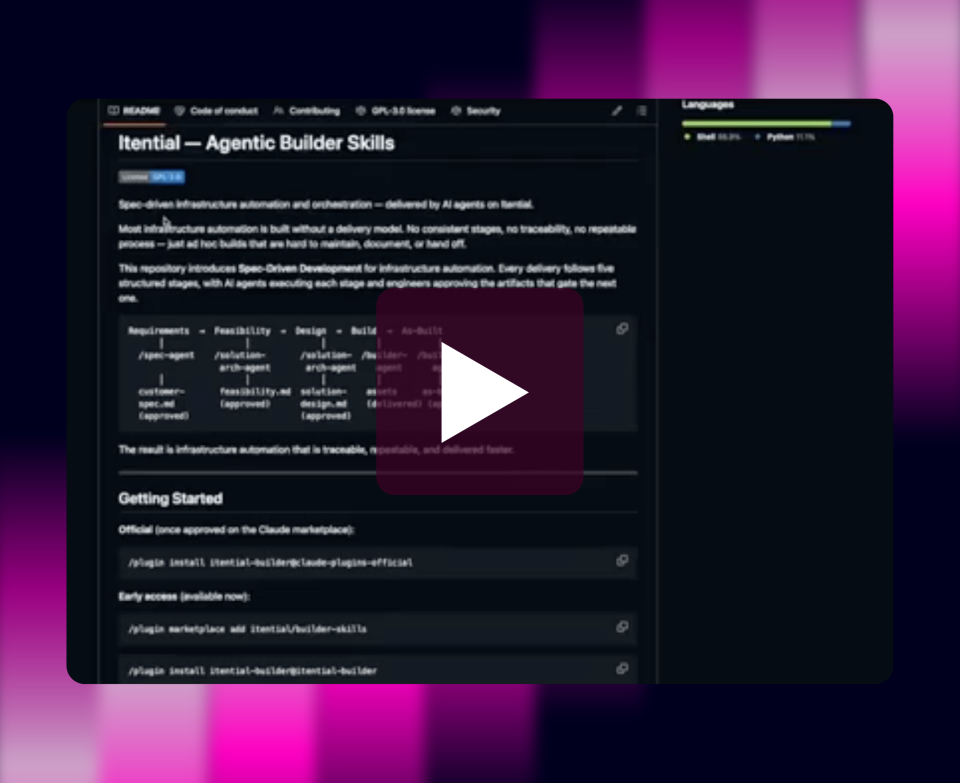
An engineer describes the workflow they need to an AI assistant powered by an Itential Builder Skill. The Skill calls the platform’s REST APIs, constructs the workflow artifact, commits to Git, and CI/CD deploys it. The output is a real platform artifact, same schema, same governance, same execution behavior as anything built manually. From spec to production, no engineer building anything from scratch.

Watch the Demo

Dive Deeper into Workflow Orchestration with Itential

Frequently Asked Questions

+

Use agentic reasoning when the goal is complex, ambiguous, or requires adapting to what the agent finds at runtime: diagnosing an incident, determining which devices are affected, deciding the right remediation approach. Use deterministic execution when the operation is large-scale, critical, or must be 100% repeatable: upgrading thousands of devices, running a compliance sweep, executing a change window. The most powerful pattern is composing both. The agent reasons through what to do, the deterministic workflow executes it at scale with validation and rollback at every step.

+

Every workflow published on the platform is automatically registered as a callable tool with a defined schema: structured inputs, defined outputs, governed execution. FlowAgents select from their allowlisted tool library at runtime. When an agent calls a workflow, it passes structured inputs, the workflow executes deterministically through the execution engine, and the result is returned to the agent as structured output. External AI systems invoke workflows the same way through the Itential MCP Server, schema-validated and RBAC-enforced before anything runs.

+

Itential Builder Skills (available on the Anthropic Marketplace) are the productized form of Spec-Driven Development for workflow orchestration. Every workflow orchestration capability is exposed as a documented REST API endpoint, and the Itential MCP Server exposes those APIs as callable skills. Describe the workflow in plain language. The Builder Skill calls those REST APIs directly to construct the workflow artifact, commits it to Git, and CI/CD deploys it automatically. The output is a real platform artifact, identical in schema, governance, and execution behavior to a workflow built manually on the Design Studio canvas. No code review required. No separate deployment step.

+

Yes. Connect to your GitHub, GitLab, or Bitbucket repo. Every committed script, playbook, and plan syncs automatically and becomes a callable workflow step executed via Itential Gateway. The execution layer handles Python virtual environments, dependency management, and concurrent execution. The platform injects secrets, enforces RBAC, and captures a full audit trail for every execution. Engineers keep building in their IDE. The platform handles how those artifacts get executed, versioned, and governed.

+

State is captured before the first step runs. If any step fails, automated rollback triggers immediately, restoring every affected system to its exact pre-execution state across every domain and device touched. No manual recovery. No partial states. Job Viewer shows the complete execution path: what ran, what failed, what rolled back, the exact failure reason, and the before/after state of every system touched. The complete record is always exportable.

+

Ansible Automation Platform is excellent at what it was built for: executing configuration tasks against infrastructure targets. But task execution is not orchestration. AAP runs a playbook against a set of hosts. It doesn’t coordinate across domains, manage service lifecycle state, enforce pre/post validation across multi-step changes, provide human-in-the-loop approval gates, or give AI agents a governed execution layer to call workflows as tools. Itential orchestrates Ansible. Your existing Ansible playbooks run inside Itential workflows as governed steps, with approval gates, blast-radius controls, rollback, and audit trails added automatically. Engineers keep writing Ansible. Itential handles what happens when that Ansible runs in a production multi-domain environment where a failure at step 3 means rolling back steps 1 and 2 across 10,000 devices.

+

AIOps platforms like IBM Concert are built to surface insights: correlating telemetry, identifying anomalies, and recommending actions. The gap is always the same. The insight can’t become a governed infrastructure action without an execution layer. An AIOps platform can detect that 500 devices are running vulnerable software. It cannot generate the remediation workflow, validate pre-conditions across every affected device, execute the fix in parallel, confirm post-change state, and produce an audit report, all within defined approval gates and blast-radius limits. Itential is the execution layer that closes the gap. AIOps platforms connect to Itential via MCP or direct API: detections trigger governed Itential workflows, execute deterministically, and return structured results back to the AIOps platform for closed-loop awareness. The insight and the action finally connect.

+

ServiceNow is the system of record for IT process: tickets, approvals, change requests, CMDB. It’s exceptional at managing the who, what, why, and when of infrastructure changes. What it doesn’t do is execute the actual infrastructure change. Pushing configuration to network devices, provisioning cloud resources, updating CLI systems, validating pre and post conditions across domains. Itential executes what ServiceNow approves. A ServiceNow change request triggers an Itential workflow. Itential validates pre-conditions, executes the change across every required domain via Itential Gateway, runs post-checks, and closes the ServiceNow ticket with execution evidence attached. ServiceNow handles process. Itential handles execution. They’re designed to work together, not replace each other.

Orchestrate Every Infrastructure Change Through One Governed Engine

See how workflow orchestration gives agents, teams, and operators one engine for every change, with pre/post validation, rollback, and audit trails on every action.

Talk to an Expert