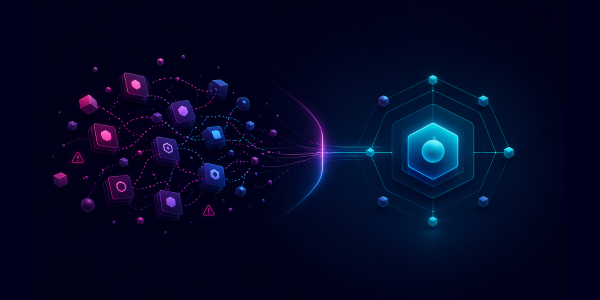
A homegrown Python orchestration platform hit its limits. Service requests piled up. Maintenance depended on a few specialized engineers. Every new tool meant custom development.
Itential replaced the homegrown stack with event-driven orchestration – ServiceNow as the front door, Itential as the engine, downstream tools called via API for end-to-end fulfillment.
Service delivery times collapsed from 5 days to 10 minutes. 15,324 productivity hours saved. 7,114 days of wait time eliminated across the business. ROI tracked in Splunk dashboards executives actually look at.
Armstrong World Industries is a global leader in ceilings and wall solutions – a fast-paced, project-driven business where IT service delivery directly impacts how the company runs. As demand grew, the IT team’s existing manual processes (and the basic scripts propping them up) couldn’t keep pace. Backlogs grew. Visibility into productivity didn’t exist. Internal customers waited.
The team had built a homegrown Python orchestration platform to take the edge off, but it introduced its own set of problems. It didn’t scale with rising request volume. Every new integration required custom development. And the whole thing leaned on a handful of specialized engineers – a fragility risk masquerading as an automation strategy. Armstrong reached the tipping point: scaling automation needed a real platform, not another internal tool to maintain.
Armstrong’s homegrown Python platform did real work – until it couldn’t. Scaling demand, integration complexity, and key-person dependency made it clear that growing automation meant moving to a platform built for it. Itential brought event-driven orchestration, deep integrations, and a workflow model the team could actually maintain.
After their internal Python platform hit its scaling ceiling, Armstrong evaluated what a real orchestration platform needed to do. Five criteria shaped the decision.
ServiceNow tickets trigger Itential workflows automatically – no manual intervention, no engineer-in-the-loop for routine fulfillment. The entire lifecycle from request submission through completion runs as a governed, event-driven workflow.
Open source integrations with ServiceNow, GitLab, Office 365, and Active Directory connect Itential to the systems Armstrong already runs. No custom development for every new tool – the integration tax that broke the homegrown platform is gone.
End-to-end orchestration unifies workflows across multi-domain infrastructure – Python scripts, REST API calls, security checks, inventory steps. Existing automation assets become callable building blocks instead of code to retire.
Drag-and-drop workflow building abstracts infrastructure complexity. Engineers create modular, reusable, scalable workflows without writing every integration from scratch – and without the platform depending on a handful of specialists to maintain.
Real-time automation metrics flow into Splunk dashboards – hours saved, wait time eliminated, throughput. The numbers leadership needs to fund the next wave of automation, captured automatically as workflows run.
Itential is in production at Armstrong – driving switch deployments, subnet creation, DNS requests, AD changes, and VM lifecycle. The architecture is simple and load-bearing: users submit in ServiceNow, Itential orchestrates everything downstream, results flow back to ServiceNow, and metrics land in Splunk dashboards leadership uses to fund what’s next.
Users submit service requests in ServiceNow. On approval, an API call hits Itential with the task number – the entire lifecycle from submission through fulfillment runs without manual intervention.
Itential queries ServiceNow, pulls task variables into a JSON object, and applies workflow logic. The same orchestration engine handles switch deployments, subnet creation, DNS requests, AD MACDs, and VM lifecycle – one platform, every IT service.
Workflows call downstream tools – GitLab, Office 365, Active Directory, network systems – through API integrations. No custom glue code per service. The integration tax that broke the homegrown platform is gone.
Pre-built components and reusable workflows replace one-off scripts. Engineers compose new automations from existing building blocks instead of starting from zero – and the platform doesn’t depend on a few specialists to keep running.
Users get automated status updates throughout fulfillment, and tasks are logged back in ServiceNow. The system of record stays the system of record – with orchestration happening underneath.
Real-time automation metrics flow into Splunk dashboards – hours saved, wait time eliminated, services delivered. The data that secured executive buy-in for the next wave of automation, captured automatically as workflows run.
Numbers leadership trusts, captured in real time. Time back for engineers to work on higher-value projects. The kind of measurable ROI that gets the next phase of automation funded.
See how Itential connects AI reasoning to governed execution across your entire infrastructure.