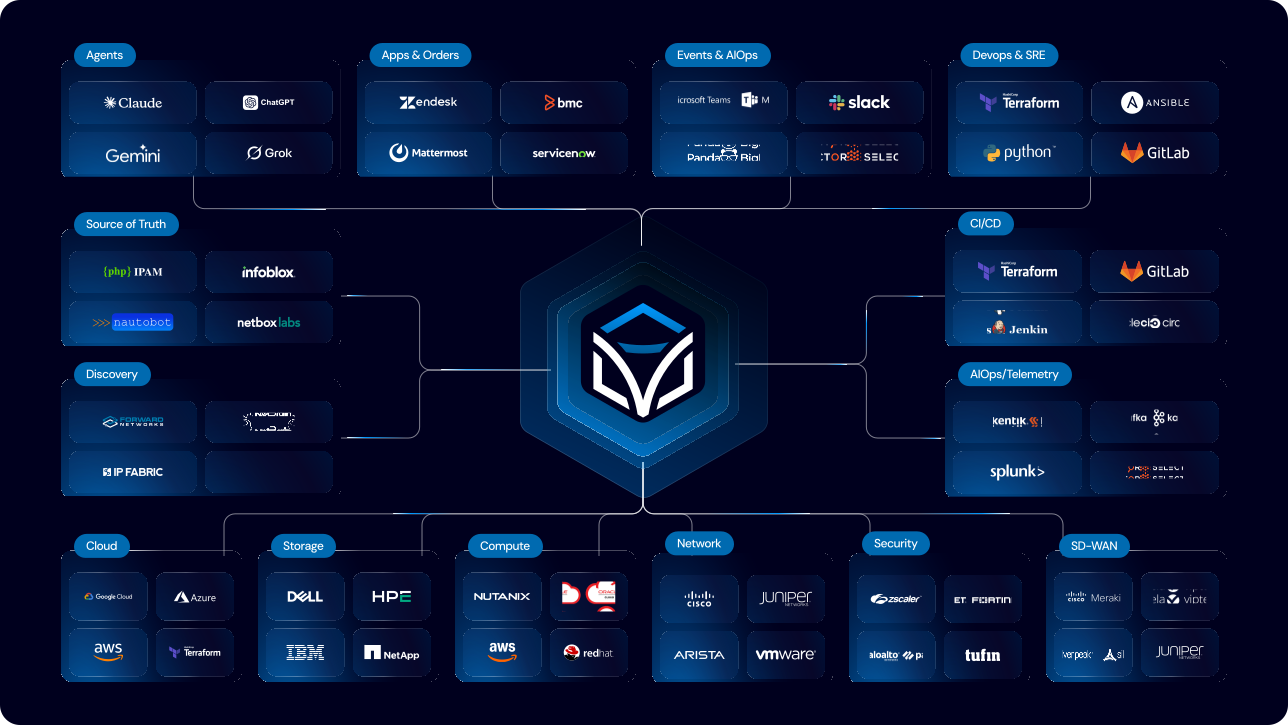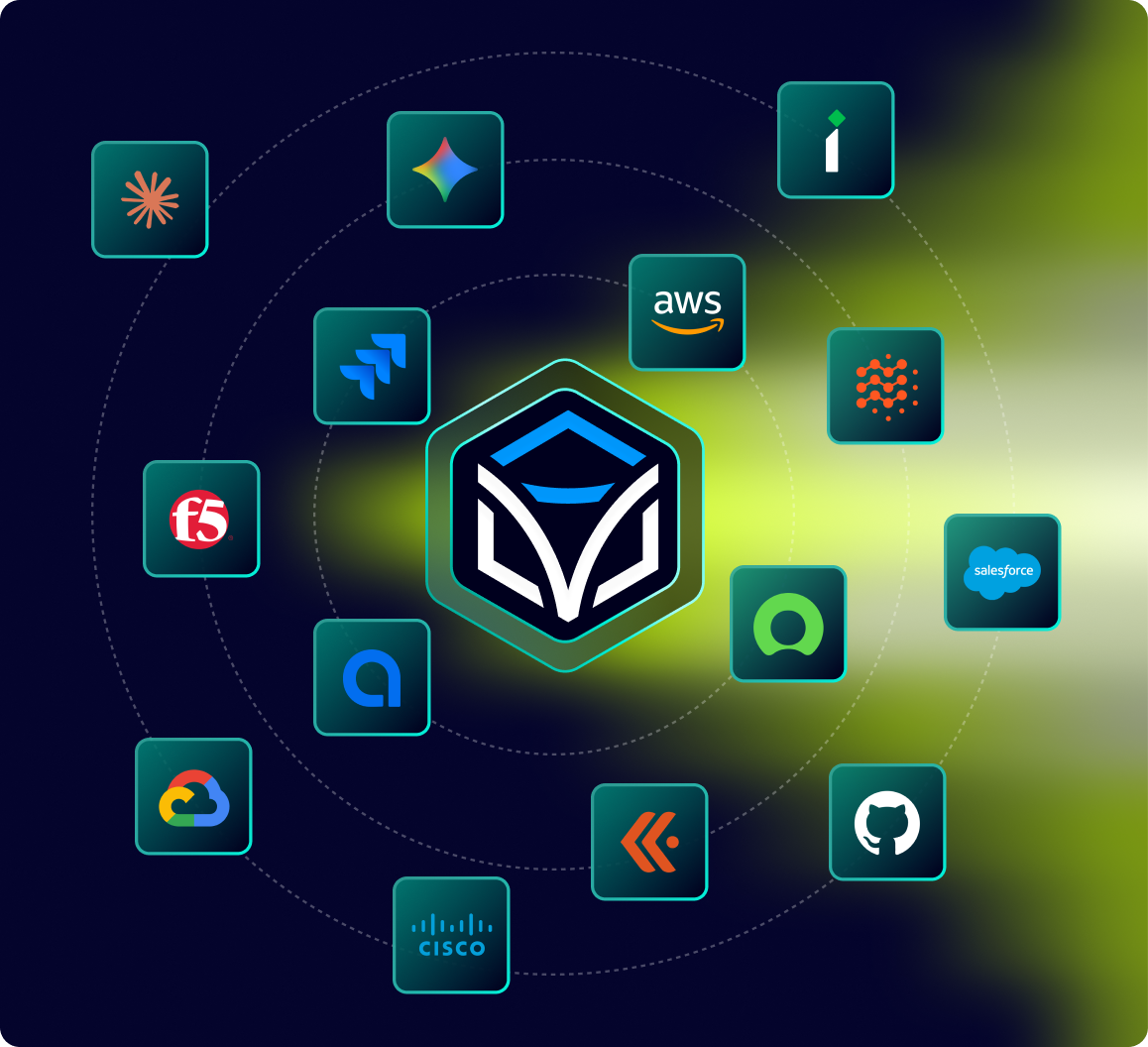
The Itential Platform connects to every system in your environment and exposes every capability it has to any system, agent, or AI that needs it, with 1,000+ open source integrations, REST APIs, MCP, and CLI all running through one governed orchestration fabric.
The Itential Platform connects to everything in your environment and exposes every capability it has to anything that needs it. 1,000+ open source integrations for the systems you already use. REST APIs for CI/CD pipelines and external orchestrators. MCP server for AI agents and LLMs. CLI for network devices that don’t expose modern APIs. Every connection runs through the same governed execution engine.
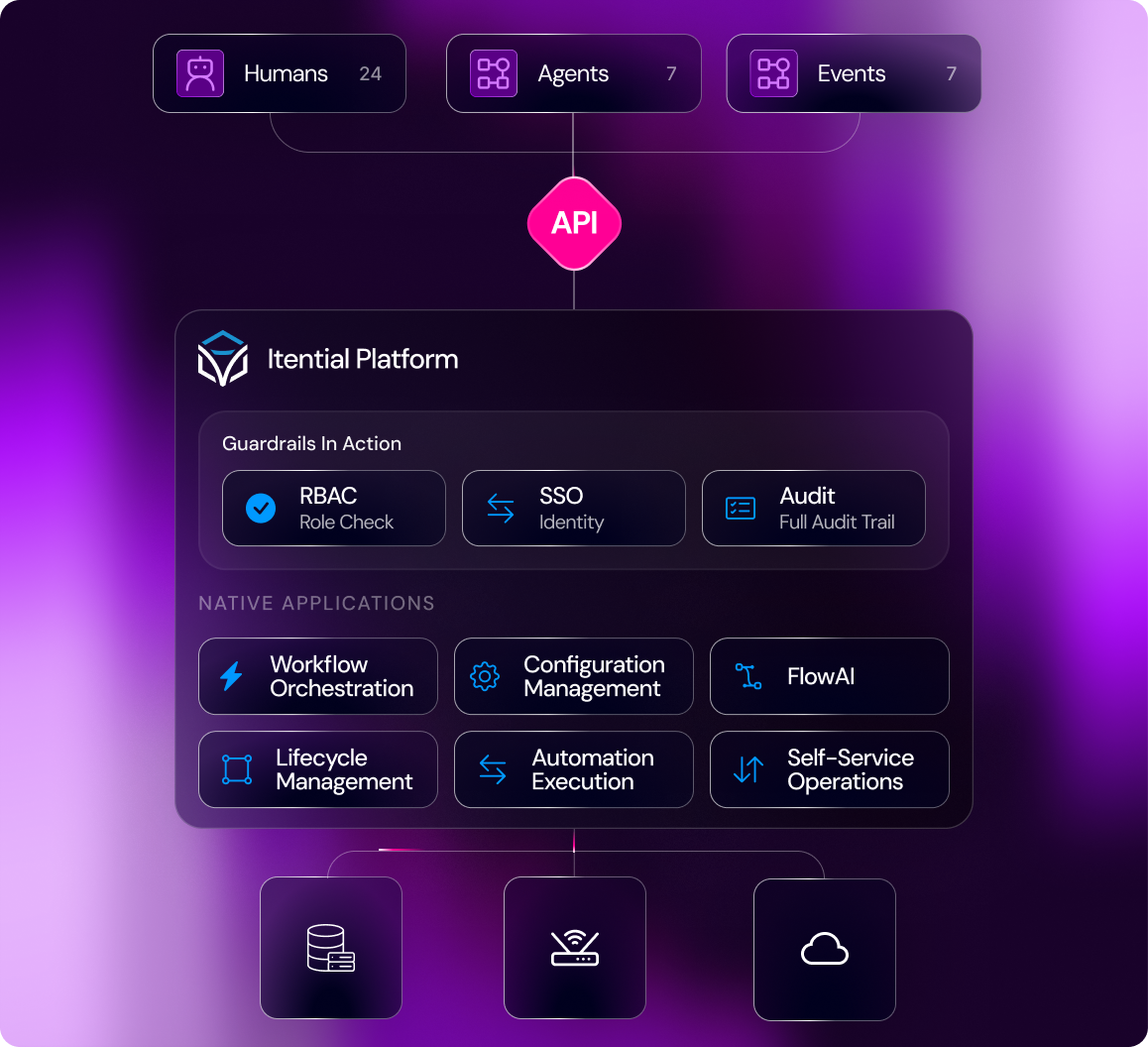
Every Itential platform capability is exposed as a documented REST API endpoint, every workflow, service, and operation. CI/CD pipelines and external systems call these APIs to trigger governed workflows and query execution state. Connected LLMs generate, version, and deploy automation by calling those same APIs directly. An MCP connection is one option, not a requirement.
Every workflow, service, and operation exposed as a documented REST API endpoint. Nothing locked inside the platform. CI/CD pipelines, ITSM systems, and external orchestrators trigger governed workflows and query execution state through standard HTTP calls.
Every REST API is also exposed as an MCP tool with a self-describing schema. LLMs and FlowAgents call the same APIs humans and pipelines do, no separate AI-only endpoints, no parallel maintenance, governed the same way every other call is.
OAuth 2.0 and API key authentication for any CI/CD pipeline or ITSM platform. API versioning maintained across platform updates so integrations don’t break when the platform evolves. Same governance applies to every external trigger.
1,000+ open source integrations connect the platform to every system in your environment, network, cloud, ITSM, CI/CD, security, and observability. New integrations generate automatically from any OpenAPI or Swagger spec, no custom code, no separate maintenance. Every integration runs through the same governed orchestration fabric.
Connect to network, cloud, ITSM, security, and observability tools out of the box. Open source adapters maintained, version-controlled, and tested. Drop into governed workflows immediately, every integration ready the same way.
SSH, Netconf, RESTCONF, and Netmiko for network devices that don’t expose modern APIs. No separate CLI tooling required, no scripts to maintain, no broker layer to operate. The platform speaks every protocol your infrastructure does.
Credentials fetched at runtime from HashiCorp Vault, CyberArk, AWS Secrets Manager, or Azure Key Vault. Never stored in scripts, configuration files, or workflow definitions. Secrets stay in your secrets manager where security teams already govern them.
Explore integrations across network, cloud, ITSM, security, and observability.
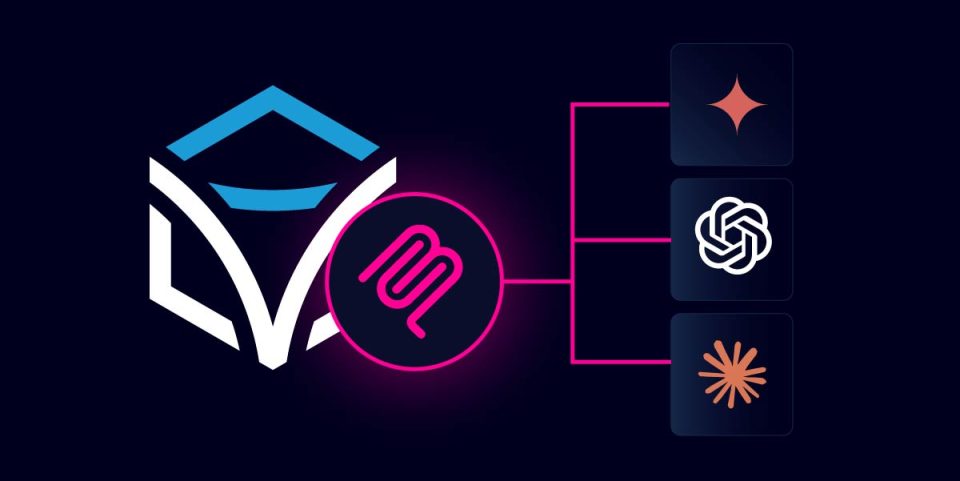
The Itential MCP Server exposes every platform REST API as a self-describing, discoverable tool any LLM can call. Connect Claude, ChatGPT, or any MCP-compatible model and it can query device inventory and configuration state, trigger workflows, and generate automation. Every MCP request is schema-validated, authenticated, and logged before anything runs.
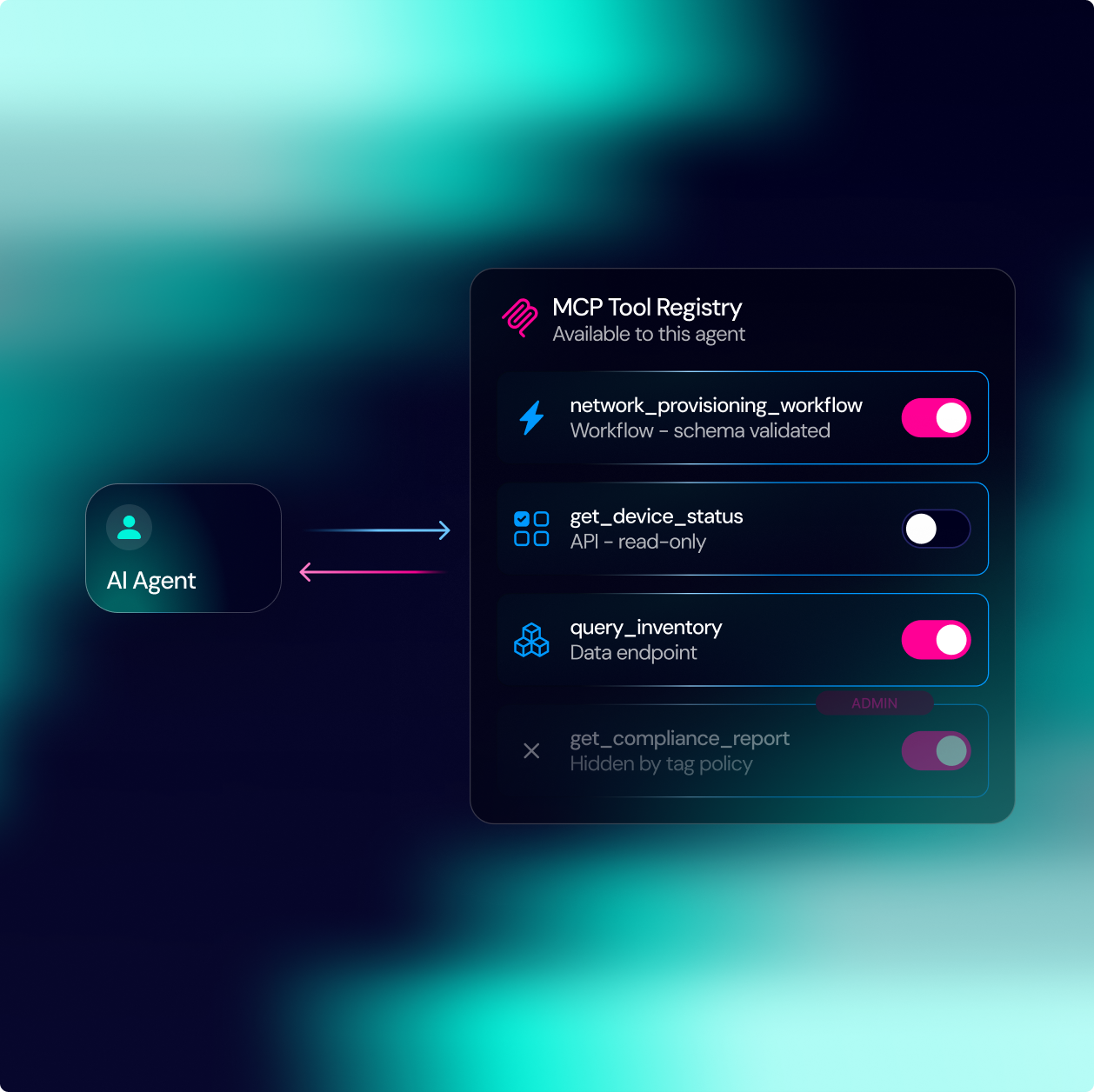
Every platform capability exposed as a self-describing MCP tool. LLMs understand when and how to call each one based on the schema, no custom prompting required to teach an agent how the platform works.
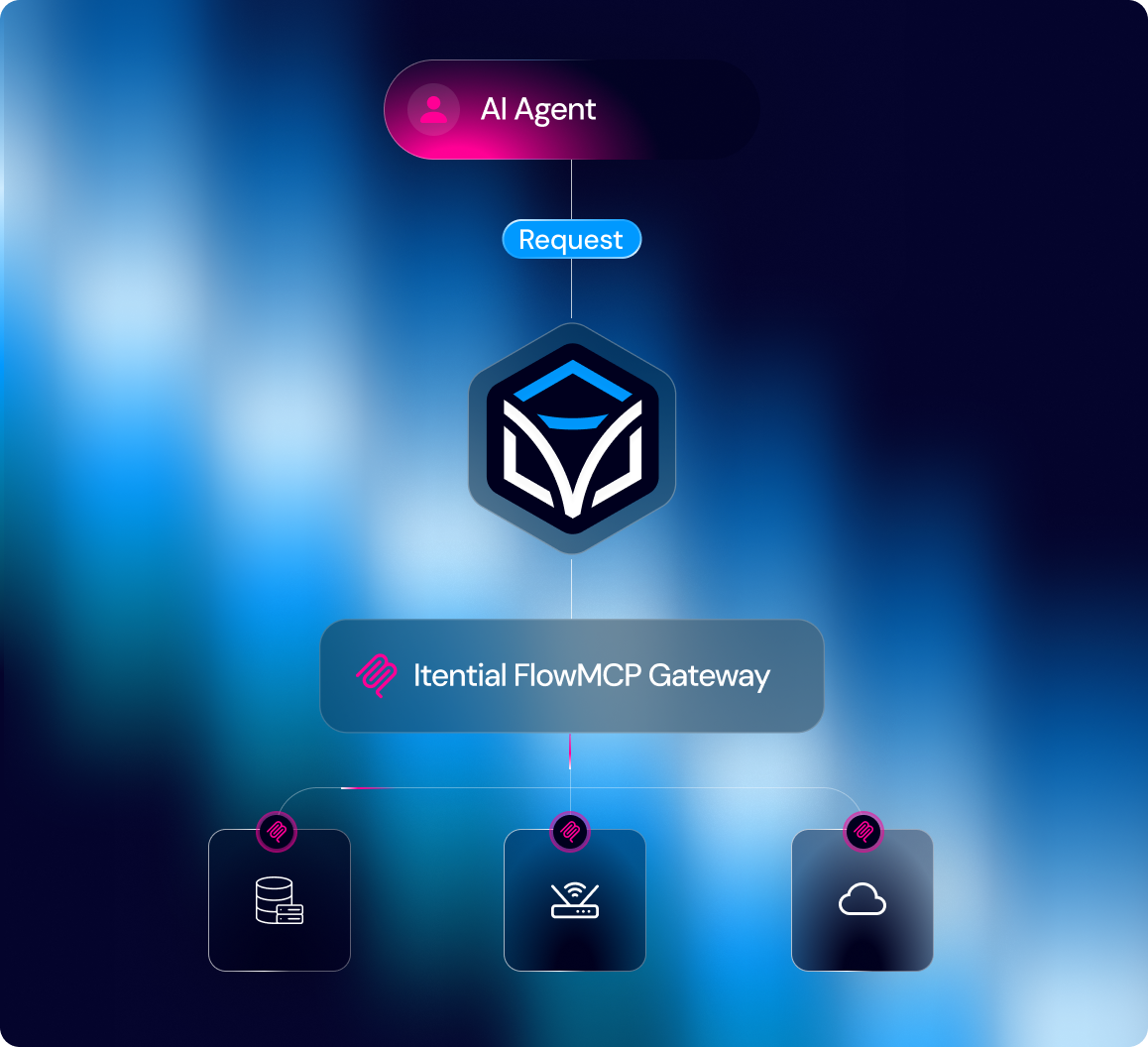
Every AI request schema-validated, authenticated, and authorized before any infrastructure action runs. Inputs checked against the tool spec, RBAC applied to the calling agent, malformed or unauthorized requests rejected at the MCP layer.
Every MCP request logged end-to-end, AI intent through to the governed infrastructure action it triggered. Same audit trail every other action gets, no separate AI logging path, every action traceable back to the prompt that triggered it.
FlowMCP Gateway is the enterprise AI connectivity layer, centralized governance across multiple MCP instances, virtual MCP servers with per-persona RBAC, and complete audit logging at every AI-to-platform handoff. Define exactly what each connected AI system can see, call, and what requires approval before execution. Every action runs through the same governed execution layer.
Define exactly what each AI system can see and call. Smaller, scoped tool sets reduce token usage, prevent agent confusion, and produce more reliable behavior. One control plane for every MCP instance across the enterprise.
Virtual MCP servers with RBAC per AI system, team, or persona. Each agent persona sees only the tools and workflows relevant to its job. Different personas, different access scopes, all governed through one control plane.
Trace a single AI request across multiple MCP instances and platform handoffs. Every action attributed to the originating agent, every handoff logged, full audit chain from initial prompt to final infrastructure change.
Integration flexibility changes the math on infrastructure orchestration. Every system in your environment becomes orchestratable. Every platform capability becomes callable by AI, workflows, and pipelines. Automation that used to stop at domain boundaries now runs end-to-end. These are the outcomes teams unlock with the integration fabric.
A single workflow provisions network, configures cloud resources, opens the ServiceNow ticket, validates with the AIOps platform, and updates inventory, all without writing one line of custom integration code. Domain boundaries stop being workflow boundaries. What used to require coordination across multiple teams now runs as one governed operation.
Connect any LLM or AI agent and it has immediate, governed access to every system you operate. No custom integration work required. AI moves from chatbot demo to production operation because the platform already has the connections, the governance, and the audit trail. The agent reasons. The platform executes safely.
Itential connects to Ansible, Terraform, ServiceNow, Datadog, AWS, and the 1,000+ tools you’ve already invested in. The integration fabric brings them into one governed orchestration layer so workflows can span them. Keep your tools. Skip the rip-and-replace. Get cross-tool automation without the migration project.
Every integration added makes every workflow, agent, and pipeline more capable. A new ITSM tool plugs in once and immediately works with every existing automation. A new AI system connects and immediately has access to everything the platform can do. Each connection compounds the value of the ones before it.
See how the Itential Platform brings every system, tool, and AI agent into a single governed orchestration fabric.
The REST API is the foundation, it exposes every platform capability as a callable HTTP endpoint. The MCP Server takes those same capabilities and wraps them as tools in the Model Context Protocol format, self-describing, discoverable functions that LLMs can reason about and call. REST is how systems and pipelines integrate with the platform. MCP is how AI systems integrate with the platform. Same underlying capabilities. Different interface layer for a different kind of caller.
The Itential MCP Server is open source, it connects a single AI system or LLM to the platform. FlowMCP Gateway is the enterprise version: centralized governance across multiple MCP instances, virtual MCP server personas with per-role tool access, and complete audit logging at every handoff. If you’re connecting one model in a lab environment, the open-source server works. If you’re managing multiple AI systems, multiple agent personas, and multiple teams using MCP in production, that’s FlowMCP Gateway.
Import any OpenAPI or Swagger spec into the no-code adapter builder. The platform generates a production-ready integration automatically, complete with schema definitions, error handling, and unit tests. The new adapter joins the same governed orchestration fabric as the 1,000+ pre-built ones, no custom code, no separate maintenance path.
No. The Itential integration ecosystem is additive, it works alongside your existing tools and automation investments. Most teams use Itential to orchestrate across tools they already have: Ansible, Terraform, ServiceNow, Datadog, AWS. The pre-built integrations get you connected faster. The no-code adapter builder handles anything custom. The point isn’t to replace your integrations, it’s to bring them into a single governed orchestration fabric so workflows can span systems instead of stopping at domain boundaries.
Both, and this is what makes it a true orchestration fabric rather than just another integration tool. The platform calls into your external systems as steps in workflows, pushing configs, opening tickets, provisioning cloud resources, querying inventory. External systems call into the platform via REST API or MCP to trigger governed operations. CI/CD pipelines deploy automation and trigger execution. AIOps platforms send events that trigger remediation. The platform is both a consumer and a producer of integrations. Every connection, in both directions, runs under the same governance model.
Credentials never live in scripts, workflows, or platform storage. The platform pulls authentication tokens, API keys, and passwords at execution time from your existing secrets manager: HashiCorp Vault, CyberArk, AWS Secrets Manager, or Azure Key Vault. RBAC controls which workflows and agents can request which credentials. Every credential request is logged. Security teams keep their existing tooling, the platform calls it at the right moment.