Itential logo
Itential + Ansible

Itential + Ansible

Connect your Ansible playbooks to the Itential Platform so FlowAgents and governed workflows can invoke, generate, and orchestrate Ansible automation across every domain, with RBAC, pre/post validation, and a full audit trail on every execution.

Why It Matters

Ansible Runs the Task. Itential Runs the Operation.

Your team has invested years in Ansible playbooks. They work. The problem is everything around them: no governance, no multi-domain coordination, no ITSM integration, no pre/post validation, and no way to safely invoke them from AI agents or CI/CD pipelines at scale. Itential wraps every Ansible playbook in a governed execution layer and makes it a callable service any team, FlowAgent, or pipeline can invoke, without rewriting a single line of YAML.

 
Current Challenges

Your Playbooks Scale, Your Operations Don’t

Ansible Automation Platform is excellent at what it was built for: executing configuration tasks against infrastructure targets. But task execution is not orchestration. AAP runs a playbook against a set of hosts. It does not coordinate across domains, manage service lifecycle state, enforce pre/post validation across multi-step changes, provide HITL approval gates, or give AI agents a governed execution layer to call playbooks as tools. As your automation library grows, the gap between what Ansible can execute and what your operations actually require keeps widening.

Playbooks Without Governance

Ansible playbooks run without RBAC at the operation level, without pre/post validation on infrastructure state, without blast-radius controls, and without an immutable audit trail. Every ungoverned execution is a compliance risk at scale.

No Multi-Domain Coordination

Ansible executes against hosts. It does not coordinate a change that spans network devices, cloud APIs, ITSM systems, and source-of-truth updates in a single governed execution path. That coordination is still manual.

AI Agents Cannot Safely Call Ansible Playbooks

Giving a FlowAgent or external LLM direct access to execute Ansible playbooks without a governed intermediary layer creates ungoverned infrastructure access. There is no scope control, no approval gate, and no audit trail.

Itential + Ansible

Wrap Every Ansible Playbook in a Governed Execution Layer

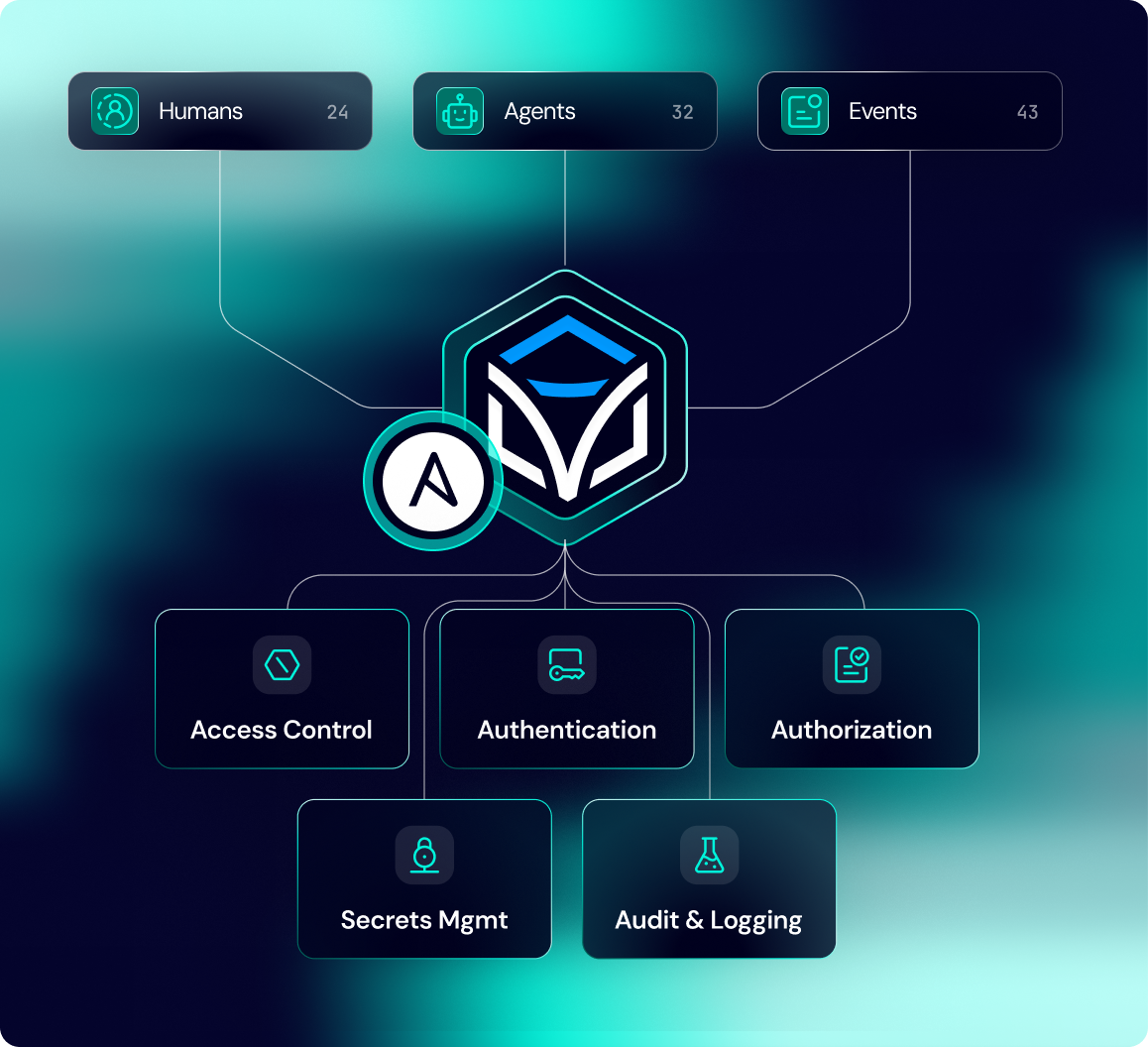
Itential connects to Ansible natively, turning every playbook in your Git repository into a governed, callable infrastructure service. FlowAgents, workflows, and CI/CD pipelines invoke playbooks with RBAC enforced, secrets injected at runtime, and a full audit trail captured automatically, all without modifying a single line of YAML.

Leverage Existing Ansible

Connect Your Ansible Investment to a Governed Orchestration Platform

Itential extends your existing Ansible investment with the orchestration, governance, and AI integration AAP doesn’t provide natively. Every playbook becomes a governed REST endpoint, callable by any team, any workflow, any agent.

Git-Native Onboarding

Every committed playbook syncs automatically. Always runs the latest committed version with no manual deploy steps.

Governed Execution

RBAC, secrets injection, ephemeral execution environments, and a full audit trail on every playbook run.

AI-Ready Invocation

FlowAgents call playbooks as governed tools. External LLMs invoke them via the Itential MCP Server, schema-validated and RBAC-enforced.

Spec-Driven Development

Generate Ansible Playbooks From Plain Language

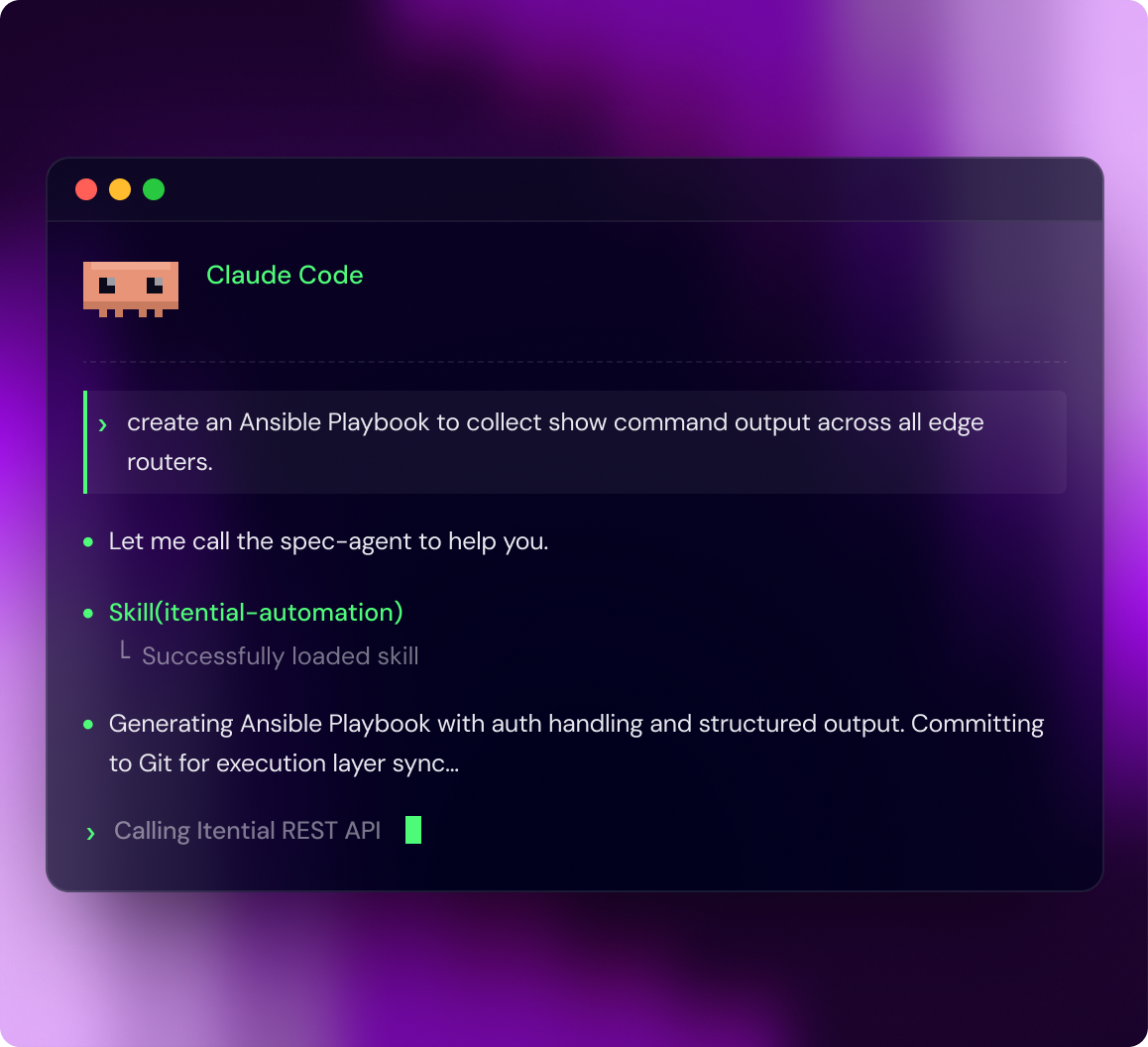
Describe the Ansible playbook you need and Spec-Driven Development generates it via the platform’s REST APIs, commits it to your Git repository, and the execution layer syncs it automatically. New Ansible automations built, governed, and callable from the first run, without writing a line of YAML.

Plain-Language Input

Describe what the playbook should do. SDD handles the YAML.

Auto-Commit to Git

The LLM generates the artifact and commits it to your specified repository automatically.

Governed From Run One

The execution layer syncs the new playbook, RBAC enforced, callable by FlowAgents and workflows immediately.

How It Works

How the Itential + Ansible Integration Works

Connect your GitHub or GitLab repository and every committed Ansible playbook syncs automatically to the Itential Platform. Governance wraps every execution: RBAC, secrets injection, ephemeral execution environments, pre/post validation, and a full audit trail, with no changes to how your team writes Ansible.

Onboard Every Existing Playbook Without Modification

Connect your Git repository and every committed Ansible module, playbook, role, and collection syncs automatically. Apply a JSON schema decorator to expose any playbook as a governed REST API endpoint callable by workflows, FlowAgents, and CI/CD pipelines. Engineers keep writing Ansible in their IDE. Governance wraps automatically.

Invoke Ansible From FlowAgents & External AI Systems

Every decorated Ansible playbook is automatically registered as a callable tool in the FlowAgent tool library. FlowAgents invoke playbooks with structured inputs, the platform creates an ephemeral execution environment, runs the playbook with injected secrets, and returns the output as structured data to the agent’s reasoning loop. External LLMs invoke the same playbooks via the Itential MCP Server, schema-validated and RBAC-enforced before anything executes.

Orchestrate Ansible Across Multi-Domain Infrastructure Changes

Ansible playbooks become governed steps inside multi-domain Itential workflows. A single workflow can run an Ansible playbook for network device configuration, call a cloud API for infrastructure provisioning, update a ServiceNow ticket, and validate the outcome, all in one governed execution path with pre/post validation and automatic rollback on failure.

Generate Ansible Playbooks From Plain Language With SDD

Describe the Ansible playbook you need and Spec-Driven Development generates it via the platform’s REST APIs, commits it to your Git repository, and the execution layer syncs it automatically. New Ansible automations built, governed, and callable from the first run, without writing a line of YAML.

Joint Benefits

Itential + Ansible Features

Git-Native Ansible Integration

Connect to GitHub, GitLab, or Bitbucket and every committed Ansible module, playbook, role, and collection syncs automatically, always running the latest committed version with no manual deploy steps.

Governed Ansible Execution

Every Ansible playbook runs through Itential’s policy engine with RBAC enforced, secrets injected at runtime, ephemeral execution environments, and a full audit trail generated automatically on every execution.

FlowAgent & MCP Invocation

FlowAgents invoke Ansible playbooks as governed tools from their allowlisted skill library. External LLMs invoke the same playbooks via the Itential MCP Server, schema-validated and RBAC-enforced before anything runs.

SDD Playbook Generation

Spec-Driven Development generates Ansible playbooks from plain language descriptions, commits them to Git, and syncs them to the execution layer automatically. New automations governed and callable from run one.

About Itential

Agentic Operations for Infrastructure, Governed at Every Step

Itential is the agentic infrastructure operations platform, connecting AI reasoning to deterministic execution across network, cloud, and IT systems. For Ansible-powered teams, Itential is the governance and orchestration layer that wraps every playbook, making it a callable service for FlowAgents, workflows, and CI/CD pipelines through a single policy-governed engine. Every action validated. Every change attributed. Human approval enforced wherever you define it.

Git-Native Playbook Onboarding
Connect GitHub, GitLab, or Bitbucket and every committed Ansible module, playbook, role, and collection syncs automatically, with no rewrites and no manual deploys.

FlowAgent & MCP Invocation
Every decorated Ansible playbook is registered as a governed tool callable by FlowAgents or external LLMs via the Itential MCP Server, schema-validated and RBAC-enforced before anything runs.

Multi-Domain, Multi-Tool Orchestration
Coordinate Ansible alongside network devices, AWS, Azure, and ServiceNow, natively running Python, Terraform, and OpenTofu without rework.

About Ansible

The Automation Standard for Infrastructure Configuration

Ansible is the open-source automation framework that has become the standard for configuration management and task execution across network, server, and cloud infrastructure. Playbooks, roles, and collections give engineers a declarative, agentless way to manage targets at scale. Ansible Automation Platform extends that foundation with enterprise execution, content management, and analytics. Itential connects to Ansible natively, wrapping every playbook in a governed execution layer without modifying a single line of YAML.

Declarative, Agentless Task Execution
Ansible’s playbook model gives teams a proven, vendor-agnostic way to configure network devices, servers, and cloud resources at scale.

Massive Community & Content Library
Years of community-built modules, roles, and collections cover virtually every major infrastructure target, giving Itential workflows and FlowAgents a deep, reusable automation library.

Open Architecture
Ansible runs anywhere, locally, in AAP, or as a step inside an Itential workflow, making every playbook available as a governed, callable service for FlowAgents, pipelines, and any team that needs it.


Keep Learning

Go Deeper on Itential + Ansible

Frequently Asked Questions

+

No, and that is the point. Ansible and AAP are excellent at what they were built for: executing configuration tasks against infrastructure targets. Itential is the orchestration layer that makes every Ansible playbook a governed, callable service and coordinates those playbooks across multi-domain workflows that span network devices, cloud APIs, ITSM systems, and source-of-truth updates. Your existing Ansible investments onboard without modification. Engineers keep writing Ansible. Itential handles how those playbooks get governed, exposed, and orchestrated.

+

AAP runs playbooks against host inventories. It does not coordinate across domains, enforce pre/post validation on infrastructure state across multi-step changes, manage service lifecycle state, provide HITL approval gates above configured thresholds, or give AI agents a governed execution layer to call playbooks as tools. A Major US Financial Services company put it this way: they had reached a point where they were running too many playbooks manually and could not scale. Itential is the orchestration and governance layer that AAP does not provide natively. The two work together, not in competition.

+

Every Ansible playbook decorated with a JSON schema is automatically registered as a callable tool in the FlowAgent tool library. When a FlowAgent reasons through a goal that requires running an Ansible playbook, it calls it with structured inputs from its allowlisted skill set. The platform creates an ephemeral execution environment with the correct Python version and Ansible collection dependencies, runs the playbook with secrets injected at runtime, captures the output, and returns it as structured data to the agent’s reasoning loop. The agent never touches the playbook directly. The execution layer controls what runs.

+

Every Ansible automation capability in the platform is exposed as a documented REST API endpoint. The Itential MCP Server exposes those APIs as callable skills for any connected LLM. Describe the playbook you need, its purpose, the devices it targets, the inputs it requires, and the expected output, and the LLM calls the platform’s REST APIs to generate the Ansible playbook artifact. The playbook commits to your specified Git repository automatically. The execution layer syncs it immediately. The output is a real Ansible playbook, identical in every technical respect to one built manually, governed and callable from the first run.

+

Secrets, device credentials, API keys, and vault tokens are never stored in playbook files or passed as plain text inputs. The platform integrates with HashiCorp Vault, CyberArk, AWS Secrets Manager, and platform-native secrets storage, injecting the correct credentials at runtime for every execution. At execution time, the platform retrieves the secret, injects it into the ephemeral execution environment, and the playbook accesses it as an Ansible vault variable. Secrets are never exposed in execution logs, never visible in Job Viewer outputs, and never accessible beyond the scope of the execution that required them.

+

Itential orchestrates above AAP. Existing Ansible playbooks running in AAP can be called as governed steps inside Itential workflows without modification. Itential adds the layer AAP does not provide natively: pre/post validation across multi-step changes, HITL approval gates, blast-radius controls, multi-domain coordination spanning network, cloud, and ITSM systems, and a governed execution layer for FlowAgents to invoke AAP playbooks as tools. AAP handles Ansible execution. Itential handles the end-to-end governed operation that depends on that execution.

Get Started

Turn Every Ansible Playbook Into a Governed, Callable Service

See how the Itential Platform wraps every Ansible playbook in a governed execution layer so FlowAgents, workflows, and pipelines can invoke them safely, at scale, with a full audit trail on every execution.

Request a Demo