Itential logo
Governed Change Management

Every Infrastructure Change Governed, Validated & Auditable by Default

Every infrastructure change is a risk event. Change windows overrun. Rollbacks fail. Auditors ask questions nobody can answer. Itential wraps every infrastructure change – human or AI-initiated – in pre/post validation, approval gates, blast-radius controls, and an immutable audit trail. Compliance validated before activation. Evidence generated automatically. Rollback always available.

Pre/Post Validation Is Manual & Inconsistent

Engineers run pre-checks manually, copy-paste outputs into tickets, and hope post-checks happen before the change window closes. When they don’t, nobody finds out until production breaks.

Rollback Is an Afterthought

Most change processes assume success. When a change fails mid-execution across multiple devices, recovery is manual, slow, and incomplete, leaving infrastructure in an unknown state.

Audit Evidence Is Assembled After the Fact

When auditors arrive, teams spend weeks pulling logs, tickets, and screenshots to reconstruct what changed, when, who approved it, and what the outcome was. The evidence was never captured systematically.

FlowAgent Actions Have No Governed Execution Path

FlowAgents can reason and recommend, but without governed execution, every FlowAgent-initiated action is a direct, ungoverned change to production infrastructure. No approval gates. No audit trail. No rollback.

Current Challenges

Manual Change Processes Create Risk, Rework, & Audit Exposure at Scale

Most infrastructure teams are executing changes the same way they did a decade ago, manually, across multiple systems, with governance as an afterthought. As infrastructure grows more complex and AI enters operations, the gap between how changes are executed and how they should be governed is widening. Every manual step is a failure point. Every ungoverned FlowAgent action is a liability.

The Execution Layer Every Change Needs – Human or AI

Governance isn’t a process you add after automation is built. It’s the execution layer every change runs through – whether a human submitted a ticket, an AI agent reasoned through a goal, or a monitoring alert triggered remediation. Itential makes governance the default, not the exception.

The Execution Model Shift

Change Management as Process vs. Change Management as Execution

Most enterprises run change management as a ticketing process: approvals in ServiceNow, execution by engineers, evidence assembled after the fact. Itential makes governance the execution itself. Every change, human or FlowAgent initiated, runs through the same policy-enforced engine. Here’s what changes.

icon of a clock face
Change Management as Process
Change Management as Execution
Pre and post checks run manually, inconsistently, sometimes skipped
Pre and post validation runs automatically on every change, every time
Engineers copy-paste outputs into tickets to prove the change worked
Immutable audit evidence generated as a byproduct of execution
Rollback is a runbook, manual recovery, often incomplete
State captured before execution, automatic rollback on any failure
Audit prep takes weeks of pulling logs and screenshots
Audit prep is a report pull, evidence is always current
Change windows overrun, then become incidents
Parallel execution compresses change windows by 80%
Agents and AI actions bypass change controls entirely
Every FlowAgent action runs through the same governed engine as human changes
icon of a clock face
Change Management as Process
Change Management as Execution
Pre and post checks run manually, inconsistently, sometimes skipped
Pre and post validation runs automatically on every change, every time
Engineers copy-paste outputs into tickets to prove the change worked
Immutable audit evidence generated as a byproduct of execution
Rollback is a runbook, manual recovery, often incomplete
State captured before execution, automatic rollback on any failure
Audit prep takes weeks of pulling logs and screenshots
Audit prep is a report pull, evidence is always current
Change windows overrun, then become incidents
Parallel execution compresses change windows by 80%
Agents and AI actions bypass change controls entirely
Every FlowAgent action runs through the same governed engine as human changes
The Change Model

Every Change Runs the Same Way

Standardized change isn’t a process to follow, it’s an execution model. Itential runs every infrastructure change through the same three checks: controls enforced before anything runs, validation at every step, and immutable evidence captured automatically. Same checks whether the change was triggered by a human, a ticket, a monitoring alert, or a FlowAgent. Consistency is the control. Scale becomes safe.

Check 1: Controls Enforced Before Execution

Every Change Passes Through the Same Set of Controls

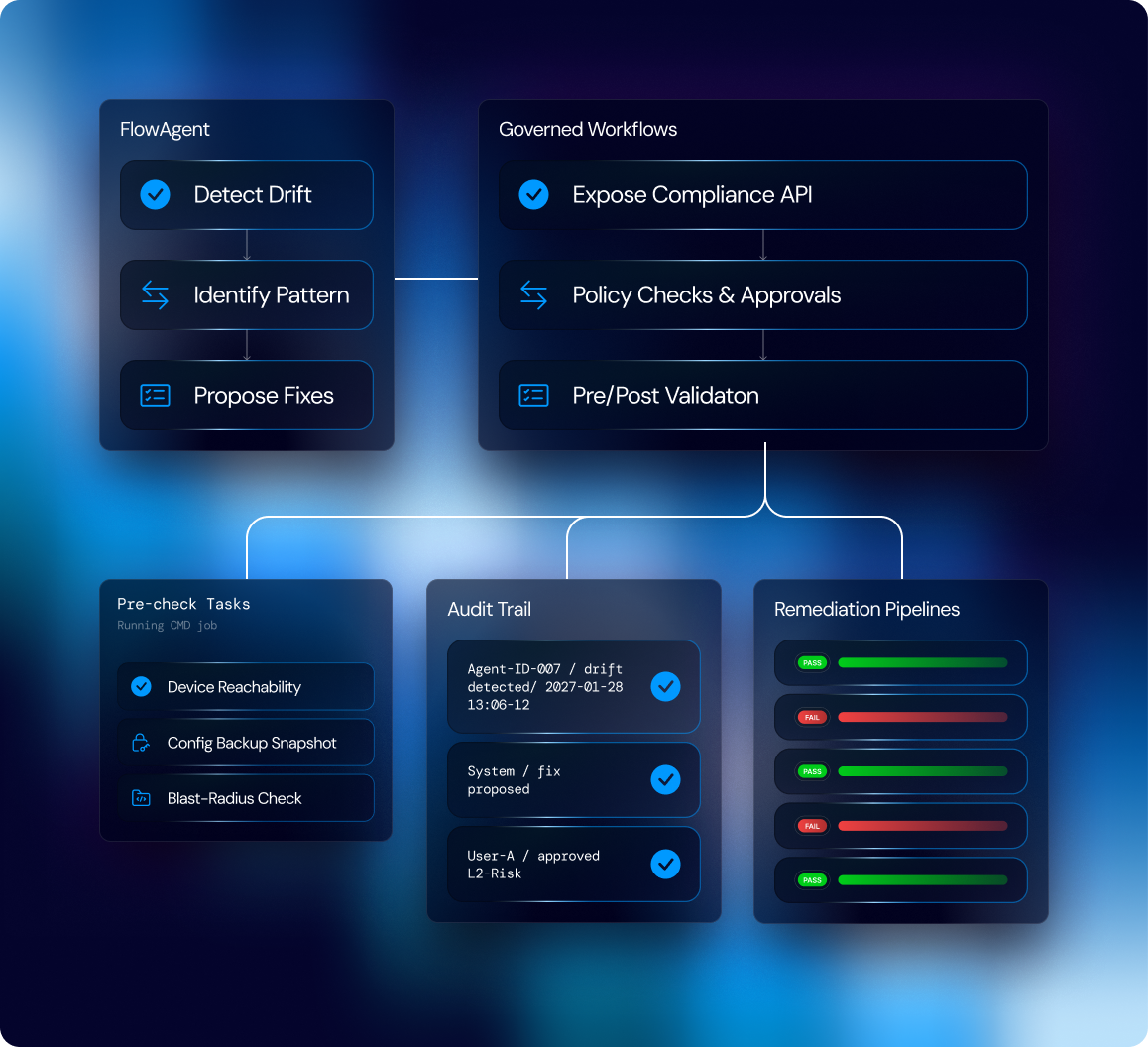
Before a single command touches infrastructure, every change runs through the same set of controls. RBAC controls who can trigger what. Risk-tiered approval gates apply based on blast radius, change window, and operation type. Golden config standards check for drift continuously. Same controls, every change, every trigger, every team.

simple icon of a checkmark
One Approval Model, Every Change

RBAC and risk-tiered approval gates apply to every change, every trigger, every team. The CAB doesn’t approve some changes and skip others. Same model whether the change came from an engineer, ServiceNow, or a FlowAgent.

Blast Radius Defined, Not Discovered

Every change declares its maximum impact before it runs. Anything exceeding defined boundaries escalates automatically, before execution begins. No more finding out a change touched more than it should have.

Icon with a key inside a shield, symbolizing security and compliance
Compliance Checked Continuously, Not Quarterly

Golden config standards run against every device and service, all the time. Drift detected at the attribute level and remediated through the same workflow that made the original change. Compliance posture is always current.

Check 2: Validation at Every Step

Every Change Enters & Exits With Evidence

State is captured before the first step runs. Pre-checks validate conditions before any change is made. Each step is validated as it executes, with post-checks confirming the intended outcome on every affected system. If any step fails, automated rollback returns every system to its pre-change state. No manual recovery. No partial states. No piecing together what happened.

Same Pre-Checks Every Time

Every change validates against live infrastructure state before any command runs. Conditions that would cause failure are caught before the first step, not after the change window closes.

Same Post-Checks Every Time

Outcomes confirmed after every step against the intended end state. Discrepancies stop execution before the next step proceeds. No more “we’ll check tomorrow when ops is back.”

Same Rollback Path Every Time

State captured before execution begins. Any failure triggers automatic rollback across every affected system, instantly. No runbook to find. No tribal knowledge required. No partial states.

Check 3: Evidence Captured Automatically

Audit Prep Becomes a Report Pull

Every change execution produces a complete, immutable audit record as a byproduct of normal operations. Who triggered it, what approved it, what executed, what changed, and the before and after state of every system touched. Always current. Always exportable. Always tied to the specific execution that made the change. The work of producing evidence disappears because the evidence is the execution.

Same Record Captured for Every Change

Actor, trigger, timestamp, approval chain, execution path, before and after state. Every change produces the same record structure. Tamper-proof and always exportable.

Same Evidence Available to Every Auditor

No more pulling tickets, logs, screenshots, and engineer memories together. Every change is its own complete audit record, generated as a byproduct of execution.

Same Trail Regardless of Trigger

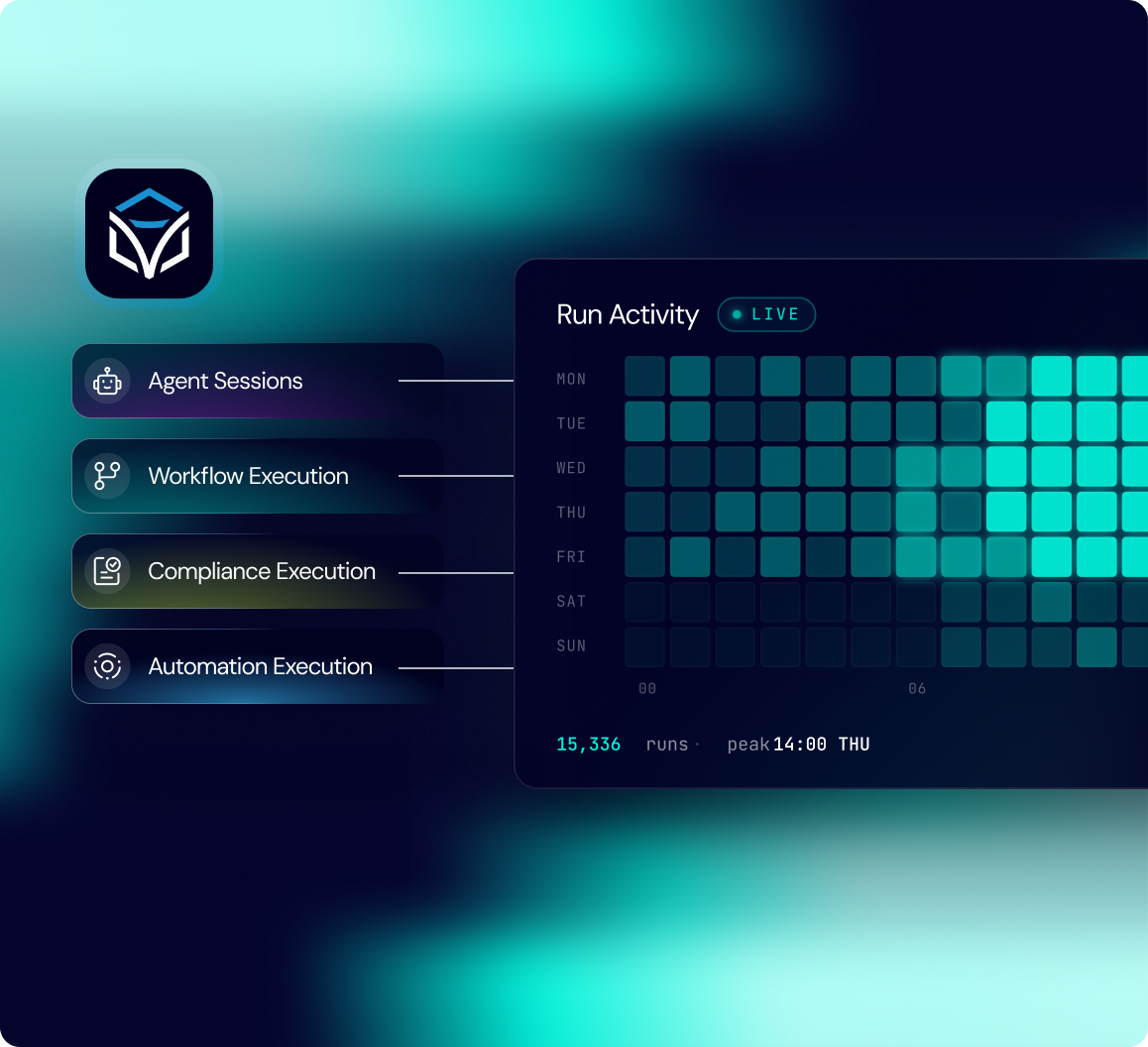
Human change, ticket-initiated change, monitoring alert remediation, scheduled compliance run, FlowAgent action. Every trigger produces the same evidence trail. No separate AI execution path. No gaps in the record.

Users now get faster service delivery because Itential automates the entire process. What used to take days now takes minutes, and that’s a massive improvement for us.
Eric Anderson
Senior Infrastructure Architect, Armstrong World Industries
Success in the Numbers

Measure What Governed Change Management Delivers

Governed change management shifts success metrics from how fast changes execute to how reliably they complete with full audit coverage, zero manual recovery, and compliance that is always current.

85%
Reduction in Change-Related Incidents
Pre/post validation catches misconfigurations before production and confirms outcomes after every step.
90%
Fewer Manual Change Steps
Automated validation, parallel execution, and rollback eliminate the manual coordination that slows every change window.
100%
Audit Coverage on Every Execution
Every change produces an immutable record, actor, approval, execution path, before and after state, generated automatically.
6
Hrs to Mins for Software Upgrade Cycle Time
Southern California Edison compressed upgrade cycles from 6 hours to under 20 minutes with governed parallel execution.
Zero
Direct Infrastructure Access for FlowAgents
Every FlowAgent-initiated action flows through the same governed execution engine, no separate AI path, no ungoverned changes.
Make Every Change a Governed Change
Not vanity metrics. The difference between infrastructure auditors trust and change windows that don’t become incidents.
Learn More from Our Customers
Get Started

Make Every Infrastructure Change a Governed Change

See how Itential gives every infrastructure change, human or FlowAgent-initiated, pre and post validation, approval gates, blast-radius controls, and an immutable audit trail. Compliance validated. Evidence generated. Rollback always available.

Request a Demo
Keep Learning

The Latest in Governed Change Management

Frequently Asked Questions

+

Most teams start with one high-volume, high-risk change type: software upgrades, configuration drift remediation, or ServiceNow-triggered network changes. Wrap it in pre/post validation, blast-radius controls, and immutable audit evidence, prove the model on something that matters, then expand. The point isn’t to govern every change on day one. It’s to prove the standardized execution model on a change that’s currently painful and grow from there. Most customers see meaningful results within 30 to 60 days.

+

Most enterprise customers see measurable results from the first standardized change type within 30 to 60 days, fewer change-related incidents, faster execution, eliminated manual rollback work, or audit evidence generated automatically for a specific change category. Broader impact, full coverage across change types, parallel execution at scale, FlowAgent governance, compounds over the next 6 to 12 months as standardized execution takes hold.

+

No. Itential makes your CAB more effective. The CAB still defines what changes need approval, what risk tiers apply, and what windows are acceptable. Itential enforces those decisions at execution time, automatically. The CAB doesn’t have to manually verify pre-checks, rollback plans, or audit evidence on every change, that’s now a byproduct of how the platform executes. CABs move from reviewing tickets to reviewing patterns.

+

ServiceNow manages the process, tickets, approvals, and workflow. Itential governs the execution, what actually happens on infrastructure when the ticket is approved. ServiceNow handles the “what and why.” Itential handles the “how”, pre/post validation, blast-radius controls, rollback, and immutable audit evidence generated at every step. They work together: ServiceNow triggers Itential, Itential executes and closes the ticket with full evidence attached.

+

Itential captures infrastructure state before the first step of any change runs. If any step fails, automated rollback triggers immediately, returning every affected system to its pre-change state across every device, domain, and system touched. No manual recovery. No partial states. The complete execution history, what ran, what failed, what rolled back, and why, is always available without log analysis.

+

Every FlowAgent action flows through the same governed execution engine as everything else. FlowAgents never touch infrastructure directly. RBAC controls what each FlowAgent can access. Approval gates apply at defined thresholds, human-in-the-loop for high-risk actions, human-on-the-loop for routine operations. Every action is logged, auditable, and reversible. No separate AI execution path regardless of who or what initiated the change.

+

Audit evidence is generated as a byproduct of normal execution, not as a separate process. Every change produces an immutable record: who triggered it, what approved it, what workflow executed, what changed on each system, and the before and after configuration state. The evidence is always current, always exportable, and always tied to the specific execution that made the change. Audit prep becomes a report pull.

+

Yes. Itential governs changes across CLI-managed network devices, API-managed cloud services, SD-WAN controllers, OT systems, and any system with a programmatic interface in a single governed execution. The same validation, approval gates, audit trail, and rollback capability applies regardless of system type. One change window. One governance model. Every domain covered.