How Itential FlowAI brings together hybrid reasoning, orchestration, and safe infrastructure execution for AI-powered infrastructure operations.
Enterprises are accelerating AI adoption but quickly discover that no single vendor or model can meet all operational needs. The result is an unavoidable hybrid approach that blends vendor provided reasoning agents with internally built infrastructure aware agents.

Making this work safely requires a clear separation between agent reasoning and infrastructure execution.
Itential FlowAI delivers that separation through two complementary applications. FlowAgent Builder provides the intelligence layer where agents reason, plan, and orchestrate, while FlowMCP provides access to infrastructure actions using MCP with strict validation, auditability, and control. Together, they form a unified model that lets enterprises scale AI across their operational environment without compromising safety, visibility, or trust.
However, this hybrid model introduces a shared requirement across all customers: the ability to safely attach internal infrastructure to both vendor agents and their own agents without compromising control, observability, or security.
This document outlines a comprehensive strategy built on Itential FlowAI technology, leveraging two complementary frameworks that enable enterprises to adopt AI safely, predictably, and
This paper explains how enterprises can safely adopt AI for real infrastructure operations by combining agentic reasoning with deterministic, governed execution.at scale.
Regardless of industry, size, or technical maturity, customers converge on the same realization when exploring AI‑driven automation:
Enterprises are responsible for production systems worth millions or billions of dollars. They cannot risk unbounded actions from autonomous systems, nor can they accept opaque execution models. This leads to several non‑negotiable requirements:
To satisfy these demands, AI execution must be separated into two layers:
A deterministic, instrumented, contract‑driven execution layer that all agents – internal or vendor – must use to interact with infrastructure.
A flexible, expressive agent‑definition layer where reasoning, planning, and orchestration logic live. Route for human or automated approval
This separation is the only model that scales safely.
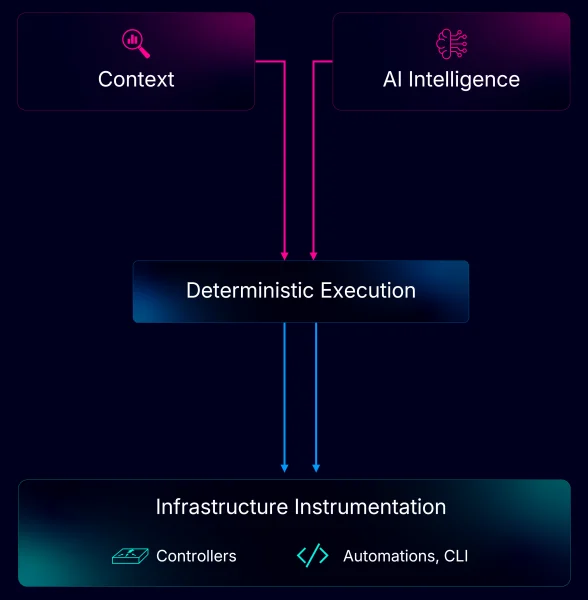
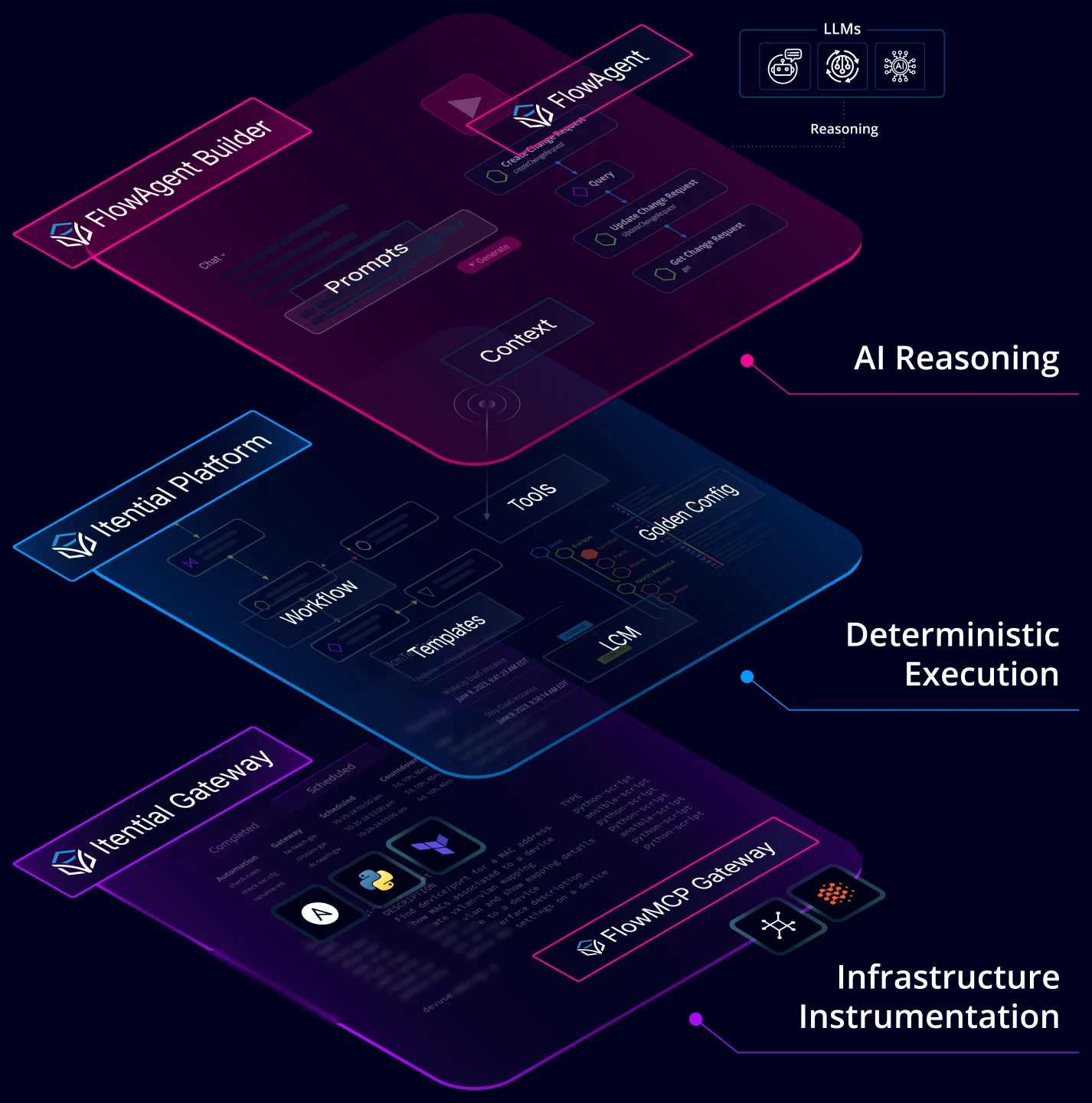
Enterprises exploring AI for operations quickly realize that they need more than intelligent agents. They need a clear operating model that defines how AI should interact with infrastructure in a safe, predictable, and compliant way. This model is built on three layers that describe how reasoning, execution, and instrumentation work together across hybrid environments.
AI ReasoningThis is where agents interpret intent, evaluate operational state, and generate plans. Agents use enterprise context and learned patterns to think through tasks but do not act on infrastructure directly.
This layer takes agent plans and executes them through validated, contract-aligned actions. It applies schemas, permissions, policies, and full auditability to ensure that every operation is safe and consistent across networks, clouds, and APIs.
This provides the operational data, telemetry, controllers, and automation capabilities that expose infrastructure in a controlled and observable way. It gives agents the visibility they need while maintaining strict boundaries around what can be acted upon.
Together, these layers form the Infrastructure AI Operating Model. When connected through a closed AI to Action loop, agents reason at the top, execution stays governed in the middle, and infrastructure is safely instrumented at the bottom. This creates the foundation for a trusted approach to AI-driven operations and sets the stage for how FlowAI brings this model to life.
With this operating model established, the next step is understanding how Itential delivers each layer through FlowAI.
Enterprises exploring AI for infrastructure operations face a clear challenge. AI agents are becoming more capable at reasoning, but production infrastructure requires strict guardrails, deterministic behavior, and full auditability. This gap between intelligence and safe execution is exactly why Infrastructure AI must follow a different operating model than traditional IT automation.
FlowAI provides that operating model. Itential unifies agentic reasoning, deterministic execution, and deep infrastructure instrumentation into a cohesive framework that connects AI systems to infrastructure in a secure and governed way.
FlowAI is built on three core components that map directly to how AI-driven operations must function inside hybrid network and cloud environments.
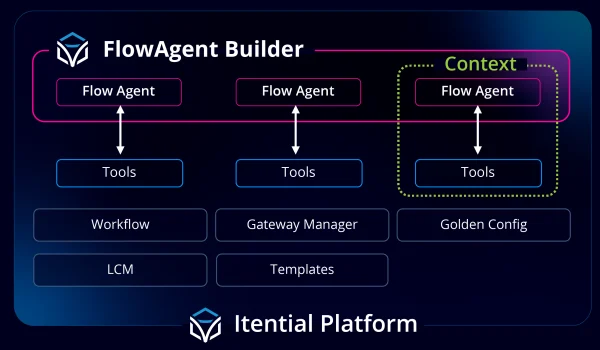
FlowAgents represent the new reasoning layer for infrastructure. They interpret intent, reason over operational context, and construct goal-oriented plans using natural language and the knowledge already in the Itential Platform. They are persona driven and designed to solve tasks, but they never execute changes directly.
FlowAgent Builder is the environment where these agents are created, customized, and governed. It provides the tools, models, and integrations that allow enterprises to define agent personas, attach LLMs for reasoning, assign tool access, and embed guardrails that shape how agents operate. Agents built with FlowAgent Builder can leverage existing Platform automations, data models, and transformations, giving them deep awareness of network, cloud, and security systems.
Together, FlowAgents and FlowAgent Builder establish the reasoning layer of the FlowAI Framework, enabling enterprises to build powerful, infrastructure aware agents that remain fully governed within the Itential Platform.
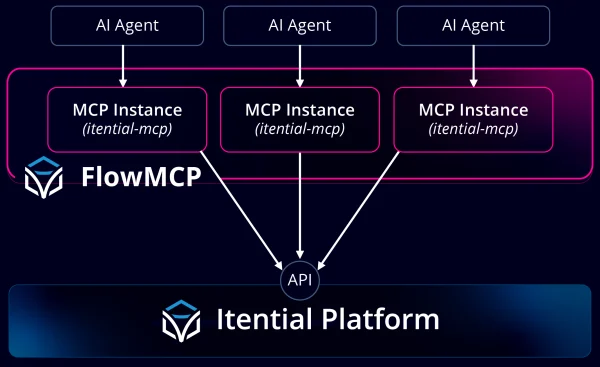
FlowMCP integrates Itential Platform with external agents through the implementation of Model Context Protocol (MCP). It serves as the controlled interface between all external agents and real infrastructure. FlowMCP exposes platform workflows, automations, and integrations as deterministic MCP tools that operate under strict schemas, policies, permissions, and audit rules. This ensures that even when agents reason freely, every action they request is validated, compliant, and predictable. FlowMCP guarantees that no AI system can directly touch production environments without passing through a governed, contract bound execution boundary.
Itential Platform (Deterministic Execution)
The Itential Platform serves as the execution engine of the framework. It provides the workflows, guardrails, RBAC, policies, validation, and transaction level controls required to run infrastructure operations safely. It executes all actions generated by FlowAgents using deterministic logic, structured schemas, and complete audit trails. It is the trusted operational fabric that ensures no AI instruction ever bypasses governance.
FlowMCP Gateway & Instrumentation
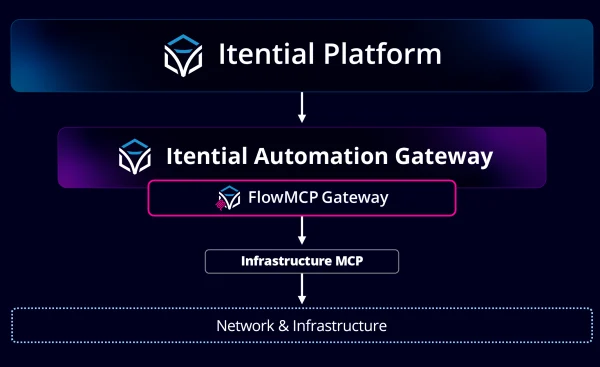
Infrastructure instrumentation is delivered through the Itential Automation Gateway and extended with FlowMCP Gateway, which exposes MCP based tools from both Itential and infrastructure vendors. This vastly expands what agents can reach while keeping all tool access controlled, modeled, and observable. As vendors begin shipping Infrastructure MCPs, the Gateway becomes the standard interface for connecting AI to programmable infrastructure.
Together, these components form the FlowAI Framework. FlowAgents reason and plan, the Itential Platform executes safely, and FlowMCP Gateway provides the instrumented access to systems across network, cloud, and security domains. They are connected through a closed AI to Action loop that ensures AI intelligence is always paired with governed action. This is the foundation for the new operating model of AI infrastructure, and the sections that follow explain each layer in depth.
With the FlowAI Framework introduced, the next step is understanding the platform that provides the secure, governed foundation for both reasoning and execution.
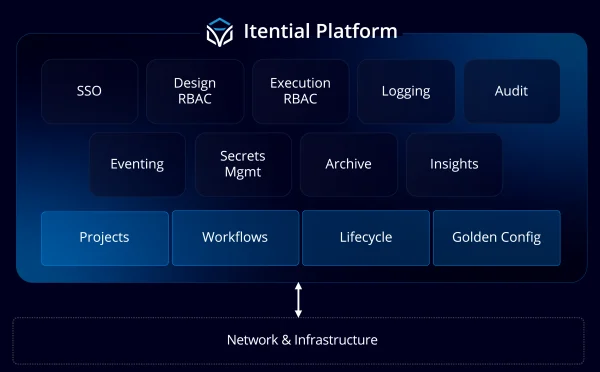
The Itential Platform is the trusted operational fabric that makes FlowAI safe, governed, and enterprise ready. It hosts both the reasoning and execution layers, delivering the orchestration, governance, security, and instrumentation needed to turn AI intent into predictable action across complex hybrid environments. Everything FlowAI does is anchored to the Platform’s mature, battle tested architecture.
The Platform provides a complete set of enterprise-grade capabilities:

Together, these capabilities make the Itential Platform the execution and governance engine of FlowAI. FlowAgents rely on its tools and context to reason. FlowMCP depends on its workflows, policies, and RBAC to execute safely. And FlowMCP Gateway uses its integration fabric to reach infrastructure systems across networks, clouds, and APIs.
The Platform ensures that every agentic workflow, every MCP call, and every automated action operates inside a secure, observable, and compliant architecture. This is why all reasoning and all execution within FlowAI is rooted in the Itential Platform
FlowAgent Builder is the enterprise framework for building platform-native agents directly on top of the Itential Platform. Unlike FlowMCP – which focuses on deterministic, governed execution – FlowAgent Builder is designed to express reasoning, orchestration logic, decision-making, and dynamic operational workflows that run inside the Platform itself.
This framework gives customers the fastest and safest path to defining agents that understand their infrastructure at a deep operational level.

FlowAgent Builder does not execute on FlowMCP. Instead, it leverages:
This makes FlowAgent Builder ideal for building agents that:
FlowAgent Builder represents the “reasoning and orchestration intelligence” layer of the enterprise AI stack – expressive, adaptive, and deeply tied into the Platform’s operational capabilities.
FlowMCP is the deterministic execution backbone of FlowAI. It creates the strict boundary where AI reasoning ends and governed action begins. FlowMCP ensures that all agent-driven operations remain safe, compliant, and predictable regardless of the reasoning model used. FlowMCP provides three critical capabilities that define deterministic execution.

FlowMCP exposes Platform workflows, automations, integrations, and infrastructure capabilities as deterministic MCP tools. Each tool operates under strict contracts that guarantee predictable behavior. Inputs must conform to schemas. Outputs follow known structures. Preconditions and postconditions are enforced. There are no silent retries or undefined behaviors. Even when an agent generates a novel plan, FlowMCP guarantees that only safe, validated actions are executed.
AI-driven operations must never be a black box. FlowMCP provides detailed execution logs, structured metrics for every tool invocation, complete traceability across multi-step operations, and both real-time and historical visibility. Every action is captured for audit and compliance, making the entire AI to action path fully observable.
FlowMCP serves as the universal interface between agents and infrastructure. Regardless of which vendor agent or internal agent generates the plan, FlowMCP controls the execution. It offers a single, secure mechanism for exposing infrastructure safely, a unified model across tools and domains, reduced integration complexity across multi-agent and multi-model ecosystems, and flexibility to change reasoning models without rearchitecting the execution layer. FlowMCP is the backbone that ensures every operation behaves exactly as intended.
Together these capabilities allow enterprises to scale AI-driven operations without compromising safety or governance. FlowMCP turns agent plans into reliable, auditable, and contract-bound actions.
FlowMCP Gateway works alongside FlowMCP to extend deterministic execution to external infrastructure MCP servers. As infrastructure vendors adopt the MCP standard, their capabilities can be consumed as MCP tools. FlowMCP Gateway brings these capabilities into the Platform under full governance.

FlowMCP Gateway performs three key functions:
The Gateway discovers MCP tool definitions from external MCP servers and translates them into Platform governed task definitions. This models inputs, outputs, permissions, and operational constraints.
All external MCP tools inherit Platform level controls, including RBAC, policy enforcement, credential scoping, schema validation, audit logging, and observability. This ensures vendor supplied capabilities adhere to the same deterministic execution guarantees as native tools.
Gateway merges vendor MCP capabilities with Platform native automations to create a single, unified tool catalog. FlowAgents can safely access both internal and external tools without any change to their reasoning behavior.
FlowMCP Gateway expands the operational reach of FlowAI by bringing external MCP ecosystems under the same governance and execution boundary that enterprises trust for their internal automations.
Enterprises often attempt to unify reasoning, orchestration, and execution into a single consolidated framework. On paper, it sounds appealing: one system to think, decide, and act. In practice, it collapses almost immediately under real-world operational pressures. The needs of reasoning and the needs of execution move in opposite directions.
Reasoning requires flexibility, creativity, and the ability to operate under uncertainty. Execution requires rigidity, guarantees, and strict control. Trying to merge the two inevitably forces one side to suffer – either agents become too constrained to be intelligent, or execution becomes too unpredictable to be safe.
FlowMCP is designed to satisfy the needs of enterprise-grade execution. It must:
This layer cannot tolerate ambiguity or improvisation. It operates as the safety buffer between AI models and actual infrastructure.
FlowAgent Builder addresses the opposite challenge: empowering customers to create reasoning agents that run directly on the Itential Platform itself, without relying on FlowMCP. These agents can leverage Platform-native tools for orchestration, transformation, validation, and integrations, making them deeply infrastructure-aware and operationally grounded. They are capable of:
This layer must remain expressive. It must allow agents to iterate on a plan, explore different strategies, and incorporate contextual knowledge that cannot always be bound to deterministic rules.
Enterprises routinely underestimate how fundamentally incompatible the goals of reasoning and execution are. These two domains operate with opposing constraints, and attempting to merge them into a single stack introduces structural risk that cannot be mitigated through policy, validation, or prompt engineering alone.
At a deep architectural level, reasoning thrives on flexibility, while execution demands rigidity. One must be free to explore; the other must be tightly controlled. If you blend these worlds, you corrupt the guarantees each one needs to function.
If an agent with unconstrained reasoning is given direct operational authority:
Even the best prompts, fine‑tuning, or guardrails cannot eliminate this risk. The inherent nature of probabilistic reasoning conflicts with the deterministic needs of production infrastructure.
On the flip side, if execution logic is embedded inside the agent layer:
This defeats the purpose of using AI in the first place. Agents must be able to rethink, re-evaluate, and reformulate plans without being entangled with execution mechanics.
If both functions are collapsed into a single layer, you end up with a system that is simultaneously:
This is the worst of both worlds – an architecture that is high-risk, high-friction, and fundamentally unsuited for enterprise-grade automation.
Splitting reasoning and execution into two purpose-built frameworks – FlowAgent Builder and FlowMCP – does more than solve an architectural problem. It creates a positive feedback loop where each layer reinforces the strengths of the other, making the entire AI ecosystem more stable, more secure, and more adaptable over time.
This separation is not merely a safety measure; it is a strategic advantage. It allows enterprises to evolve AI capabilities without jeopardizing operational integrity and to evolve infrastructure automation without disrupting intelligent agent behavior.
FlowMCP guarantees that every infrastructure action is deterministic, validated, and policy-bound. Because reasoning agents cannot bypass this boundary, safety becomes an inherent property of the system—not something bolted on afterward.
This removes entire classes of risk:
Safety becomes predictable, not aspirational.
Separating the layers allows infrastructure teams to update tools, schemas, credentials, and execution behavior in FlowMCP without touching agent logic. Similarly, AI teams can iterate on reasoning, prompting, or planning strategies in FlowAgent Builder without risking execution pathways.
This dramatically reduces coordination overhead and enables:
The enterprise becomes more capable, not more constrained.
Because FlowAgent Builder includes the FlowMCP Gateway, which allows customers to expand the available toolset by connecting external infrastructure MCP servers into the Itential Automation Gateway. This gives enterprises the freedom to:
FlowMCP ensures execution consistency no matter who the reasoning provider is. This prevents vendor lock-in and future-proofs the AI stack.
FlowMCP centralizes instrumentation and telemetry for all infrastructure actions—regardless of where the agent originated. This means:
With reasoning and execution separated, observability is no longer fragmented across systems.
Reasoning models evolve at a blistering pace; execution frameworks evolve slowly and deliberately. By decoupling the two:
This protects long-term investments while enabling rapid evolution.
As systems mature:
This creates a flywheel where each layer compounds the value of the other. With both layers defined, the next step is understanding how they operate as a complete system inside a real enterprise environment.

By this point, the architectural separation between reasoning (FlowAgent Builder) and execution (FlowMCP) has been well established. But the true value emerges when you look at how enterprises actually operate day-to-day with AI systems. The real world is messy. Multiple vendors, multiple models, legacy systems, inconsistent APIs, distributed teams, and stringent compliance pressures all converge in one place: the customer’s operational environment.
This hybrid model provides a clear, scalable path for integrating AI into that environment without compromising safety or slowing innovation.
Enterprises will continue to adopt best-in-class agentic experiences from multiple vendors. These agents excel at:
But these vendor-provided agents lack the deep infrastructure context or guardrails necessary to safely interact with operational systems. They need an execution boundary. This is where FlowMCP steps in.
Vendor agents – no matter how powerful – must remain reasoning-tier systems, not execution-tier systems.
In parallel, enterprises build their own agents using FlowAgent Builder. These agents are:
They become the enterprise’s operational AI workforce – agents that understand not just what needs to be done but how to execute safely within the constraints of real environments.
FlowAgent Builder empowers teams to encapsulate operational expertise into reusable agent behaviors, giving enterprises a durable competitive advantage.
FlowMCP sits between reasoning and infrastructure, acting as the controlled gateway for all operations:
FlowMCP becomes the single source of truth for infrastructure automation from AI, even in a multi-agent, multi-vendor ecosystem.
This ensures that no matter which agent initiates the plan, the execution remains safe, observable, and fully governed.
Because all execution flows through FlowMCP, governance becomes dramatically simpler:
This eliminates the fragmentation that happens when each vendor agent attempts to define its own execution logic and observability model.
When all components come together, the enterprise gains:
Human → Vendor Agent → Internal Agent → FlowMCP → Infrastructure
A clean, layered pipeline where:
This layered flow lets enterprises scale AI adoption confidently rather than cautiously.
By embracing this architecture, enterprises position themselves to handle:
The hybrid model avoids lock-in, supports continuous improvement, and ensures that both agentic reasoning and real infrastructure operations evolve at their natural pace.
Enterprises adopting AI must embrace a hybrid operating model if they want both innovation and stability. But adopting a hybrid model without a unifying architectural foundation leads to fragmentation, inconsistent governance, and operational risk. The Itential FlowAI Framework solves this by bringing together two purpose-built, tightly integrated components:
The deterministic, governed, instrumented execution backbone that exposes Itential Platform capabilities and external MCP-based infrastructure as safe, validated tools.
The platform-native agent framework that enables enterprises to define powerful, infrastructure-aware agents capable of reasoning, orchestration, and operational decision-making.
Together, these components form a singular, cohesive framework that allows enterprises to:
The Itential FlowAI Framework gives enterprises the confidence to accelerate AI adoption without compromising trust, control, or operational integrity. It establishes a durable architectural foundation where AI reasoning, orchestration, and deterministic execution reinforce each other – unlocking a scalable, secure, future-proof model for enterprise automation.
This architecture gives enterprises confidence to adopt AI at scale while keeping every action safe, visible, and governed.
Enterprises want to use AI to plan and coordinate changes, but they cannot allow models to act directly on production systems. FlowAI gives organizations a safe way to connect AI intent to real infrastructure by separating agent reasoning from governed execution. This removes the operational risk that comes from letting models improvise actions on live networks or cloud environments.
FlowAI is Itential’s agentic orchestration framework that allows enterprises to safely use AI planning and reasoning in real infrastructure operations. It separates agent intelligence from infrastructure execution so agents can interpret intent, evaluate state, and build plans while all actions run through a governed, deterministic layer (the Itential Platform). This gives organizations a trusted way to bring AI into network and cloud operations without exposing critical systems to unpredictable agent behavior.
FlowAgents are infrastructure aware agents built on the Itential Platform that can reason over operational data, evaluate system state, and construct multi step plans. They do not execute actions directly. Instead, they orchestrate workflows and hand all changes to a governed execution layer that enforces schemas, policies, and permissions.
FlowAgent Builder is the platform native framework for creating, customizing, and managing FlowAgents. It gives enterprises tools, data models, and integrations that allow agents to understand networks, clouds, security systems, and enterprise workflows. It is designed for advanced reasoning, orchestration, and policy aware decision making.
FlowMCP is the deterministic execution layer that all agents must use when making changes to infrastructure. It applies strict input validation, enforces RBAC and policy rules, executes actions in a controlled way, and produces complete logs and audit trails. It ensures that even if an agent reasons creatively, all actions remain predictable and safe.
FlowMCP blocks malformed inputs, unauthorized requests, policy violations, and any action that falls outside approved boundaries. It acts as a safety boundary so no agent, model, or external system can execute operations without passing through governed controls.
FlowAI forces every agent plan to pass through a deterministic execution layer that validates inputs, checks permissions, enforces policy, and logs every step. Agents can think freely, but actions remain fully controlled. This prevents issues like malformed commands, permission overreach, or unexpected changes from reaching production.
Hybrid environments span clouds, networks, security systems, and APIs. Without governance, an AI generated instruction could impact critical systems or violate compliance rules. FlowAI applies consistent validation, auditability, and control to every action so organizations can safely introduce agentic automation without exposing operational risk.
FlowAgents reason with infrastructure context, operational data, and enterprise workflows. They do not execute actions on their own. All execution is handled by a governed layer that enforces schemas, policies, and RBAC. Generic LLM agents mix reasoning with direct action, which cannot be trusted for high stakes infrastructure changes.
FlowAI isolates reasoning from action. Agents can evaluate state, plan steps, and propose workflows, but every action is executed by FlowMCP, through the Itential Platform, which enforces structured inputs, validations, and full logging. Even if an agent produces an unexpected plan, the execution layer will only run safe, contract bound operations.
A FlowAgent may receive intent to prepare for an application rollout. It reviews current state, checks policies, and builds a multi-step plan. It then hands that plan to FlowMCP, which validates each operation, applies RBAC and policy checks, and logs everything. The agent provides intelligence and planning, while FlowMCP guarantees safe, predictable execution.
FlowMCP Gateway, a component of the Itential Automation Gateway (IAG), connects Itential Platform native FlowAgents with external MCP based infrastructure. This allows agents to access a larger catalog of deterministic tools that span networks, clouds, APIs, and third-party systems while maintaining the same safety and governance controls.
Enterprises rely on many vendors and domains. Gateway lets FlowAgents orchestrate across all of them without breaking the separation of reasoning and execution. It expands reach while keeping every action validated and secure.
The AI to Action loop is the path from intent to agent reasoning to safe execution. FlowAI keeps this loop closed so that no AI system can directly issue commands to infrastructure. Agents generate plans, but FlowMCP controls all execution. This prevents risks like hallucinated commands, permission overreach, and unapproved changes.
See how Itential connects AI reasoning to governed execution across your entire infrastructure.