Peter Sprygada • 00:02
This is the 4th wow. It’s hard to believe this is Autocon 4. You know, I made I made this comment on LinkedIn the other day that I feel like Autocon Zero was like last week. It’s just amazing. But uh looking out at this room, it’s really an impressive thing to see. But that’s not what I’m here to talk about. I am here to talk about everybody’s favorite tech or everyone’s favorite topic, AI.
Peter Sprygada • 00:24
Yay. So, you know, I talked at Autocon 3 when we launched our MCP server. You know, I talked about you know my personal journey with AI, and I talked about how, you know, I’m I’m a network engineer, right? And and I always that person was like, AI is never touching my network and never touching my infrastructure. And I’m sure that there are those here today that still have that feeling. But I do believe there is a place for AI. I’m gonna talk a little bit about how we can actually leverage AI and what an operating model might look like with um AI for how we manage network and infrastructure.
Peter Sprygada • 00:58
But to start an AI conversation, let’s start here. And you know, Dinesh made a comment and I took it to heart in his presentation about, you know, we’re all network engineers at the end of the day. And we all have to lean on those skills. And one of the things that we recognize as network engineers is that we’ve got a lot of tools at our disposal. Right? And these can be protocol constructs, these can be scripts, this can be software, this can be whatever they are. We have tons of tools at our disposal.
Peter Sprygada • 01:29
And it’s always important for us never forget to use the right tool for the right job. Right? AI, while it is a disruptive technology, it’s revolutionary technology, at the end of the day, it’s still just a tool. And it’s, I have to check myself very often to make sure I don’t get caught up in the AI hype. Right? That AI doesn’t solve everything for us. As a matter of fact, I’d assert that there’s a lot of infrastructure that will never be AI enabled for a lot of good reasons.
Peter Sprygada • 02:00
But if we start to treat it like a tool and we start to think about it in these terms, we can start to see an operating model start to evolve, and we can start to see how we can start to leverage it in infrastructure.
Peter Sprygada • 02:52
Next, we have to be able to govern, and we have to be able to account for what AI may be doing in our infrastructure. We really have to make sure that we’re thinking through governance, accountability, and traceability of how AI may or may not be working with our infrastructure. And we have to recognize that the stuff we work with every single day is not gonna have native AI interfaces.
Peter Sprygada • 03:41
So we put all that together, we start to see this operating model that starts to evolve. And it really starts at the bottom layer or the instrumentation layer. This is what we’ve been doing all along.
Peter Sprygada • 04:10
Whether it’s scripts or playbooks or CLI commands, whatever it is, we need to continue to see that layer evolve. The next layer that we want to talk about is that deterministic execution layer. And this is what orchestration is all about — building a layer that can do things the same way every single time.
Peter Sprygada • 04:45
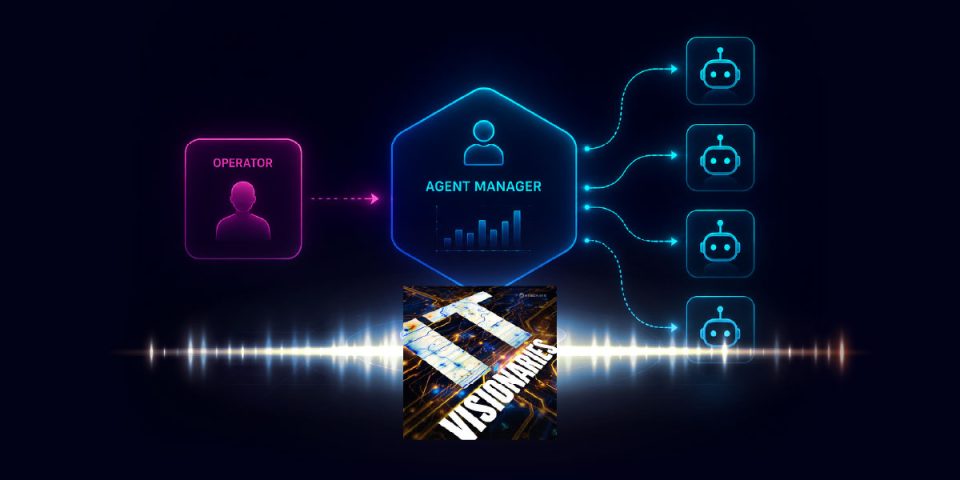
But now we can add the 3rd layer to it, the AI reasoning layer, where I can take context and marry it with AI reasoning and LLMs, put those together, and now I can start to reason through what I may want to do to change my infrastructure. Our goal is to get to what I believe is the future of agentic operations — autonomous network operation.
Peter Sprygada • 05:31
We’d build a script or a playbook, generate a config, and what would I do? I would visually check that and make sure it was right before pushing to the box. We didn’t call that at the time, but that’s human in the loop. We’ll see the same thing happen with AI — that’s how we can start to leverage AI to do infrastructure operations. Then we transition to human on the loop.
Peter Sprygada • 05:56
Where we’re starting to let AI actually make changes to our infrastructure through this operating model, but we are just monitoring the changes. With the ultimate goal: let’s just get the humans out of the loop. None of us want to be in this loop. That’s what we’re building.
Peter Sprygada • 06:22
Why? Because we built it to be safe, auditable, traceable in this new operating model. As we start to think about how we introduce AI and leverage these different layers, what do we actually build?
Peter Sprygada • 07:21
When I build workflows, no matter how I build them, whatever my workflow tool of choice is, I want to start thinking about it as doing very discrete things. Let’s bring back that old Unix philosophy of do one thing and do it well. Get rid of these massive workflows that are trying to do everything under the sun. With simplicity comes a lot of power, and that’s how we gain a lot more control back.
Peter Sprygada • 07:49
So I am here, and I’m very excited to announce that today we just introduced a brand new AI-enabled framework that is all designed around this operating model. We call it the FlowAI framework, and it was purposely built from day one to follow this operating model.
Peter Sprygada • 08:29
So the FlowAI framework focuses on the instrumentation layer with MCP gateway functionality so we can plug in MCP servers. We can continue to do deterministic layer work, leveraging MCP tools if we want, but we stay in control at this point. Then we add the reasoning layer through the introduction of FlowAI agent builder with flow agents. And these agents now have the ability to go out and actually change infrastructure, but they do it through this layered model.
Peter Sprygada • 09:13
Okay, so that’s actually what we’ve introduced. We actually have this technology working. Come see me afterwards. Let’s talk about AI in general. Let’s look at what we’ve put together. And by all means, the most important thing I’m gonna tell you here today is keep automation weird.
Peter Sprygada • 09:31
Thank you for your time.











 Agentic Operations Connect AI to infrastructure for trusted, automated actions.
 Infrastructure Modernization Transform legacy networks into modern, AI-ready infrastructure.
 Infrastructure as a Product Deliver network and infrastructure services on demand - self service, governed, & consumed like cloud.
 Hybrid & Multi-Cloud Orchestration Unify hybrid & multi-cloud infrastructure through agentic orchestration.
 Governed Change Management Execute every infrastructure change with pre/post validation, audit evidence, & rollback, human or AI-initiated.