How to prioritize and select the right automation use cases to drive business value.
As networks become more complex, the activities necessary to maintain and manage them have become exponentially more difficult and time-consuming.
Due to the constant pressure put on IT and NetOps teams to ensure their networks meet these growing demands, tasks such as software upgrades, migrations, and provisioning of new network elements in an efficient and compliant manner is critical and network automation is required to accelerate and maintain network operations. While many IT and NetOps teams have started down the road of network automation – and using various combinations of network automation tools – others are still considering their first steps, and the most advanced groups are already reaping the benefits of using agentic AI in network automation.
All groups face the question of which use cases to tackle first to realize the most time savings and productivity enhancements. The key to any successful automation project starts with choosing the right use cases.
Dive into the top automation use cases and how to calculate the expected time savings that automation can deliver.
Before we dive into each use case, it’s important to understand how best to evaluate and prioritize where to start with network automation based on the value use cases would deliver to your organization.
The scope of this eBook presents a simple model to calculate value (improvement x task volume) for each use case with a handful of estimated metrics to start building your business case and understanding the value automation can deliver.
Task Time: The amount of time it takes to execute the specific task.
End-to-End Time: The amount of time it takes to complete the full process of a specific task from ticket creation to ticket closure, such as data gathering, pre-checks, the change itself, post-checks, closing the ticket, and communicating the change via messaging systems.
End-to-End Time Saved =
(Manual End-to-End Duration – Automated End-to-End Duration) x (Devices x Frequency Per Device)
Human Task Time Saved =
(Human Manual Time – Automated Time) x (Device Count x Frequency Per Device)
Total Automation Benefit =
Total Hours of Human Effort Time Saved per Year on Each Task
Easily the most common network activity, regular software upgrades are required to maintain operation of network devices. It is important that this process be efficient, accurate, and repeatable to avoid network vulnerabilities from out-of-date software on devices.
Due to the manual effort required, software upgrades tend to stay in the backlog or only happen once a year. With automation, organizations can automatically discern which devices are vulnerable and upgrade in real-time to increase upgrades by 10X+ so network teams can focus on bigger projects and security teams can sleep better at night.
Automation can deliver time savings and cycle reduction such as:

Device onboarding consists of the configuration and activation of a new device in the network. It requires consistent application of standard configurations to meet the quality goals of most network operators. This is critical for businesses to rapidly extend their networks, provide services to and activate new customers, as well as improve quality of service. Proper management is needed for the application of Day 0 configurations for network connectivity, Day 1 configurations for operational settings, and management of device configuration over time.
Automation replaces manual operational processes, reducing swivel chair and touch points for expedited provisioning and activation times.
Automation can deliver time savings and cycle reduction such as:

NetOps teams are responsible for managing device configurations, including audit and compliance, to avoid and manage configuration drift. Activities also include turn up of network devices, migration of devices, replacement of devices, or auditing and remediation of compliance to a defined standard. Configuration standards and compliance are critical for businesses to ensure accurate representation of networks over time for real-time informed decisions and adhering to security and audit requirements.
Automating network configuration management allows enterprises to easily standardize configurations across their network infrastructure. Successfully implementing Golden Configurations provides a uniform centrally defined way to view and manage configurations and policies, audit them for compliance, and remediate across all different types of devices and domains.
Automation can deliver time savings and cycle reduction such as:

SD-WAN branch management consists of the configuration and activation of connectivity between existing enterprise offices and new locations being brought online. It provides a multi-cloud architecture for businesses to optimize exponential traffic growth, reducing operational costs. How you deploy SD-WAN in Day 0 and 1 has a big effect on how efficient and automatable the management of your SD-WAN network will be in Day 2+.
Enterprises need to look at leveraging automation for multi-domain, multi-vendor systems involved in the entire SD-WAN deployment process. Implementation of fallout feedback loops and expansion of active participation to IT and operations teams will increase rate of change and minimize human errors.
Automation can deliver time savings and cycle reduction such as:

Maintenance and updating of DNS records such as host names, IP address, and zone is essential as business websites rely on multiple servers to manage their services. Out of date, incorrect, or slow manual migrations can cause outages to these desired services. These issues are time consuming and complicated to resolve, involving cross team cooperation and ultimately costing businesses additional overhead costs, and delayed time to market and time to revenue.
By automating pre- and post-checks, you can eliminate manual errors and tie together a holistic, safe guarded operational process.
Automation can deliver time savings and cycle reduction such as:

Load balancer management includes the configuration of load balancing rules, virtual IPs (VIPs), creation of load balancer pools, and the onboarding of new servers or devices. These activities are critical for businesses as they not only enable efficient distribution of incoming network traffic but also ensure the reliability of services that reside on them by quickly responding to failovers.
A consistent strategy for management of load balancing and VIPs customized to evolving network infrastructure will look to meet requirements across all teams involved and reduce inconsistencies and cycle times.
Automation can deliver time savings and cycle reduction such as:

Firewall configuration changes includes the validation, management, and configuration of policy rules across the network. Accurately maintaining and updating organizations’ policies across their network is critical for avoiding network outages and adhering to security and audit requirements.
Automated deployment and validation of firewall configuration ensures changes are executed safely, with limited to no downtime, while reducing the time spent on this activity during a finite number of change windows.
Automation can deliver time savings and cycle reduction such as:

Virtual Private Cloud (VPC) networking encompasses provisioning cloud infrastructure with configuration of the subnets, route tables, internet gateways, ACLs, and security access groups. As businesses continue to expand or migrate towards leveraging cloud infrastructure, private cloud networking provides self-service, customizable controls for application performance, and security policies.
This enables faster deployments, mitigates risks of configuration errors, and provides an audit of changes.
Automation can deliver time savings and cycle reduction such as:

As a result of virtualization, the data center environment has quickly transitioned from static to dynamic. As applications and workloads grow, shrink, and shift based on client demands, the network team must also make changes to the VLAN configuration on their devices to match these changes.
Automation of VLAN changes to the data center network in coordination with workload and application changes significantly reduces the turnaround time to complete a VLAN change, ensuring customers stay satisfied.
Automation can deliver time savings and cycle reduction such as:

Firewall policy management is needed to ensure the continuous monitoring and maintaining of the compliance of policy rules across the network. Complex networks require a significant time investment to manually ensure, monitor, and update policies. Constant change of requirements outpaces the time it takes to discover and remediate out of compliance policies. Accurately maintaining and updating organizations’ policies across their network is critical for avoiding network outages and adhering to security and audit requirements.
Greatly reduce labor efforts and cycle times by implementing automation of firewall policy management. Automating the business systems and policy management tools instills greater trust in accuracy level of rule replacement.
Automation can deliver time savings and cycle reduction such as:

Now let’s put it into practice. Here’s a real-world example of a customer evaluating three uses and the benefit automation can deliver. By calculating the value for each, it’s clear to see where you should start as well as the full benefit automating across all three can bring.
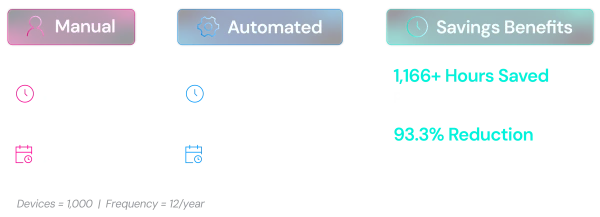
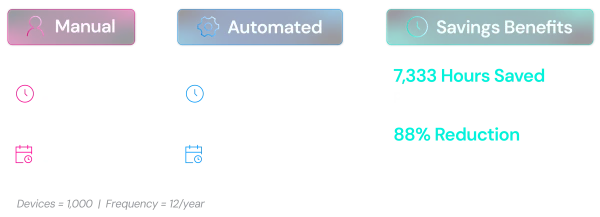
Manual: 1,000 devices upgraded 4 times per year currently require 45 minutes of human effort and spans 3 days (7,200 minutes) of end-to-end duration (prep, scheduling, pre-check, install, post-check).
Automated: Reduces this process to 5 minutes of human effort within a 2 hour (120 minutes) end-to-end duration.
Human Effort Saved: (45 minutes – 5 minutes) x (4 times annually x 1,000 devices) = 160,000 minutes saved or ~2,666 hours
Automation Benefit: 88.9% reduction in time/effort
End-to-End Time Saved: (7,200 minutes – 160 minutes) x (4 times annually x 1,000 devices) = 28,320,000 minutes (472,000 hours / 53 years of duration reduced)
Manual: 500 devices configured, created, or onboarded 25 times per year currently require 29 minutes of human effort and span 7 days (10,080 minutes) of end-to-end duration (prep, scheduling, pre-check, configure, post-check).
Automated: Reduces this process to 1 minute of human effort within a 5 minutes end-to-end duration.
Human Effort Saved: (29 minutes – 1 minute) x (25 annually x 500 devices) = 237,500 minutes saved or ~3,958 hours
Automation Benefit: 96.5% reduction in time/ effort
End-to-End Time Saved: (10,080 minutes – 5 minutes) x (25 times annually x 500 devices) = 125,937,500 minutes (2,098,958 hours / 239 years of duration reduced)
Manual: 1,000 devices onboarded 1 time per year currently require 4 hours of human effort and span 20 days (28,800 minutes) of end-to-end duration (prep, scheduling, pre-check, onboarding, post-check).
Automated: Reduces this process to 15 minutes of human effort within a 5 days (7,200 minutes) end-to-end duration.
Human Effort Saved: 240 minutes – 15 minutes) x (1 time annually x 1,000 devices) = 225,000 minutes saved or ~3,750 hours
Automation Benefit: 93.75% reduction in time/effort
End-to-End Time Saved: (28,800 minutes – 7,200 minutes) x (1 time annually x 1,000 devices) = 21,600,000 minutes (360,000 hours / 41 years of duration reduced)
~10,374 Hours
92.9% reduction in time/effort
175,857,500 minutes (2,930,958 hours / 333 years of duration reduced)
Itential is redefining enterprise network automation. Organizations around the world use Itential’s automation products to deliver services faster, simplify network change management, and maintain security with standardized configuration and compliance.
With Itential, accelerate your transition from manual processes to self-service automation, and full-scale AI-based infrastructure automation too.
Drag-and-drop automation canvas for network engineers and non-programmers to build integrated workflows that enable the automation of any CLI-based network devices and API cloud services.
Explore the Platform
Our automation platform provides an easy on ramp for customers to rapidly adopt network automation for all use cases. With Itential’s Pre-Built Automations, organizations can start fast, onboard automation principles quickly and stay fast, mitigating manual management and reducing errors.
Explore Our Library of Pre-Built Automations
Integrate operational processes and connect your entire IT ecosystem such as ticketing, change management, inventory, source of truth, monitoring tools, and any network or cloud technology and SD-WAN system with Itential’s library of open integrations to 100+ systems.
Explore Our Library of Pre-Built Integrations
The Itential Automation Platform makes complicated networks more manageable with support for any use case across any network domain from Cloud, IP Services, Network Applications, Branch/SD-WAN, Data Center, Multi-Cloud, and more.

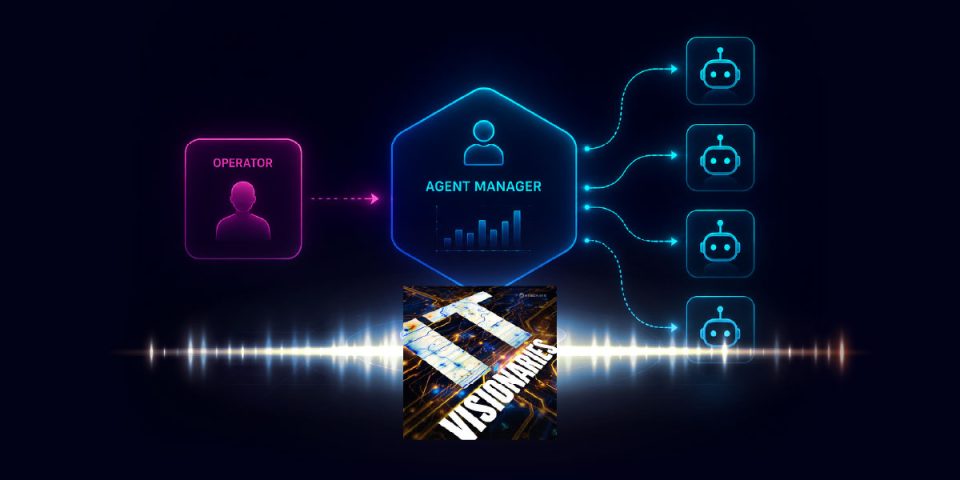
See how Itential connects AI reasoning to governed execution across your entire infrastructure.