A global pharmaceuticals and biotechnology team turned years of Python and Ansible work into a self-serve internal developer platform with Itential – delivering 100% reliability in SD-WAN rollout and error-free standard changes across the global estate.
A small network team running essential infrastructure for global pharma manufacturing, logistics, and research – where downtime is a huge risk and errors can have disastrous consequences – had hit the limits of high-code scripts on their own.
Itential as the orchestration platform that sits above the team’s existing Python and Ansible work – turning standardized network changes into self-serve products consumed across the organization through an internal developer platform.
The only commercial solution that could support self-serve networking, centralized orchestration, and continued high-code automation work – with an integration model that pulled SolarWinds, change management, and access control into one governed flow.
At this global pharmaceuticals and biotechnology company, network infrastructure is essential to daily operations – supporting applications for medical research and pharmaceuticals production, managing global logistics, and keeping plants running smoothly. Deployments happen across complex global infrastructure in a business where downtime is a huge risk and errors can have disastrous consequences.
The relatively small network team had been early adopters of network automation through open source tooling. They were comfortable building high-code automations and had several use cases live early on. But they spotted hurdles ahead: scripts became unwieldy when orchestrating multiple changes, script-library maintenance scaled with size, total request-to-fulfillment time still bumped against manual compliance checks and change management, and there was no easy way to expose automations for consumption – so services were still delivered the same ticket-driven way.
Combined with leadership priorities to maximize operational uptime and eliminate human error, the team and IT leadership landed on a new strategy: self-serve delivery for all network services, globally. That target required entire processes to be automated from request to fulfillment across multiple network domains and external systems – and a platform that could complement, not replace, the team’s existing Python and Ansible expertise.
Each one was manageable on its own. Together, they capped what high-code automation could deliver – and made self-serve networking impossible without a platform layer.
Some activities targeted for automation left the team writing large, unwieldy scripts – especially when orchestrating multiple changes rather than single-domain tasks. The complexity grew faster than the value.
As the number of automations went up, manual work to maintain them, execute them across environments, and troubleshoot issues went up with them – eating engineering time the small team did not have.
Total time between service request and fulfillment was not significantly impacted by early automation – compliance checks, validation, change management, and other manual activities still gated every change.
There was no easy way to expose automations for consumption, so network services were still delivered in the same ticket-driven manner as before – capping utilization no matter how many scripts the team built.
The team identified Itential as the only commercial solution that could support self-serve networking goals and centralized orchestration, while letting them continue building high-code automations and maximizing their impact. Itential’s unique integration model was one of the most important factors in the decision – SolarWinds payloads could be ingested and transformed via JSON into any required downstream format, so compliance checks ran directly inside orchestrated workflows. Six capabilities anchored the choice.
Six capabilities sat at the center of the decision – together making it possible to expose the team’s existing high-code work as self-serve products without rewriting it.
A single platform for building, operating, maintaining, and exposing workflows across all network infrastructure – data centers, SD-WAN, cloud – so the same orchestration model covers every environment the team manages.
The ability to onboard existing CLI-based automations (Python, Ansible) and attach APIs to them – preserving years of high-code investment while making it consumable through the same governed workflow layer.
An API-driven integration model for every third-party system and application required to deliver automated network services – eliminating the custom effort previously needed to integrate scripts with each new system.
A low-code workflow builder that orchestrates onboarded scripts, integrated systems, and data transformations into end-to-end network services – without the team having to rewrite their automations as new code.
The ability for engineers to decorate scripts with JSON schemas – including input validation – so high-code automations can be safely presented to users without coding expertise. The mechanism that makes self-service safe.
Network changes exposed as services to non-networking users – integrated with existing SSO and RBAC – greatly increasing utilization and reducing the load on the network team.
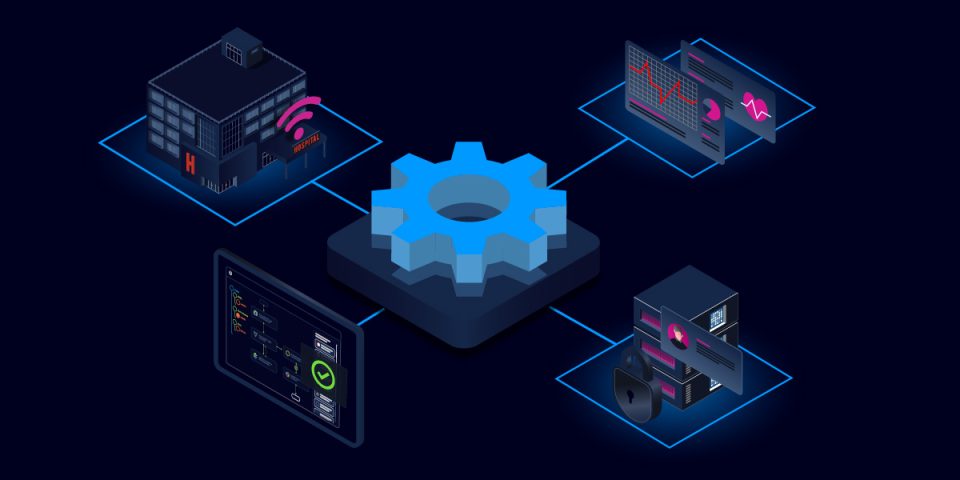
Itential sits above the team’s existing high-code work – letting them build orchestrations that ingest from SolarWinds, integrate with change management and access control, and expose standardized network changes as products through an internal developer platform.
Endpoint management, software upgrades, configuration management, asset port management, VLANs, and more – across the entire enterprise switching estate, automated through workflows built by the team.
SD-WAN deployment and migration automated per site through Itential workflows – turning a complex multi-site rollout into a repeatable, error-free process.
SolarWinds payloads ingested and transformed via JSON into the formats downstream systems require – so compliance checks run inline within orchestrated workflows instead of as separate gating steps.
Standardized network changes exposed as services through an internal developer platform, called via API and consumed across the organization – including by users without networking expertise.
The team adopted Itential to maximize uptime and eliminate human error. The results landed faster than they expected – and the same platform now drives an expanding portfolio of self-serve network products.
The forward goal is to offer all standard network services through the self-serve platform – turning the network into a driver of efficiency across the organization, with Itential as the platform underneath.
Continued focus areas include expanding the catalog of network services exposed as products, broadening JSON-schema decoration across more of the team’s existing automations, and deepening integration with the third-party systems that gate end-to-end service delivery.
See how Itential connects AI reasoning to governed execution across your entire infrastructure.