








Multi-Domain Orchestration for Cisco-Powered Networks







Cisco NSO, Catalyst Center, Meraki, ACI, and Catalyst SD-WAN each manage their own domain. Itential is the orchestration layer that spans all of them. FlowAgents reason through multi-domain goals. Governed workflows coordinate changes across every Cisco platform and IT system the change touches, with pre/post validation, ITSM integration, and a full audit trail.
Most enterprise and service provider networks run on Cisco. NSO manages service provider infrastructure. Catalyst Center manages campus. ACI manages the data center. Meraki manages cloud-managed sites. Catalyst SD-WAN manages distributed branches. Each platform has its own management model, its own API, and its own operational boundary. Changes that span those boundaries require manual coordination across teams, tools, and ticket queues, and that coordination is where SLAs slip and engineers get buried.

A change touching campus, data center, and SD-WAN requires separate operations in Catalyst Center, ACI, and Catalyst SD-WAN. No native path exists to coordinate them in one governed workflow.

NSO is the gold standard for service provider orchestration but does not coordinate natively with ITSM systems, cloud platforms, or other Cisco tools.

When a Cisco advisory publishes, identifying every affected device, staging the patch, and confirming remediation across thousands of devices still requires coordinated manual effort.
Itential connects to Cisco NSO, Catalyst Center, Meraki, ACI, Catalyst SD-WAN, ISE, ThousandEyes, and Splunk through native adapters and the Itential MCP Server, coordinating multi-domain changes across every platform in a single governed workflow with ITSM integration and a full audit trail.
Itential connects natively to every major Cisco management platform. Multi-domain workflows coordinate changes across campus, data center, SD-WAN, and service provider infrastructure simultaneously, with pre/post validation, conditional branching, and automatic rollback on failure.
FlowAgents query current IOS versions across the device estate, identify upgrade and PSIRT remediation candidates, stage the rollout, and execute with pre-checks, parallel deployment, and post-validation across thousands of devices. Upgrade cycles that took hours now take minutes.
Itential orchestrates the full service lifecycle above NSO: ServiceNow ticket triggers the workflow, Itential calls NSO for network configuration, updates inventory in the source of truth, and closes the ticket with execution evidence. NSO handles the device layer. Itential handles the end-to-end process.
When ThousandEyes detects a network performance issue or application degradation, Itential receives the signal via REST API or the Itential MCP Server, routes it to the appropriate FlowAgent or governed workflow, and executes remediation across the affected Cisco infrastructure. Full audit trail, start to finish.

Connect to Cisco NSO, Catalyst Center, Meraki, ACI, Catalyst SD-WAN, ISE, ThousandEyes, and Splunk through native adapters and existing Python scripts and Ansible playbooks, all governed by the same execution layer.

Coordinate changes across campus, data center, SD-WAN, and service provider infrastructure in a single governed workflow, with conditional branching, pre/post validation, and automatic rollback on failure.

FlowAgents identify affected Cisco IOS devices, stage upgrades and PSIRT remediations across thousands of devices in parallel, and confirm post-change state, all governed and fully auditable.

Orchestrate the full service lifecycle above NSO: order management, service provisioning, inventory updates, and ITSM ticket lifecycle in one end-to-end governed workflow.

Build golden config templates for Cisco IOS, NX-OS, and ACI devices, run continuous compliance checks, and trigger governed remediation automatically when drift is detected.

Connect ThousandEyes observability and Splunk intelligence to Itential’s governed execution layer via REST API or MCP. When either platform detects an issue, a governed remediation workflow executes automatically.

Itential is the agentic infrastructure operations platform, connecting AI reasoning to deterministic execution across network, cloud, and IT systems. For Cisco-powered networks, Itential is the orchestration layer that spans NSO, Catalyst Center, Meraki, ACI, Catalyst SD-WAN, ISE, ThousandEyes, and Splunk – coordinating multi-domain changes through a single policy-governed engine. Every action validated. Every change attributed. Human approval enforced wherever you define it.
Native Cisco Connectivity
Pre-built adapters for every major Cisco platform, plus direct CLI access to IOS and NX-OS devices and the Itential MCP Server exposing it all to FlowAgents and LLMs.
FlowAgent-Driven Multi-Domain Orchestration
FlowAgents reason through goals that span campus, data center, SD-WAN, and service provider domains, executing across every affected Cisco platform with pre/post validation and human-in-the-loop approval.
Multi-Domain, Multi-Tool Orchestration
Coordinate Cisco alongside AWS, Azure, and ServiceNow, natively running Ansible, Python, Terraform, and OpenTofu without rework.
Cisco builds the platforms that run the world’s enterprise and service provider networks – NSO for service provider orchestration, Catalyst Center for campus, ACI for data center, Meraki for cloud-managed sites, Catalyst SD-WAN for distributed branches, and ISE, ThousandEyes, and Splunk for security, observability, and intelligence across all of them. Each platform exposes APIs that Itential connects to natively, turning the full Cisco ecosystem into a single coordinated execution layer.
Best-in-Class Domain Platforms
NSO, Catalyst Center, ACI, Meraki, and Catalyst SD-WAN each deliver deep, domain-specific control over the infrastructure they manage.
Observability & Security Across the Estate
ThousandEyes surfaces performance issues across owned and unowned infrastructure, Splunk delivers operational and security intelligence, and ISE enforces identity and access policy.
Open API Architecture
Every major Cisco platform exposes APIs that Itential connects to natively, making the full ecosystem available to governed workflows and FlowAgents.
Itential connects natively to Cisco NSO, Catalyst Center, Meraki, ACI, Catalyst SD-WAN, ISE, ThousandEyes, and Splunk through pre-built adapters. It also connects to Cisco IOS and NX-OS devices directly via CLI. The Itential MCP Server exposes all Cisco platform capabilities as queryable tools for any connected LLM or FlowAgent. Every connection path uses the same RBAC model, secrets injection, and audit logging.
Itential orchestrates the full service lifecycle above NSO. When a ServiceNow order or event triggers a workflow, Itential coordinates the end-to-end process: calling NSO for network service configuration, updating source-of-truth systems like NetBox or CMDB, managing ITSM ticket lifecycle, and confirming the outcome with post-checks. NSO handles what it does best: device-layer service orchestration. Itential handles the cross-domain process that NSO does not cover natively. Deutsche Telekom and multiple Tier 1 service providers use this pattern in production.
Yes. FlowAgents query current IOS versions across the device estate via CLI or Catalyst Center, identify devices requiring upgrades or PSIRT remediation, stage the rollout based on configured thresholds, and execute with pre-checks, parallel deployment across device groups, post-validation, and automatic rollback on failure. Human-in-the-loop approval gates apply at the thresholds you define. A Tier 1 service provider reduced router upgrade cycle time from 4 hours to 45 minutes using this pattern.
ThousandEyes detects network performance issues and application degradation across owned and unowned infrastructure. Splunk surfaces security and operational intelligence across log and telemetry data. Both platforms connect to Itential via REST API or the Itential MCP Server. When either detects an issue, it triggers a governed Itential workflow that queries live infrastructure state, executes remediation across the relevant Cisco platforms, confirms the outcome with post-checks, and closes the ITSM ticket with full execution evidence. Detection to resolution without manual handoff.
Multi-domain workflows in Itential coordinate changes across multiple Cisco management platforms in a single governed execution path. A VLAN change might touch Catalyst Center for campus configuration, ACI for data center policy, and ServiceNow for ticket management simultaneously. The workflow handles sequencing, conditional branching, pre/post validation at each step, and automatic rollback across every affected domain if any step fails. No manual handoff between platforms or teams required.
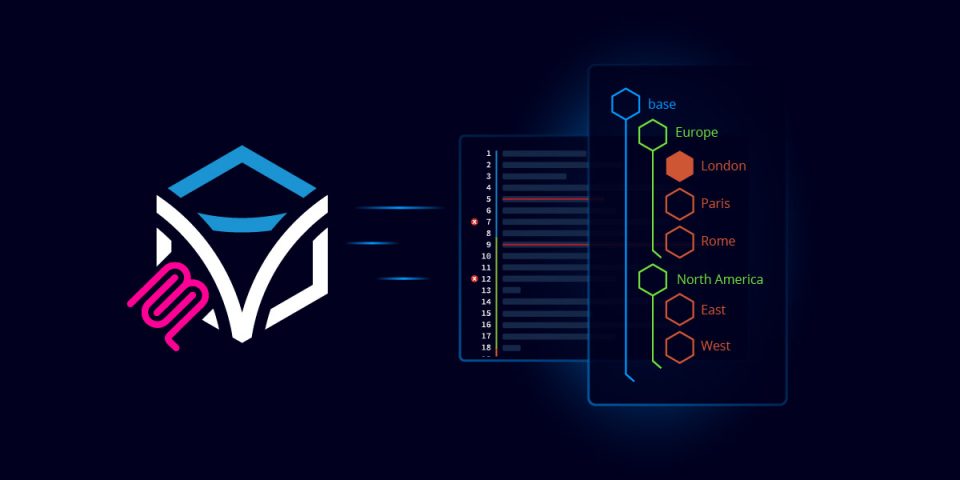
Build golden configuration templates for Cisco IOS, NX-OS, and ACI devices using hierarchical inheritance, where a root standard cascades to child nodes automatically. Continuous compliance checks run against live device configurations, detecting drift at the attribute level the moment it occurs. Routine drift triggers automatic remediation workflows with pre/post validation. High-risk deviations surface for human-in-the-loop review before any change executes. Every check, deviation, and remediation is logged immutably, covering Cisco devices alongside multi-vendor and cloud infrastructure in the same compliance plan.
See how the Itential Platform coordinates changes across Cisco NSO, Catalyst Center, Meraki, ACI, and every IT system the change touches, with pre/post validation, rollback, and a full audit trail.