Manual coordination and siloed automation couldn’t keep pace with Tier 1 scale. Growth was being limited by execution capacity, not market demand. Risk and cost grew with every change.
Itential delivered deterministic orchestration and lifecycle-based service management – standardizing execution across core, transport, mobile, and enterprise services as one operating model.
Enterprise activation: 45 days → less than one day. New service creation: 18 months → ~3 months. 25x productivity. 98% fewer fault-causing errors. 100k+ hours back to engineers.
A Tier 1 North American service provider operates one of the largest, most complex networks in the world – spanning wireless, wireline, core, transport, and enterprise services. At this scale, network operations aren’t a technical function. They’re a core business capability. And the operating model behind them had hit its ceiling.
Growth was no longer limited by demand or capital. It was limited by the organization’s ability to execute consistently. Service activation required heavy coordination across teams, systems, and vendors. Infrastructure changes leaned on individual expertise and manual execution. Automation existed – in scripts and point tools – but it was siloed by domain, hard to extend, and getting harder to govern. Each volume increase still required incremental people, oversight, and risk. The question stopped being how to automate faster and became how to scale execution without scaling risk and cost.
The provider didn’t need another point tool. They needed a platform that could productize automation with governance, integrate across existing systems, and scale proven operational practices – the same way the network itself scales. Itential delivered all three.
After scripts and point automation hit their ceiling, the provider evaluated what a real orchestration platform needed to do across one of the world’s largest, most complex networks. Seven criteria shaped the choice – and Itential met all of them.
Network changes had to follow the same validated process every time – with built-in checks, sequencing, and rollback. Itential’s deterministic execution model is the prerequisite for operating at Tier 1 scale without increasing risk, and the foundation AI agents will need to act safely on production infrastructure.
Change history, execution context, and outcomes captured automatically – not in a separate audit project. The governance Tier 1 networks demand, built into the platform layer instead of bolted on. The same audit trail human and AI-initiated changes will operate under.
OSS platforms, internal tools, and network devices were already in place. Itential orchestrates across them rather than replacing them – turning years of investment into callable building blocks instead of liabilities to retire.
Proven automation needed to become shared operational assets – not one-off projects tied to individual teams. Itential turns workflows into reusable, governed components that scale across teams, regions, and technologies without rewriting them.
Core, transport, mobile, and enterprise services all needed to operate under a common orchestration model. Itential delivers multi-domain orchestration as a single platform – not domain-specific tools stitched together with custom code.
Pre-checks and post-checks run as part of every workflow – catching configuration drift before it becomes an incident. Assurance is embedded in execution, not handled by standalone tools that fire after the fact.
Deterministic orchestration plus lifecycle state is exactly what AI systems need to operate safely on production infrastructure. The provider built the operating discipline first – so when AI is introduced, it augments operations rather than competing with control.
Itential is in production across the provider’s network and service operations – driving large-scale upgrades, multi-domain change management, enterprise and mobile service delivery, and lifecycle-based service management. The platform unifies what was fragmented and replaces tribal knowledge with deterministic, governed workflows.
Network upgrades that used to require careful sequencing and dozens of engineers now run as orchestrated, parallel workflows. Multiple devices upgraded simultaneously. Execution time per device dropped to minutes. The work that used to be fragile became repeatable, auditable, and confident.
Enterprise and mobile services modeled end-to-end as coordinated workflows. Provisioning, validation, and updates run as governed sequences instead of disconnected tasks – with structured rollback paths and shared remediation logic across orders and changes.
Services tracked through defined states with attributes and history captured as they evolve. Visibility into status, consistent execution across orders, and the ability to remediate without reinventing delivery for every new request.
Pre-checks, post-checks, and validation standardized across deployments – the assurance layer Tier 1 networks require, embedded in the workflow itself instead of handled by separate tools.
Tens of thousands of enterprise services onboarded and managed. Mobile infrastructure expansion across transport and backhaul. Nearly 100,000 automated jobs executed in a single year – with substantial reductions in manual effort and operational risk.
Existing automation assets reused rather than replaced. New use cases added without introducing new tooling silos. The orchestration platform became a shared foundation – and the operating model itself.
Numbers that compound across network and service domains – and the operational confidence that makes them durable.
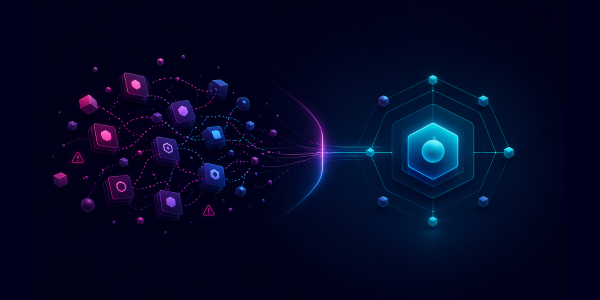
See how Itential connects AI reasoning to governed execution across your entire infrastructure.