A research-backed guide to the tools, economics, and strategies shaping network and infrastructure automation success in the enterprise.
Quick Answer: Network automation tools are software platforms that replace manual network configuration with repeatable, policy-driven workflows spanning configuration management, Infrastructure as Code, source-of-truth databases, vendor-native platforms, and multi-vendor orchestration. The landscape includes hundreds of tools across these categories — each suited to different problems, scales, and operational maturities.
Network automation is no longer optional – it’s the foundation of modern enterprise operations. Yet the reality is sobering: only 18% of network automation initiatives are fully successful. The remaining 82% either fail outright or achieve partial results that never justify their investment.
The failure isn’t from lack of tools. The market offers hundreds of automation platforms spanning configuration management, Infrastructure as Code, vendor-native systems, and orchestration frameworks. The failure comes from misunderstanding which tools solve which problems, underestimating the total cost of ownership, and choosing tools that don’t match the organization’s actual environment or maturity.
Drawing from practitioner research, case studies, and vendor analysis, this research maps the network and infrastructure automation landscape – from configuration management and Infrastructure as Code (IaC) platforms to source-of-truth databases, vendor-native ecosystems, and multi-vendor orchestration frameworks.
The Goal: Help leaders make smarter choices, avoid the pitfalls that derail 82% of initiatives, and close the automation success gap.
Here is what the research reveals:
Only 18% of automation projects are fully successful 54% achieve partial results; 28% stall or fail. (McGillicuddy, 2025)
80% of fully funded automation projects are successful vs. 29% of underfunded projects – making investment the single biggest predictor of outcomes. (Beevers, 2024)
95% of public sector network changes remain manual, proving automation adoption lags well behind capability. (Axians UK, 2023)
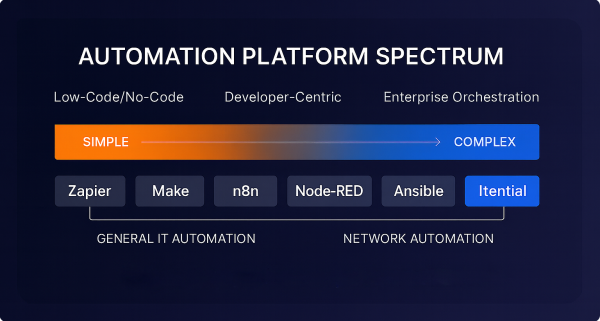
Not all network and infrastructure automation tools are created equal – and that’s by design. Understanding where tools sit on the automation spectrum prevents the common mistake of expecting a low-code tool to solve enterprise orchestration problems (or vice versa). Automation platforms span a broad spectrum from low-code prototyping tools to full enterprise orchestration platforms.

The automation market is fragmented. Tools were designed for different problems, at different times, and often with conflicting assumptions. To make sense of this, we’ve organized the landscape into four major tool categories – plus the strategic frameworks for making smart decisions.
Each category has its own strengths and blind spots. Some are brilliant for Day-0 provisioning but collapse under Day-2 operations. Others excel in vendor ecosystems but struggle in multi-domain environments.
The Key for Leaders: Understanding not just what these tools do, but where they fit in your strategy – and where they don’t.
Below you’ll find snapshots of each category – what it is, where it shines, where it lacks, and our key research findings.
Declarative automation for device and system configurations.
Configuration management (CM) tools apply declarative models (often YAML) to automate device and system configurations. They were the first wave of automation most network and infrastructure teams adopted, helping replace manual CLI changes with repeatable playbooks.
Sample Tools

Key Findings: Research shows 32.1% of Ansible users report reliability issues, with teams hitting a predictable “complexity wall” around 250 devices. Organizations below this threshold see success, but scaling beyond it requires either Red Hat AAP+ (at $650K–$3.45M for 5-year TCO) or an orchestration platform approach.
Where They Shine:
Where They Lack:
Declarative infrastructure provisioning with state management.
IaC platforms define infrastructure declaratively and manage state. Dominant in cloud provisioning, they’re now extended into networking – with mixed results.
Sample Tools

Key Findings: Terraform dominates with 70%+ market share, but research reveals the “Day-2 operations gap” – infrastructure provisioning represents only 20–30% of network service delivery. The remaining 70–80% requires operational workflows and business logic that IaC wasn’t designed to handle.
Where They Shine:
Where They Lack:
Authoritative databases for network intent and inventory.
Source of truth platforms store authoritative network intent – devices, services, policies, relationships. They anchor automation pipelines by feeding accurate “desired state” to configuration and orchestration tools.
Sample Tools

Key Findings: Research reveals the sobering reality of source of truth platforms: 60% of documentation projects fail, and network documentation maintains only 15–30% accuracy without automated synchronization. NetBox leads the market but requires significant manual maintenance. Nautobot addresses this with built-in automation features at $15K–$200K annual cost. Infrahub’s Git-native approach offers version control advantages but requires a 6–12 month learning curve for team adoption.
The bottom line: SoT platforms are successful or fail based on data discipline and automation integration – not just tooling selection.
Where They Shine:
Where They Lack:
Organizations face a fundamental choice: pursue single-vendor standardization for operational simplicity, or embrace multi-vendor reality with orchestration to coordinate across domains.
Research shows 87% of enterprise networks are multi-vendor due to mergers, best-of-breed selection, and technology refresh cycles – making orchestration essential for most organizations.
Deep automation within a single vendor’s ecosystem.
Single-vendor platforms are built by hardware vendors for their own equipment. They offer deep feature integration, advanced telemetry, and AI/ML capabilities – but only within their vendor’s ecosystem.
Sample Tools

Key Findings: These platforms deliver exceptional value in homogeneous environments. However, 87% of enterprise networks are multi-vendor due to mergers, best-of-breed selection, and legacy infrastructure – creating a coordination gap that vendor-native tools weren’t designed to solve.
Where They Shine:
Where They Lack:
Compare Vendor-Native Platforms →
Multi-vendor coordination and business workflow automation.
Orchestration platforms coordinate workflows that span multiple vendor domains, cloud services, and business systems. Rather than replacing vendor-native tools, they enhance them by providing the integration and business logic layer.
Sample Tools

Key Findings: Organizations using orchestration improve success rates from 18% to 85%+. Market projected to grow from $9.22B (2024) to $47.17B (2033), reflecting the necessity of cross-domain coordination.
Where They Shine:
Where They Lack:
Compare Orchestration Platforms →
Purpose-built network orchestration for multi-vendor, multi-domain environments.
Itential provides a unified orchestration layer purpose-built for network and infrastructure operations — coordinating across vendors, cloud platforms, and business systems. Rather than replacing existing tools like Ansible or Terraform, it connects them into governed, end-to-end workflows that span the full automation lifecycle.
Sample Tools

Key Findings: Implementations document 834+ annual hours saved and 6-month payback periods, with 80% reduction in process variation across multi-vendor environments. 400+ commercially supported integrations address the integration difficulty barrier that 25% of organizations cite as their top automation obstacle.
Where They Shine:
Where They Lack:
Before you choose tools, you need to understand the economics. The “open source is free” and “we’ll build it ourselves” assumptions create massive budget planning errors that doom projects before they start.
Research reveals the hidden costs that turn “free” solutions into the most expensive option, and why custom development typically costs 300–500% more than commercial alternatives over three years. The 18% who are successful understand true total cost of ownership – the 82% who struggle learn these lessons the hard way.
Why “free” often costs more.
The Hidden Truth: IDC research shows organizations using commercially supported solutions realize $2.08M in annual benefits compared to “free” alternatives.
When open-source wins: Development/testing environments, standard use cases with large communities, organizations with dedicated open-source expertise.
When commercial wins: Business-critical systems, compliance-heavy industries, resource-constrained teams, rapid deployment needs.
Key Insights:
The 70% rule – why “we’ll build it ourselves” rarely works.
The Hidden Truth: Research shows 70% of a custom script’s lifecycle is spent on maintenance – not initial development. Organizations that choose custom development find themselves dedicating 30–50% of total engineering capacity to maintaining automation scripts rather than delivering new business value.
When to Build: The 20% of workflows that drive 80% of your competitive differentiation.
When to Buy: Standard operations, resource constraints, business-critical systems requiring vendor SLAs.
The Maintenance Burden:
The Knowledge Transfer Crisis:
The Long-Term Economics:
Quantitative evaluation that makes decisions defensible.
Most automation tool decisions happen the wrong way: a compelling vendor demo, a recommendation from a peer, or “we already know Ansible.” The result? Tools that work brilliantly in demos but collapse under real-world complexity.
The 18% success rate isn’t random – successful teams use structured evaluation frameworks that account for team capabilities, environment complexity, business requirements, and implementation risk. This framework provides the scoring rubrics and decision matrices that turn tool selection from subjective debate into quantifiable analysis.
What You’ll Get:
Explore the Tool Selection Framework →
Need help applying this research to your environment? Itential works with enterprise teams to navigate automation complexity – from initial assessment through implementation planning.
The network automation tools landscape breaks into six categories: configuration management tools (Ansible, SaltStack, Chef), infrastructure as code platforms (Terraform), network source of truth platforms (NetBox, Nautobot), vendor-native management platforms, multi-vendor orchestration platforms, and the Itential orchestration platform purpose-built for network and infrastructure operations.
Research shows only 18% of network automation projects fully s쳮d — 54% achieve partial results and 28% stall or fail entirely (McGillicuddy, 2025). Funding is the strongest predictor: 80% of fully funded projects s쳮d vs. 29% of underfunded ones (Beevers, 2024). Organizations that adopt multi-vendor orchestration improve success rates from 18% to 85%+.
According to Itential and EMA research (2024), the top challenges are integration difficulties (25%), network complexity and lack of standards (24.9%), legacy infrastructure (24.3%), tool complexity (23.7%), and data quality issues (22.3%). A compounding structural challenge: 87% of enterprise networks are multi-vendor, making cross-domain coordination essential.
The research recommends a four-dimension scoring framework evaluating team fit, environment complexity, business needs, and implementation risk — rather than relying on vendor demos or peer recommendations, which is how most tool decisions happen and a key driver of the 82% failure rate. The right tool depends on your scale, vendor mix, operational maturity, and the workflows you need to automate.
See how Itential connects AI reasoning to governed execution across your entire infrastructure.