The operating model applied – to the use cases your team actually runs, at the scale and complexity your environment actually demands.
Network and infrastructure automation operates against production systems where the cost of informal practice isn’t a UI bug – it’s a routing change that takes a service down, a server fleet patched to the wrong standard, a cloud environment provisioned without approved IAM boundaries, or a compliance automation enforcing an interpretation nobody reviewed. Spec-Driven Development is the operating model that governs how automation across both domains gets built, trusted, and scaled. This guide covers SDD applied to the use cases your team actually runs and why applying it consistently at scale requires more than good intentions.
TL;DR
What Spec-Driven Development is, how the five phases work, what each produces, and how the two approval gates govern phase transitions. Includes the core principles and the execution model that keeps builds governed.
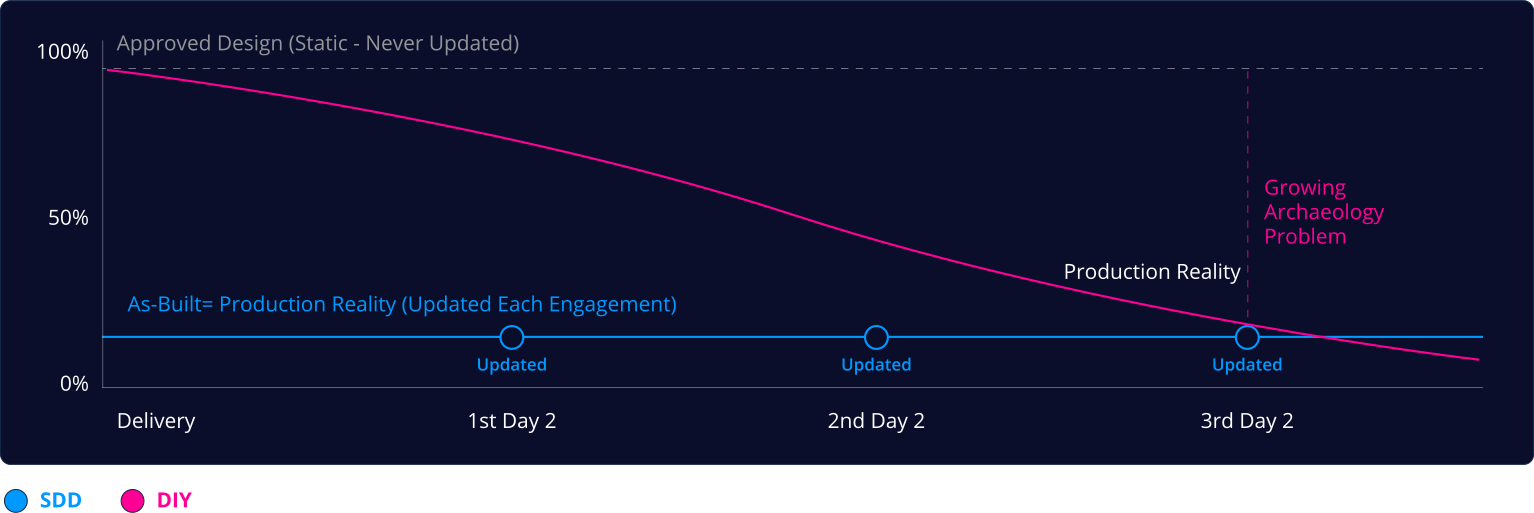
How SDD affects time to value on initial build, and why the real payoff is Day 2 – every extension, debug session, and handoff starting from an as-built record instead of archaeology.
How the operating model maps to real network automation work, what it changes organizationally, how AI-driven and agentic operations fit within it, and why a governed execution platform is what makes SDD enforceable at scale.
Network & Infrastructure Engineers
See SDD applied to the work you actually do — provisioning, compliance, patching, change management — and understand what each phase requires from you.
Automation Managers & Leads
See what consistent SDD application produces across an automation estate — measurable delivery, transferable knowledge, and a compounding asset base rather than recurring discovery work.
VPs, Directors & CTOs
The case for a governed execution platform — why SDD at scale requires system enforcement, not discipline, and what that means for compliance, AI-readiness, and operational trustworthiness.
The Operating Model Gap
Most network and infrastructure teams have automation. They have orchestration platforms, cloud APIs, integration libraries, AI-assisted tooling, and years of accumulated automation scripts. What most don’t have is a governing operating model – a defined system for how a user request becomes an approved requirement, how that requirement becomes a tested design, how that design becomes working automation, and how every engagement produces a record the next team can actually start from.
Without that operating model, automation accumulates. It doesn’t compound. Each new workflow requires the same discovery the last one required. Each Day 2 engagement starts by reverse-engineering what was built and why. Each team rotation loses the institutional knowledge that left with the previous engineer. The automation estate grows in size but not in trustworthiness.
Network and infrastructure automation are the domains where this gap is most costly – because both operate against production systems where the blast radius of informal practice is operational risk, not a UI bug. A misunderstood requirement in network automation produces a routing change that takes a service down. In infrastructure automation, it produces a server fleet patched to the wrong standard, a cloud environment provisioned outside approved IAM boundaries, or a compliance automation enforcing an interpretation that was never formally agreed. These aren’t documentation problems. They’re incidents, audit findings, and FinOps surprises.
Informal Practice
Ticket → Someone figures it out
✗Requirements captured informally — tickets, Slack threads
✗Design happens during build, never formally reviewed
✗Scope changes absorbed silently into the automation
✗Knowledge lives with the engineer who built it
✗Every Day 2 engagement starts from archaeology
Spec-Driven Development
Request → Governed operating model
✓Requirements captured in a written spec, approved at Gate 1
✓Design reviewed and approved before build begins
✓Scope changes visible at gates — not discovered at deployment
✓As-built record produced after every engagement
✓Every Day 2 engagement starts from reconciled truth
Spec-Driven Development fixes this structurally – not by adding better documentation practices or more rigorous ticket templates, but by defining the operating model that governs how every engagement moves through five phases: requirements, feasibility, design, build, and as-built reconciliation. Two approval gates enforce the phase boundaries. Two artifacts – the approved spec and the approved solution design – govern what gets built and how. The as-built record closes the loop, making every engagement a better starting point for the next.
This guide covers SDD applied to network and infrastructure automation – the use cases your team actually runs, why scale makes manual compliance structurally unreliable, and what a governed execution platform enforces that discipline alone cannot. If you’re looking for the foundational framework, start with Guide 1.
4 Use Cases
Four use cases across both domains – two network, two infrastructure – showing what SDD produces when it’s applied, what each gate protects against, what the as-built record enables on Day 2, and what makes the operating model hold in practice.
Infrastructure automation operates against a different surface – cloud APIs, compute fleets, IaC toolchains, and server estates – but it carries its own category of blast radius. A misconfigured IAM policy provisioned at scale grants cloud access nobody approved. A CIS benchmark applied at the wrong level enforces the wrong security standard across hundreds of servers. A drift remediation workflow that runs against an unapproved baseline corrupts the configuration estate it was supposed to protect. The operating model problems are identical to network automation. So is the structural cost of applying it without enforcement.
Reconciliation
The as-built phase is the most common place where SDD discipline breaks down in practice. The automation works. The ticket is resolved. Writing the as-built record feels like overhead after the win – and without a system requiring it, it gets deferred, abbreviated, or skipped entirely.
What that produces over time is a growing gap between approved artifacts and operational reality. Debugging gets harder because the design document no longer reflects what runs. Reuse gets less reliable because the as-built record doesn’t exist or doesn’t capture platform-specific adaptations. Compliance claims become unverifiable because the chain of authority ends at delivery.
When reconciliation holds – because a platform produces the as-built record as a required phase output rather than a document an engineer writes from memory – the automation estate compounds in value. Each engagement produces a reconciled baseline the next one starts from. Reuse is identified rather than rediscovered. Day 2 work starts from truth, not from the workflow code.
Without reconciliation, the operating model produces successful outcomes that don’t compound. Each future engagement on the same use case must rediscover what the previous one resolved. With reconciliation, every engagement becomes a better starting point – and the automation estate becomes progressively easier, not harder, to operate.
By Role
When SDD is enforced as a system rather than practiced as a discipline, the automation estate compounds in value with each engagement. That compounding effect lands differently depending on where you sit – and what you’re accountable for.
→ Every engagement starts from an approved spec and an approved design – not from a Slack thread or a stale ticket interpretation
→ Deviations are documented, not absorbed into the workflow code. The as-built record protects the next engineer from archaeology
→ Day 2 work – extensions, debug sessions, modifications – starts from the reconciled baseline, not from reverse-engineering what was built
→ Reuse is identified during design, before build, when the full asset inventory can actually be assessed
→ The compliance audit trail is a byproduct of the delivery process – not a documentation sprint after the fact
→ Delivery is measurable: time to approved spec, deviation rate, reuse rate, reconciliation completeness across the estate
→ Scope changes are visible at approval gates – not discovered at deployment when they’re expensive to address
→ Onboarding is faster because knowledge is in artifacts, not in the heads of engineers who may have left
→ The operating model that makes AI-assisted and agentic automation governable is already in place – you don’t need to retrofit governance when agents are ready
→ Consistent delivery regardless of which engineer handles the request – the model scales without scaling individual expertise
→ The automation estate compounds in value with each engagement rather than accumulating technical debt that compounds in cost
→ Compliance is demonstrable through artifact chains – Gate 1 records, Gate 2 decisions, deviation logs, as-built reconciliation – not asserted through memory
→ The case for AI acceleration is credible because the governance layer is already in place. Agents run inside a governed model – they don’t require a new one
→ Infrastructure and network teams shift from cost centers that absorb tickets to strategic partners delivering trusted, auditable automation at scale

Why Enforcement Matters
SDD is the right operating model. The question at enterprise scale isn’t whether the framework is correct – it is whether discipline alone can hold it consistently across the operating conditions that define network and infrastructure automation. It can’t. Not because engineers fail, but because the environment works against it structurally. These four conditions are why enforcement matters.
The operating model is right. The environment demands a system to hold it.
These aren’t failures of SDD – they are the operating conditions that make a governed execution platform necessary. The framework defines what should happen at every phase. The platform is what makes it happen consistently, regardless of who’s on the project, how much pressure the deadline carries, or how many engagements are running in parallel. That is the difference between SDD as a practice and SDD as a system.
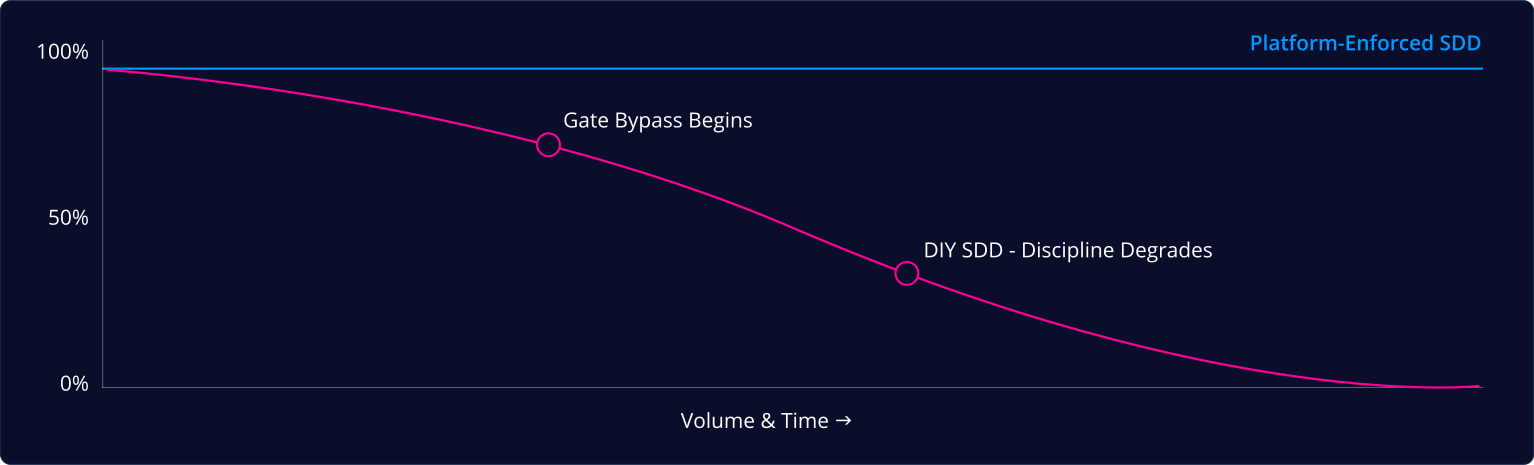
Where Manual Compliance Degrades
With the operating conditions established – complexity, blast radius, volume, delivery pressure – here is exactly how manual SDD compliance degrades in practice, and what that produces.
The Platform Argument
A functional description of what enforcement produces at each phase – what a governed, deterministic execution platform does that manual discipline cannot reliably do at scale across either domain.

The table above is the difference between SDD as a practice and SDD as a governed system. Guide 3 covers how Itential’s platform enforces every row in this table – for human execution, AI-assisted execution, and agentic operations at scale.
The Platform Requirement
Every section of this guide makes the same structural argument: SDD works when it’s enforced. Requirements approval, design review, as-built reconciliation – each one produces the outcomes described above when it happens consistently. None of them happen consistently without a platform that makes them preconditions rather than conventions.
The platform requirement is not a product argument. It is a logical conclusion. The five failure modes in the previous section – gate bypass under pressure, as-built records skipped at delivery, deviations absorbed silently, reuse missed at volume, compliance claims that can’t be verified – are all structural consequences of treating the operating model as a team discipline rather than a system boundary. Discipline degrades. System boundaries don’t.
Itential is the agentic operations platform for network and infrastructure automation. It is what makes SDD executable at scale – not as a practice teams try to maintain, but as a governed system that holds regardless of team size, delivery pressure, or how much AI acceleration you bring to the process. The platform has three capabilities that make this possible.
The operating model is the same whether a human or an agent executes it. The gates are system boundaries either way. The approved design is the execution contract either way. The as-built record is a required output either way. Guide 3 covers how Itential’s agents execute inside that same governed model – and how the trust progression from AI-assisted to autonomous operations works in practice.