Enterprise technology leaders have spent a decade squeezing cost out of data centers, only to watch their workloads and budgets migrate to public cloud at record speed. The reason is not economics alone. Cloud providers have engineered a user experience that converts an idea on a whiteboard into a running service with a single click or an API call. It is why shared-cloud infrastructure spending is projected to climb at 16.9 % CAGR through 2029, reaching $372 billion while on-prem growth stays flat, according to IDC. Yet many network and infrastructure teams within enterprises still ask internal teams to submit three separate tickets — one for compute/storage, one for a firewall rule and one perhaps for a VIP + A-record before an application can see daylight. Every day that cycle persists, application development slows down — directly impacting revenue and overall productivity.
The Hidden Costs of “Legacy Infrastructure Service Delivery”
Every multi-ticket workflow carries three forms of drag:
- Time-to-Revenue: Product launch slips by weeks when network, security, and compute teams operate in silos and majority of the time sequentially.
- Regulatory Exposure: Without a cohesive and co-related chain of custody for every change, audit preparation explodes and incident forensics stall.
- Big Data Spend: Once data lands in the cloud, pulling it back is pricey. Egress fees alone can offset any perceived per-minute savings.
Boards and audit committees are starting to ask the question in plainer terms: why can’t our internal network behave like the cloud without the cloud bill?
Productizing Infrastructure: Your Strategic Imperative
World-class leaders answer by treating infrastructure as a product line complete with SKUs, lifecycle metrics, and a friction-free catalog. ⚙️ Standardize the Offering Bundle the compute, load balancing, and security services that an application needs into a single “App Stack” service. Consistency replaces one-off engineering time. 📋 Track the Full Lifecycle From the initial request to provisioning, followed by service updates and eventually decommissioning, every action must be tied to an effective record associated with the requesting entity. Change Advisory Boards should review data, not anecdotes. ☁️ Deliver a Cloud-Grade Experience Whether the front door is ServiceNow, a chatbot, or an API, the request must complete in minutes. Anything longer pushes users back to public cloud. Organizations that execute on this model essentially enable high adoption of their own infrastructure leading to reclamation of high-margin workloads, shrunk change windows, and simplified yet data rich audit reports that are routinely generated. 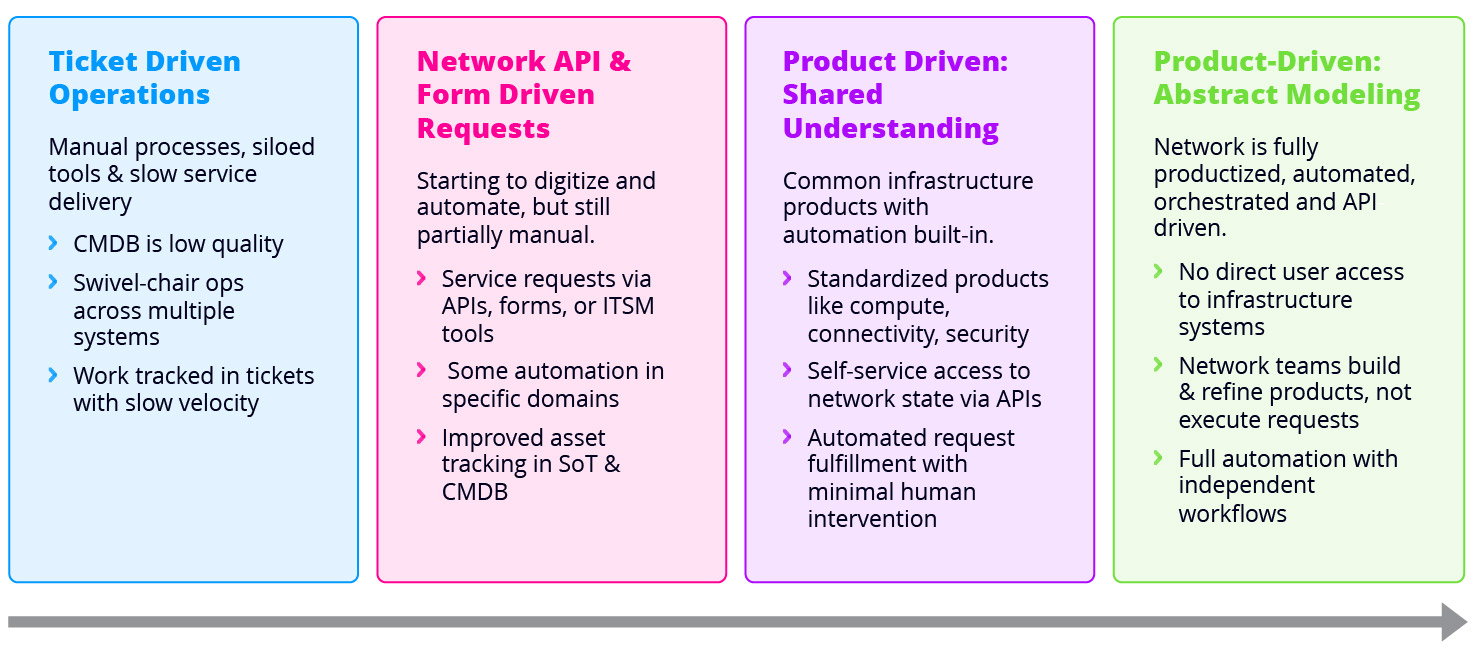 Evolving from Ticket-Driven Operations to Productized Self-Service Infrastructure
Why Stateful Orchestration Closes the Governance Gap
Stateless scripts and automations can execute a task, but they cannot answer the governance questions that now dominate executive risk dashboards:
- Who requested and owns this change?
- What does this infrastructure change additionally impact?
- How fast can we roll back in case of misconfiguration of the infrastructure?
Stateful orchestration closes that gap. By persisting the relationship between every resource, potentially spread across many technologies, and business request, it turns infrastructure data into an always-current ledger. One that change-advisory boards, security teams, and auditors can trust without unnaturally implementing gates within and across teams that must deliver infrastructure services for line-of-business groups focused on revenue.
How Itential’s Lifecycle Manager Makes the “Infrastructure-as-a-Product” Vision Real
Itential’s Lifecycle Manager (LCM) application is the operational backbone that enables an infrastructure-as-a-product approach and turns a catalog idea into day-to-day reality without forcing you to rip-and-replace the tools and processes already in flight.
LCM Capability
What It Does
Why Infra Leaders Care
Product ModelsCodify the data and policy rules that define each service SKU, whether it is a single device upgrade, a multi-vendor VIP, or a full application stack.Consistency at scale: every request inherits the same guardrails, naming, and tagging conventions automatically.Lifecycle ActionsMap those models to pre-existing or newly created automated workflows that handle Day-0 provisioning, Day-2 changes, and Day-N retirement—complete with pre-checks, post-checks, and conditional rollbacks.Change velocity without compliance anxiety: policy enforcement and remediation steps are baked in, not bolted on.Stateful InstancesMaintain a live, immutable record of every deployed asset, including who requested it, when it changed, and its current health, no matter how many tools or teams touch it.Instant lineage for audits, incidents, and M&A due diligence; eliminates the “who touched what?” war room.Native IntegrationsConnects to ServiceNow, Jira, chatbots, Ansible, Terraform, and cloud APIs so teams keep familiar interfaces while gaining stateful governance behind the scenes.Faster time-to-value: deploy LCM atop existing automation investments instead of launching a multi-year platform replacement.Executive DashboardsSurfaces product-level KPIs such as lead-time to fulfill, compliance status, cost baseline, alongside traditional uptime metrics.Translates technical effort into business outcomes your board and CFO can track quarter over quarter.
Bottom-Line Impact
- 30%–50% faster service delivery by collapsing multi-ticket workflows into a single catalog request.
- Up to 60% reduction in audit prep hours thanks to continuous, system-generated evidence.
- Five-figure monthly savings in avoided cloud egress fees when on-prem services match public-cloud ease of use.
With LCM, executives regain visibility into how infrastructure investments translate into customer-facing capabilities, while engineering teams keep the self-service velocity that users demand.
Big Picture
Digital businesses will not slow down, and cloud providers will not lower their standards for ease of use. The only sustainable answer is to offer the same experience inside your four walls. Productizing infrastructure, backed by stateful orchestration, turns capital assets into agile, governed services that accelerate revenue and shrink risk. The sooner your infrastructure behaves like a product, the sooner your business outpaces those still operating on tickets. If you’re ready to close the experience gap, let’s talk. I’ve been able to see how our customers are doing this firsthand and would love to chat. Schedule some time with our team here or reach out to me on LinkedIn.










 Agentic Operations Connect AI to infrastructure for trusted, automated actions.
 Infrastructure Modernization Transform legacy networks into modern, AI-ready infrastructure.
 Infrastructure as a Product Deliver network and infrastructure services on demand - self service, governed, & consumed like cloud.
 Hybrid & Multi-Cloud Orchestration Unify hybrid & multi-cloud infrastructure through agentic orchestration.
 Governed Change Management Execute every infrastructure change with pre/post validation, audit evidence, & rollback, human or AI-initiated.